
What are moles and warts?
Patients tend to group them together, but they are two different things. A mole (melanocytic naevus) is a benign cluster of melanocytes, the cells that give skin its pigment. Almost everyone has between 10 and 40. The vast majority stay harmless for life; a few change, and that change is the reason a mole is never removed “blind”.
A wart is a skin lesion caused by the human papillomavirus (HPV): common warts on hands and fingers, plantar warts on the sole of the foot, flat or filiform warts on the face and neck. Because they are viral they can spread by contact, seed other areas of your own skin and — this deserves saying up front — come back even after correct treatment.
Skin tags (acrochordons) are removed at the same visit: those soft hanging lesions on the neck, armpits and eyelids that catch on clothing and jewellery. They are benign and quick to remove.
When does a mole need to be removed?
There are two valid reasons and one urgent one. The valid ones: it bothers you (rubs against clothing, razor or bra strap) or it bothers you aesthetically, especially on the face and neck. The urgent one: it has changed. That is what the ABCDE rule is for:
- A — Asymmetry: one half does not match the other.
- B — Border: irregular, notched or poorly defined edges.
- C — Colour: several shades within one lesion, or a recent change in colour.
- D — Diameter: larger than 6 mm, or growing.
- E — Evolution: any change — size, shape, colour, elevation, itching or bleeding — in a mole that used to be stable.
Mole checks and early skin cancer detection
A mole with ABCDE findings is not simply “taken off”: it is assessed, the type of excision that preserves the diagnosis is chosen, and the whole specimen goes to histopathology. That is the difference between a cosmetic service and a surgical consultation: the first goal is to know what it is; the second is a good scar.
If pathology confirms a malignant lesion, the next step is skin cancer surgery with margins and, where needed, reconstruction — the plastic surgeon’s own ground. You can read how that is handled on the basal cell carcinoma: excision and reconstruction page.
How is mole and wart removal performed?
Both are outpatient procedures under local anaesthesia, in the office. You walk in and walk out, with no fasting and no hospital stay. A typical session takes 15 to 40 minutes depending on the number of lesions.
For a mole, technique follows the lesion: scalpel excision — elliptical, with a fine margin of healthy skin and fine-suture closure — when the intact specimen is needed for study or the lesion is deep; or a shave excision at skin level for raised benign lesions, which needs no stitches. In both cases the removed tissue is sent for histopathology.
For warts, depending on type, size and location: electrofulguration (cautery), cryotherapy with liquid nitrogen for small superficial lesions, or surgical excision for large, resistant or diagnostically doubtful ones. Plantar warts often need more than one session.
See the full guide: Post-surgical recovery and care.
Technique and scar: why with a plastic surgeon
Any skin lesion can be “burned off”. The difference shows six months later, on the patient’s face. A plastic surgeon’s judgment brings:
- The right technique per lesion: not everything gets cauterised; what deserves study is excised so the pathologist can read it.
- Incisions oriented along the skin’s tension lines, so the scar matures fine and discreet.
- Tension-free closure with fine suture, especially on the face, neck and décolletage.
- Histopathology for every excised mole: the diagnosis is confirmed, never assumed.
- A postoperative scar plan: silicone and sun protection where the area and the patient call for it.
Mole, wart or something else? How to tell them apart
A good part of the consultation is giving the lesion its correct name, because the name decides the treatment.
- Mole (naevus): pigmented, stable for years, regular surface. Excised with pathology; never cauterised without a diagnosis.
- Common or plantar wart: rough surface, dark dots at the centre (thrombosed capillaries), may hurt on pressure. Viral: can recur and spread.
- Skin tag (acrochordon): soft, skin-coloured hanging lesion on the neck, armpits or eyelids. Quick office removal.
- Seborrhoeic keratosis: waxy, “stuck-on” plaque, very common after 40. Benign; removed if it bothers you.
- A lesion that demands study: any pigmented lesion with ABCDE findings, a “wart” that bleeds or fails treatment, or an ulcer that will not heal. That is not cauterised: it is investigated.
Possible risks and complications
These are minor procedures with low — but not zero — risk. Possible issues: a more visible scar than expected (especially in keloid-prone patients), pigment changes in the treated area (more frequent in darker skin), superficial wound infection, minor bleeding and — specific to warts because of their viral origin — recurrence of the lesion, which may require further sessions.
If you have a history of keloid scarring, mention it at the consultation: it changes the closure technique and the scar-care plan.
Who is a good candidate?
Anyone with moles, warts or skin tags that rub, bother, look wrong or have changed. At the consultation each lesion is examined — with dermoscopy when indicated —, the right technique for each is chosen, and a clear quote for the whole set is provided. All surgery carries risk and requires a prior medical assessment. Results may vary according to each patient, their anatomy and their individual healing process.
Before and after
Most patients want to see before-and-after photographs before deciding. Out of respect for each person’s privacy, Dr. Arístides Arellano shows real cases —always with documented consent— during your in-person consultation, where you can review results from patients with a starting point similar to yours. Results may vary from patient to patient.
Approximate price in Puebla
Reference prices: lunares from $5,000 MXN and verrugas con Plasmage from $3,500 MXN, approximate, depending on the number, size and location of the lesions, and whether the specimen goes to pathology. Approximate price — the definitive cost is set at your private consultation with Dr. Arístides Arellano.
Credentials
Dr. Arístides Arellano is a plastic surgeon holding a specialty licence: he practises under a Mexican medical licence (D.G.P. 1125959) and a specialty licence in Plastic & Reconstructive Surgery (0002008), both issued by the Directorate General of Professions (DGP), which reissued his certificate of professional standing in 2025. His career began before Mexico’s present-day specialty-board system existed: he belongs to the founding generation of plastic surgery in Puebla, the second generation of a surgical tradition started in 1971 by Dr. Francisco Arellano Ocampo. Trust is verified, not promised: both licences are public and anyone can look them up in the DGP’s National Registry of Professionals.
Moles and lasers: the safety rule that comes first
Before we talk about lasers there is a non-negotiable rule: a mole that changes, bleeds, itches or looks different is not vaporised with a laser. The laser destroys the tissue, and once that tissue is destroyed it can no longer be analysed — and it is precisely the analysis (the biopsy) that rules out a melanoma. A pigmented or suspicious lesion is excised with a scalpel, with a margin, and sent to pathology. Full stop.
The CO₂ laser does have its place, and it is a different one: already-confirmed benign lesions and warts. On a viral wart the CO₂ vaporises the tissue while coagulating, in a controlled field; a benign mole removed for purely cosmetic reasons is taken off once the doctor has judged it benign. Which route applies is decided by medical judgement at the consultation, not by the rush to laser it off.
The NovaPulse and the biopsy rule
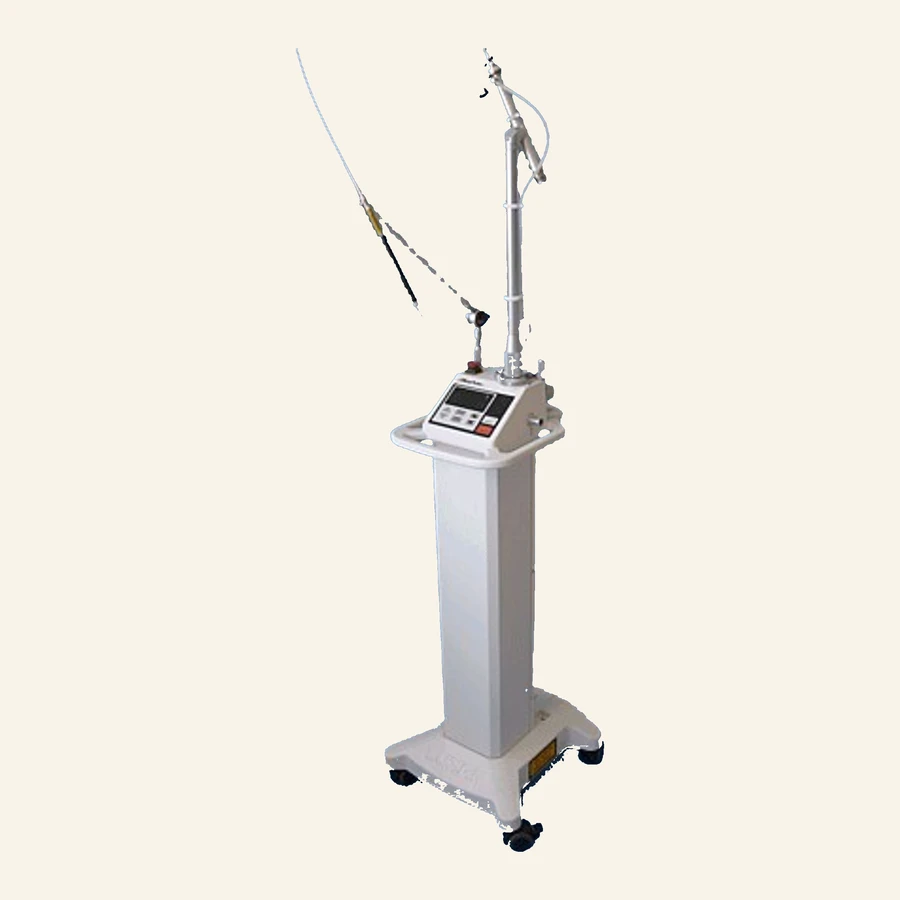
The NovaPulse (Lumenis · Luxar) is a focused-beam surgical CO₂: a scalpel of light. CO₂ emits at 10,600 nm, a wavelength that tissue water absorbs almost completely. It therefore cuts in a very thin layer and seals the finest vessels as it goes: it incises and coagulates in the same pass. For a wart or a benign skin lesion that means a short procedure with little bleeding and good precision.
And here is the rule this practice does not break: a suspicious mole is never treated with a laser. The laser vaporises the tissue — and with it, any possibility of examining it. If that lesion was a melanoma, the evidence has been destroyed and the diagnosis lost. Any lesion with suspicious features is excised with a blade and sent for histopathology.
Put simply: the laser is excellent for what we already know is benign, and contraindicated for what needs to be studied. Dr. Arístides Arellano, plastic surgeon in Puebla, assesses the lesion before choosing the technique, not the other way round.
Documented training in cutaneous lesion surgery
A mole removed without being analysed is a biopsy that never happened. Dr. Arístides Arellano is accredited before the DGP as a specialist in Plastic & Reconstructive Surgery, and his work on skin tumours is documented from 1996 onward:
- Speaker: surgical treatment of skin tumors — Jornada de Alergia, Dermatología y Cirugía Estética · BUAP, noviembre de 1996
- Fellow — International Society for Dermatologic Surgery — Nueva York · abril de 1991
- 2nd Argentine Congress of Dermatologic Surgery — pre-congress course — Asociación Médica Argentina · Buenos Aires, 12 de octubre de 2006
Trust is verified, not promised. All 210 scanned documents —degree, licences, diplomas, publications and certificates, from 1977 to 2025— are open in Dr. Arístides Arellano’s credential archive, alongside an explanation of the difference between a specialty licence and a board certification.
Recovery · step by step
- Day 1Minimal discomfort. Normal life from the same day; the treated area is kept clean and dry.
- Days 2–7Simple wound care as advised. A small scab forms on cauterised areas; do not scratch or pick it.
- Days 7–14Sutures removed where there was an excision. The histopathology result is delivered and explained.
- Weeks 2–4New skin is pink and sensitive: strict sun protection to prevent pigmentation.
- Months 2–6The scar or mark lightens and blends progressively with the surrounding skin.
Frequently asked questions
How much does mole or wart removal cost in Puebla?
There is no single price, because no two patients bring the same lesions: the quote depends on how many there are, their size and location, the technique each one needs, and whether the specimen goes to histopathology. At the consultation every lesion is reviewed and you receive the full cost in writing before deciding.
Does mole or wart removal hurt?
It is done under local anaesthesia: you feel the initial sting of the anaesthetic and then pressure, not pain. Once it wears off there may be mild burning for a day or two, controlled with simple analgesics.
Can I remove a wart at home with pharmacy acids or remedies?
It is not advisable. Over-the-counter caustics burn healthy skin, leave scars and pigment marks, and in the worst case spend months “treating” a lesion that was never a wart. Any lesion that bleeds, grows or changes should be assessed before it is treated.
Will the mole that is removed be analysed?
Yes, as a rule. Every excised mole is sent for histopathology to confirm it is benign. The result is delivered and explained at the follow-up visit. For warts, pathology is reserved for atypical or treatment-resistant lesions.
Do warts come back after treatment?
They can. A wart is a viral infection (HPV) and no method can guarantee it will not reappear: recurrence exists with laser, cautery, cryotherapy and surgery alike. Plantar warts are the most stubborn and may need more than one session. Results may vary.
What scar does mole removal leave?
It depends on the technique: a shave leaves a flat mark that tends to blend with the skin; an excision leaves a fine line the size of the lesion, planned along the skin’s natural lines. With sun protection and proper care, both tend to fade over the months. Results may vary.
When should I worry about a mole?
If one half stops matching the other, if the border turns irregular, if it shows several colours or changes colour, if it is larger than 6 mm or growing, or if it itches, bleeds or becomes raised. Any of those findings deserves assessment — not to alarm you, but to study it in time.
Can several lesions be removed in one visit?
Yes, that is the norm. At the consultation all lesions are reviewed and, if they are low-risk, most can be removed in a single outpatient session under local anaesthesia.
Can a mole be removed with a laser?
Only if it is a benign mole already assessed by the doctor. A mole that has changed, bleeds, itches or looks irregular should not be lasered, because the laser destroys the tissue and no longer allows the biopsy that rules out skin cancer. In that case it is excised with a scalpel and sent for analysis. Clearly benign moles removed for cosmetic reasons can be taken off after evaluation.
What are warts removed with — laser or another method?
It depends on the type, number and location. Viral warts respond to several methods — cryotherapy, keratolytics, CO₂ laser; the CO₂ laser is useful above all for resistant or plantar warts and delicate areas, because it vaporises the lesion while coagulating. Because the virus (HPV) can remain in the surrounding skin, any method carries a chance of recurrence and sometimes more than one session is needed.
The equipment used
Every case is different. Discuss yours in a personal consultation.
Book a consultation on WhatsAppEvery figure published on this site is approximate and is not a quote. Any procedure or treatment first requires a private assessment consultation with Dr. Arístides Arellano —$800 MXN, charged separately— and it is at that consultation that the definitive cost of your case is determined.
Educational content; it does not replace a medical consultation. Results may vary from person to person.