
What is the ARTAS iX system?
The ARTAS iX is a robotic hair-transplant system guided by artificial intelligence. Its camera analyses the scalp in real time —dozens of images per second—, identifies each follicular unit, calculates its angle, depth and orientation beneath the skin, and decides which to harvest so the donor area is never emptied in patches.
It then extracts each follicle with a dual-mechanism punch, applying the same force, the same depth and the same angle every time. It is not a robot that operates alone: it is an instrument of very high precision, directed by the surgeon, who plans the design, sets the strategy and supervises every phase.
Technique: what the robot actually solves
The real problem in a long manual FUE is not the surgeon’s skill. It is fatigue. A hair transplant demands extracting between 1,500 and 4,000 follicles, one at a time, across six to eight hours. Follicle number 3,000 is extracted by a hand that has been working for seven hours.
Transection —the follicle damaged or cut during extraction, which will never grow again— is the metric separating a good transplant from a mediocre one, and it rises with the hours. The robot does not tire, does not tremble, and does not lose judgment at hour seven.
- AI follicular selection: chooses which units to harvest so the donor area keeps its density and natural look — no patches, no moth-eaten appearance.
- Angle and depth calculated follicle by follicle: hair does not grow perpendicular to the skin, and the robot measures it per unit, not “on average”.
- Lower transection rate: more follicles harvested intact = more hair that actually grows.
- Constant precision across the whole day: graft 2,000 is extracted like the first.
- No linear scar: it is FUE — millimetric dots, not a strip.
How is it performed?
The session is outpatient and under local anaesthesia, exactly like a manual FUE. First the surgeon designs the hairline and sets the strategy: how many grafts, from where, in which direction, at what density. No machine does that part, and it is the part that decides whether the result looks natural.
The robot then performs the extraction of the follicular units under the surgeon’s continuous supervision. Opening the recipient sites and implantation —where the angle, direction and density of every hair are set— remain the surgical team’s work.
The honest conclusion: the robot improves the mechanical, repetitive part; it does not replace judgment. An ARTAS in the hands of a poor planner delivers perfectly harvested follicles placed into a design that will look artificial for life. Technology does not rescue a bad plan. See the full hair-transplant guide.
Who is a good candidate?
The same criteria as any hair transplant: androgenetic alopecia, a sufficient and stable donor area, good health and realistic expectations. The ARTAS iX performs especially well in large sessions —where manual fatigue weighs most— and in patients who want to avoid the linear FUT scar entirely.
At the consultation, with HairMetrix diagnosis, we determine whether your case benefits from the robot or whether manual FUE, FUT or Long Hair FUE is the better choice. All surgery carries risk and requires a prior medical assessment. Results may vary according to each patient, their anatomy and their individual healing process.
Technology directed by a surgeon, not the other way round
Worth saying plainly, because the hair market says the opposite: a robot is not a surgeon. It is an instrument —an extraordinary one— that executes with a precision no human hand sustains for eight straight hours. The one who plans, decides and answers is still the doctor.
Dr. Arístides Arellano is a licensed plastic and reconstructive surgeon and an ISHRS member since 1996. The technology arrived at this clinic after three decades of surgical judgment, not before it.
Dr. Arístides Arellano is a plastic surgeon holding a specialty licence: he practises under a Mexican medical licence (D.G.P. 1125959) and a specialty licence in Plastic & Reconstructive Surgery (0002008), both issued by the Directorate General of Professions (DGP), which reissued his certificate of professional standing in 2025. His career began before Mexico’s present-day specialty-board system existed: he belongs to the founding generation of plastic surgery in Puebla, the second generation of a surgical tradition started in 1971 by Dr. Francisco Arellano Ocampo. Trust is verified, not promised: both licences are public and anyone can look them up in the DGP’s National Registry of Professionals.
Before and after
Most patients want to see before-and-after photographs before deciding. Out of respect for each person’s privacy, Dr. Arístides Arellano shows real cases —always with documented consent— during your in-person consultation, where you can review results from patients with a starting point similar to yours. Results may vary from patient to patient.
Approximate price in Puebla
The reference price starts at approximately $70,000 MXN, depending on the number of follicles to be transplanted and the technique. The price is all-inclusive: it covers use of the operating theatre and facilities, pre-operative laboratory work and the post-surgical recovery treatments. It is not the surgeon’s fee alone. Approximate price — the definitive cost is set at your private consultation with Dr. Arístides Arellano.
Documented training in hair restoration
The robot does not operate: it assists. The surgeon is the one who sets the indication, designs the hairline and decides how many follicles are harvested. Dr. Arístides Arellano is a specialist in Plastic & Reconstructive Surgery authorised by the DGP since 1990, with a hair-surgery record beginning in 1986:
- Article: Surgical treatment of baldness — 20 years of experience — Medicina Cutánea I.L.A., Vol. XIV, 1986 · Chajchir, Benzaquen, Arellano
- Member — International Society of Hair Restoration Surgery (ISHRS) — 1996
- Speaker — Argentine Hair Micro-transplant Association course — Tema: evolución de la cirugía de las alopecias definitivas · Buenos Aires, 27 de abril de 2020
Trust is verified, not promised. All 210 scanned documents —degree, licences, diplomas, publications and certificates, from 1977 to 2025— are open in Dr. Arístides Arellano’s credential archive, alongside an explanation of the difference between a specialty licence and a board certification.
Recovery · step by step
- Days 1–3Mild swelling; sleep semi-upright. No linear scar: only millimetric dots in the donor area.
- Days 7–10Crusts fall; back to work. The donor area blends with short hair.
- Weeks 2–6Shock loss: the transplanted hair falls out. Normal and expected.
- Months 3–6New hair emerges and thickens progressively.
- Months 12–18Definitive result.
Frequently asked questions
What is the ARTAS iX robotic hair transplant?
It is a robotic system guided by artificial intelligence that analyses the scalp in real time, identifies each follicular unit and extracts it at optimal depth, force and angle. The surgeon designs the hairline, sets the strategy and supervises the whole procedure; the robot performs the extraction with constant precision.
Is robotic better than manual transplantation?
The robot brings constant precision and a lower transection rate —follicles damaged during extraction— especially in long sessions where manual fatigue tells. It does not replace surgical judgment: design, recipient-site creation and implantation remain the surgeon’s work. The best technique for each case is decided at the consultation.
Does the robot operate on its own?
No. The ARTAS iX is an instrument directed by the surgeon, who plans graft count, hairline design and density, and supervises every phase. The technology improves the mechanical, repetitive part of the procedure; it does not replace medical judgment.
Does ARTAS leave a scar?
It leaves no linear scar, because it is an FUE technique: extraction is follicle by follicle and leaves millimetric dots in the donor area that blend in as hair grows, even worn short.
What is transection and why does it matter?
Transection is the follicle damaged or cut during extraction, which will never grow again. It is the metric that most influences how much hair actually emerges. It rises with surgical hours and fatigue; the robot keeps the same precision at graft 2,000 as at the first.
Does it hurt?
It is performed under local anaesthesia. You feel the initial application and then pressure, not pain. The patient is awake throughout and can rest, eat or listen to music.
How much does a robotic hair transplant cost in Puebla?
As with any hair transplant, cost is calculated by the number of follicular units the case requires. It is set at the consultation, after hair diagnosis, with a written quote including the exact planned graft count.
The equipment used
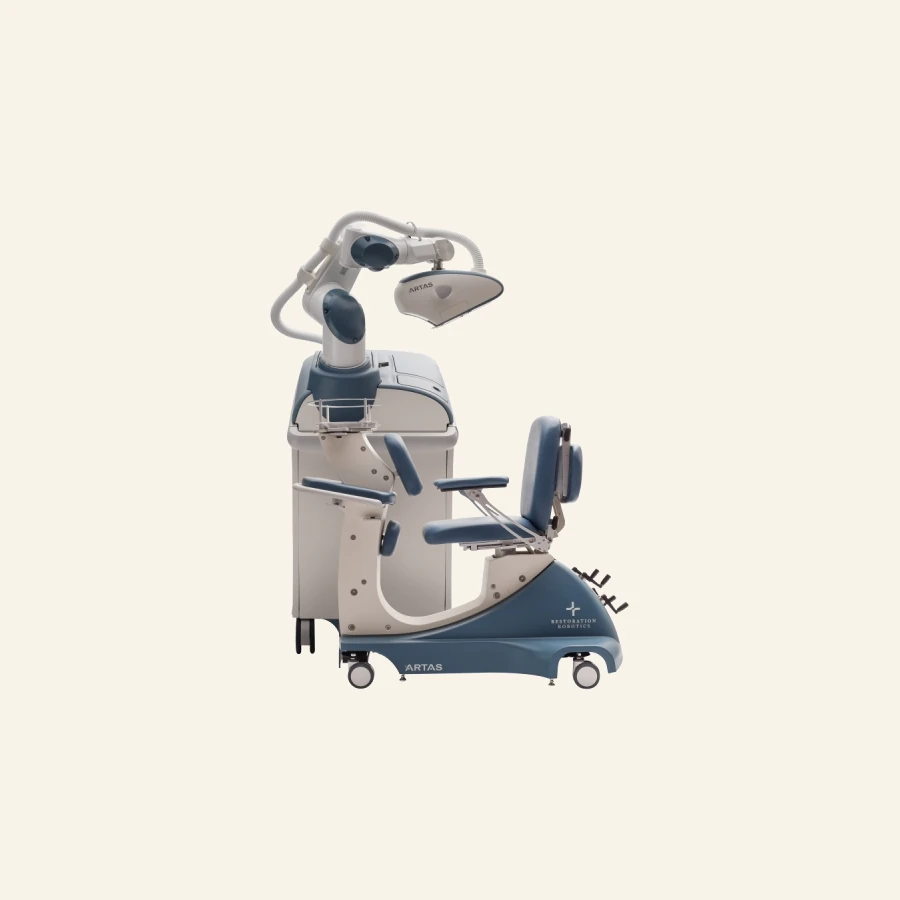
Every case is different. Discuss yours in a personal consultation.
Book a consultation on WhatsAppEvery figure published on this site is approximate and is not a quote. Any procedure or treatment first requires a private assessment consultation with Dr. Arístides Arellano —$800 MXN, charged separately— and it is at that consultation that the definitive cost of your case is determined.
Educational content; it does not replace a medical consultation. Results may vary from person to person.