What is a breast lift?
Mastopexy —a breast lift— treats breast drooping (ptosis) without necessarily adding volume. Excess skin is removed, the gland is repositioned upward, the areola is reduced and relocated, and the result is a higher, firmer, better-projected breast, largely using the tissue the patient already has.
It solves a problem that neither exercise nor any non-surgical treatment can correct: once the skin and supporting ligaments have stretched —through pregnancy, breastfeeding, weight loss or simply time— the breast does not rise again on its own. A lift raises the breast; an implant fills it. These are two different problems and they frequently coexist, which is why many patients benefit from combining them.
Techniques used by Dr. Arístides Arellano
There is no single pattern: the one chosen depends on the degree of ptosis (how far the nipple has descended relative to the inframammary fold), skin quality and the volume of gland available. The goal is always the same — the smallest scar that actually solves the case. A pattern too short for a significant droop yields a result that drops again; that is the error avoided in planning.
- Periareolar mastopexy (Benelli / "round block" technique): the scar is confined to the areolar border. It leaves the smallest footprint and is indicated in mild ptosis. Dr. Arístides Arellano presented a free paper on periareolar mastopexy at the Endoscopic Surgery Society of Hospital Betania in 1996 — the document is part of his credential archive.
- Vertical ("lollipop") mastopexy: adds a vertical scar from the areola to the fold. It is the most used pattern in moderate ptosis because it allows the breast cone to be reshaped, not merely the skin tightened.
- "Anchor" mastopexy (Wise pattern): adds a horizontal scar in the inframammary fold. It is reserved for severe ptosis or significant skin excess, and offers the greatest reshaping capacity.
- Augmentation mastopexy (lift + implants): raises and fills in the same operation. This is the answer when, besides drooping, there is real volume loss in the upper pole — the most common scenario after breastfeeding.
- Mastopexy with autologous tissue repositioning (auto-augmentation): in selected cases the patient’s own breast tissue is repositioned toward the upper pole to regain projection without an implant. Assessed case by case.
How is it performed?
Surgery is performed under general anaesthesia in a hospital operating room and lasts approximately 2 to 3.5 hours, depending on the pattern chosen and whether implants are combined. It is usually outpatient or a short stay (24 hours of observation). A support bra is placed at the end and worn for the first weeks — it is part of the result: it holds the tissue while it heals in its new position.
All surgery carries risk and requires a prior medical assessment. Results may vary according to each patient, their anatomy and their individual healing process.
Who is a good candidate?
The assessment reviews nipple position relative to the fold, skin elasticity and gland volume. The pattern follows from that:
- Bothersome breast sagging — the nipple points downward or sits below the inframammary fold.
- Loss of firmness and upper-pole projection after pregnancy, breastfeeding or significant weight loss.
- Stable weight and good general health, with no contraindications to surgery.
- Realistic expectations about the scar: mastopexy always leaves a scar — the goal is the most discreet one possible, offset by the change in shape.
- If pregnancies are planned soon, waiting is usually advised: a new pregnancy and breastfeeding can alter the result.
Lift, augmentation, or both?
This is the most frequent question at consultation, and it is decided by one simple anatomical reference: the position of the nipple relative to the inframammary fold. If the breast sits well but lacks volume, the answer is a breast augmentation. If it has enough volume but has dropped, the answer is a lift. If it has dropped and lost volume —the classic post-breastfeeding scenario— the honest answer is the combination: lift + implants. An implant placed on a drooping breast makes it larger, but it does not raise it: it lowers it.
Recommended post-surgical treatments
To support recovery and protect scar quality —the point that concerns mastopexy patients most— Dr. Arístides may recommend manual lymphatic drainage, hyperbaric chamber sessions and, later, laser treatment on the matured scar. See the full guide: Post-surgical recovery and care.
Before and after
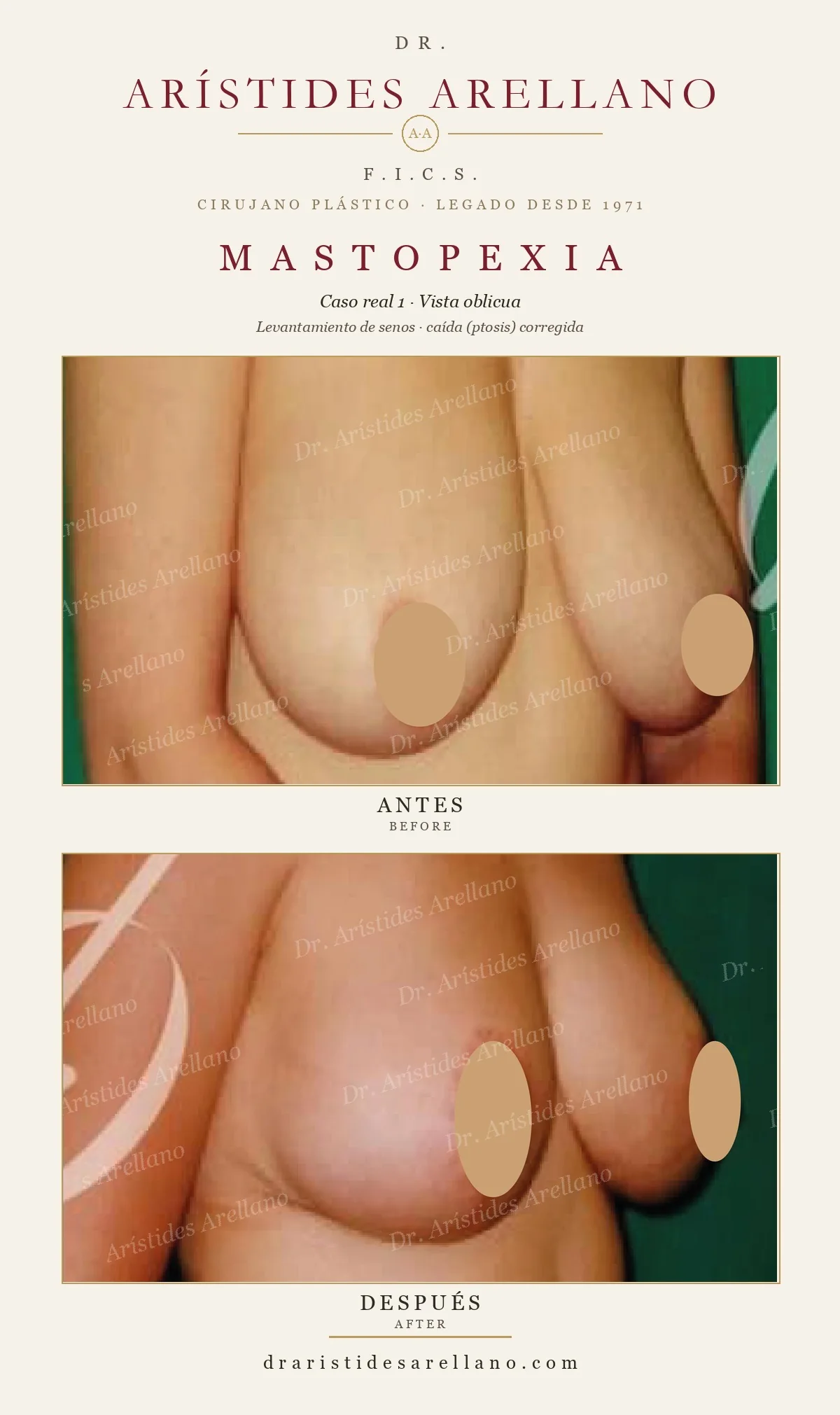
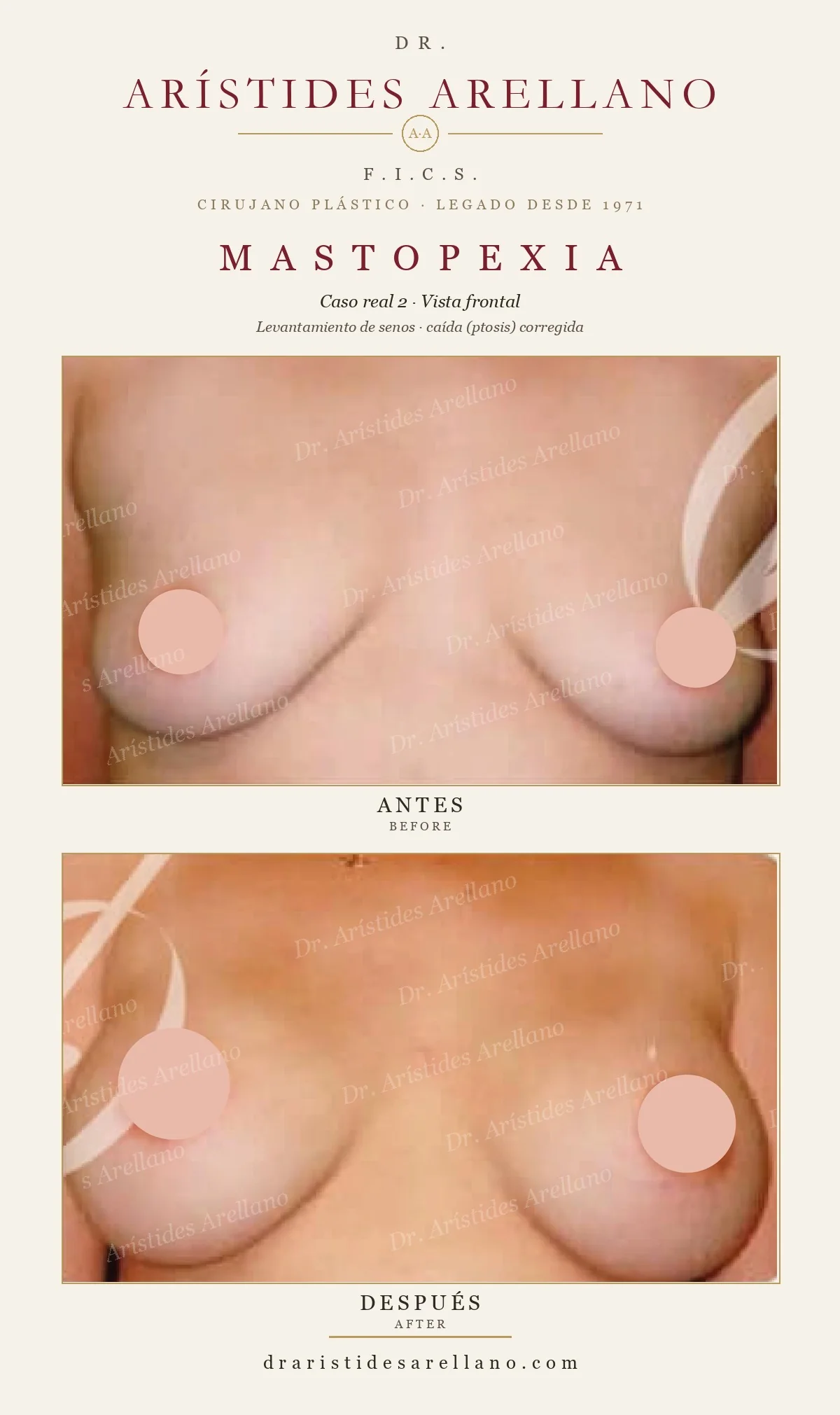
The cases below are real patients of Dr. Arístides Arellano, published with their written informed consent. Out of respect for each person’s privacy, only expressly authorised cases are published; at your in-person consultation Dr. Arístides can show you further cases with a starting point similar to yours. Results may vary from patient to patient.
Approximate price
Mastopexy (breast lift) has a reference cost of $60,000 MXN, and the lift + implants combination, $60,000 MXN. Approximate price — the definitive cost is set at your private consultation with Dr. Arístides Arellano. The final cost depends on the pattern required, whether implants are placed, and hospital and anaesthetist fees. All references are in the price list.
About Dr. Arístides Arellano
Dr. Arístides Arellano is a plastic surgeon holding a specialty licence: he practises under a Mexican medical licence (D.G.P. 1125959) and a specialty licence in Plastic & Reconstructive Surgery (0002008), both issued by the Directorate General of Professions (DGP), which reissued his certificate of professional standing in 2025. His career began before Mexico’s present-day specialty-board system existed: he belongs to the founding generation of plastic surgery in Puebla, the second generation of a surgical tradition started in 1971 by Dr. Francisco Arellano Ocampo. Trust is verified, not promised: both licences are public and anyone can look them up in the DGP’s National Registry of Professionals.
Related patient guide
If your assessment includes implants: How long do breast implants last? The 10-year myth — part of the informational guide series reviewed by Dr. Arístides Arellano.
Recovery · step by step
- Days 1–7Support bra, moderate discomfort and arm rest.
- Weeks 2–3Return to daily activities without strain.
- Weeks 4–6Progressive exercise as advised.
- Months 2–6Scars mature and pale; contour settles.
Risks and contraindications
A breast lift repositions breast tissue and removes skin: its currency is scars, and an informed decision starts by understanding them. Its risks:
- Permanent scars: around the areola and, depending on the degree of ptosis, vertically down to the fold or in an inverted T. They mature and fade over 12 to 18 months, but they do not disappear.
- Nipple sensitivity changes: usually temporary; in some cases persistent.
- Nipple-areola necrosis: rare; the risk rises with smoking and with long-distance lifts.
- Dehiscence: opening of a wound segment, most often at the T-junction, the point of highest tension.
- Residual asymmetry: breasts are not identical before surgery and will not be identical after; a marked difference may require a touch-up.
- Recurrent sagging: a lift does not stop gravity, weight changes or pregnancies: the result evolves over the years.
- Hematoma, seroma and infection: monitored at post-operative visits.
- Effects on breastfeeding: the technique aims to preserve the ducts, but breastfeeding can be affected in some cases.
A breast lift is postponed or reconsidered in these situations:
- Pregnancy planned in the near term, or recent breastfeeding: waiting at least six months after finishing breastfeeding is recommended.
- Active smoking, because of necrosis and poor-healing risk.
- Unstable weight: significant weight gain or loss after surgery compromises the result.
- Breast disease pending investigation: age-appropriate imaging must be up to date.
- Expecting more volume from the lift alone: a mastopexy repositions, it does not fill; when more volume is wanted, combining with an implant is discussed at the consultation.
Frequently asked questions
How much does a breast lift cost in Puebla?
The reference price is approximately $60,000 MXN for mastopexy, and $60,000 MXN when combined with implants. The exact amount is confirmed at your in-person consultation and depends on the pattern required and on hospital and anaesthetist fees.
Does a breast lift increase size?
No. On its own it firms, raises and reshapes, but it does not add volume: in some cases the breast even looks slightly smaller because it sits higher and more compactly. If you also want volume, an implant is combined in the same procedure (augmentation mastopexy).
Do I need a lift or an augmentation?
The practical reference is the position of the nipple relative to the inframammary fold. If the breast sits well but lacks volume, an augmentation is indicated. If it has volume but has dropped, a lift is indicated. If it has dropped and lost volume, the combination is usually the answer. An implant on a drooping breast enlarges it but does not raise it.
What scar does a breast lift leave?
It depends on the pattern: periareolar (around the areola only, for mild drooping), vertical (areola plus a line down to the fold, for moderate drooping) or anchor (adds a horizontal line in the fold, for severe drooping). A lift always leaves a scar; the pattern chosen is the one with the smallest scar that genuinely solves the case, and it tends to fade over time. Results may vary.
What is periareolar mastopexy?
It is the technique in which the scar is confined to the areolar border, also known as the Benelli or round-block technique. It is indicated in mild drooping. Dr. Arístides Arellano presented a free paper on periareolar mastopexy at the Endoscopic Surgery Society of Hospital Betania in 1996.
How long does a breast lift last?
The result is durable, but it does not stop time: skin continues to age and gravity continues to act. Maintaining a stable weight and avoiding large fluctuations helps preserve it. A new pregnancy with breastfeeding can alter it. Results may vary.
Does it affect breastfeeding?
Many techniques preserve the gland and ducts and aim to maintain the ability to breastfeed, though it cannot be guaranteed in every case. It is discussed in detail at the assessment before the pattern is chosen.
Can a breast lift be done without scars?
No. No surgical lift of the breast is performed without an incision, and every incision leaves a scar. Any procedure promising to raise a genuinely drooping breast with no scar should be reviewed with caution. What can be chosen is the pattern that leaves the most discreet scar possible for each case.
Before and after
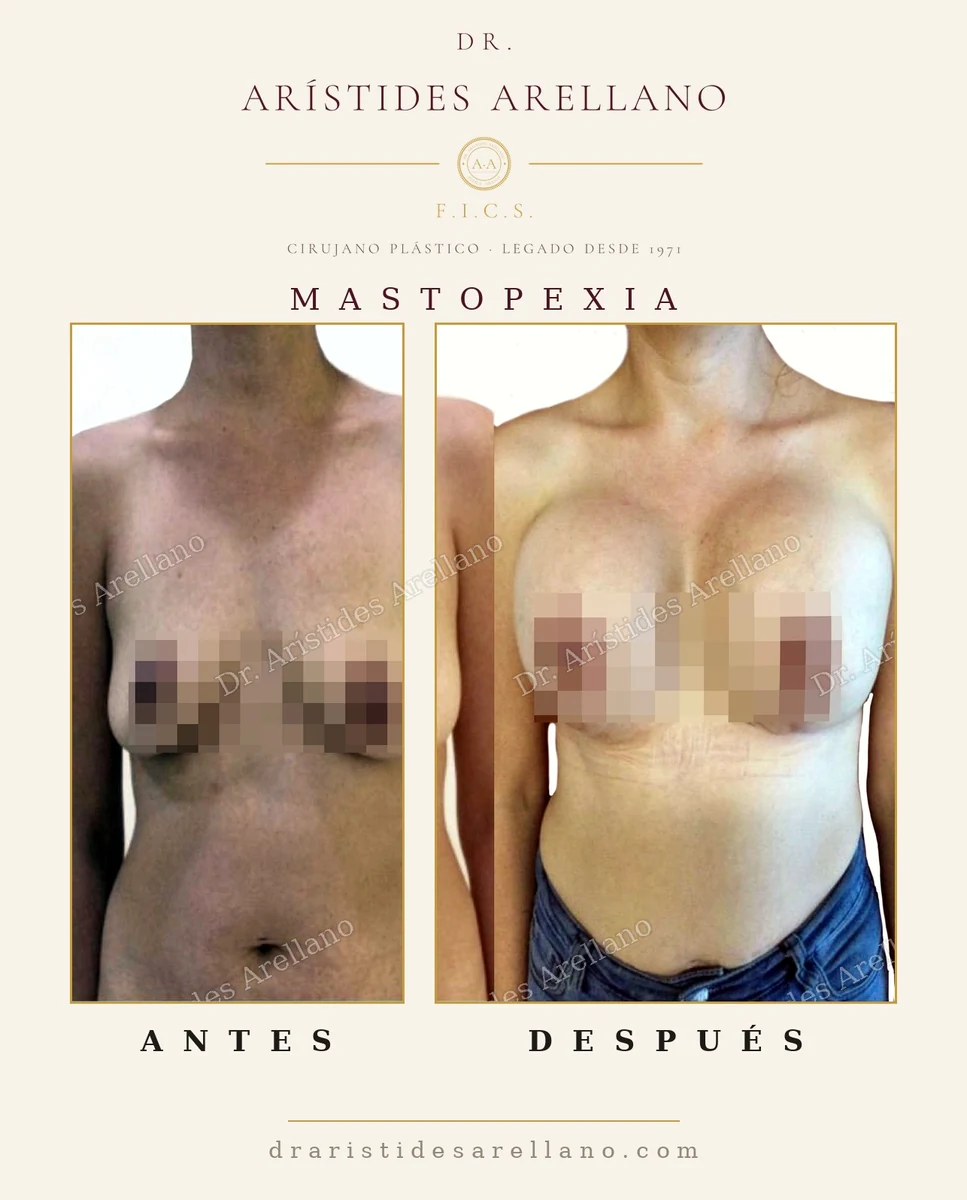
Photographs of real patients, published with their written informed consent. Results may vary from person to person; these images are not a promise of outcome.
Every case is different. Discuss yours in a personal consultation.
Book a consultation on WhatsAppEvery figure published on this site is approximate and is not a quote. Any procedure or treatment first requires a private assessment consultation with Dr. Arístides Arellano —$800 MXN, charged separately— and it is at that consultation that the definitive cost of your case is determined.
Educational content; it does not replace a medical consultation. Results may vary from person to person.