
What are buttock implants (gluteoplasty)?
Gluteoplasty increases buttock volume and projection by placing a solid silicone implant inside the muscle. Unlike augmentation with the patient’s own fat (BBL), where the volume comes from the patient’s fat, here it comes from an implant — and that is exactly why it exists: it is the option indicated when the patient does not have enough fat to graft.
The implant used is a solid, cohesive silicone elastomer, not a liquid gel. It is placed through a single incision in the intergluteal crease —the midline between the two buttocks, where the scar stays hidden— and it provides permanent volume: unlike grafted fat, the implant is not reabsorbed over time and does not change with weight fluctuations.
It matters to understand what each procedure does and does not do. The implant projects and fills the buttock; it does not sculpt the waist or hips. A BBL, because it includes contouring liposuction, reshapes the whole silhouette. So the choice between the two is not a matter of fashion but of anatomy: how much donor fat there is, and what kind of change the patient is after.
Techniques used by Dr. Arístides Arellano
The safety and the natural look of a gluteoplasty result depend on three technical decisions: which plane the implant goes into, how it is accessed, and what size the patient’s anatomy will actually accept. These are the decisions made in this practice:
- Intramuscular plane: the implant is housed inside the gluteus maximus muscle. It is the reference plane because the muscle covers the implant —it hides the edges, reduces how much it can be felt or seen, and lowers the risk of it shifting—. An implant placed just under the skin, without muscular cover, is far more visible and prone to migrate.
- A single midline incision, within the intergluteal crease. Both implants are placed through one incision, and the scar stays hidden in the natural fold between the buttocks.
- Solid, cohesive silicone implant, designed specifically for the buttock. It is not a liquid gel: if the shell were damaged, the material does not disperse through the tissues as can happen with other fillers.
- Size is dictated by anatomy, not by a catalogue. The available muscular space limits the implant that can be placed safely; forcing a larger size strains the closure and raises the risk of complications. When the desired volume exceeds what the plane allows, it is said plainly before operating.
- Hospital operating room, an anaesthetist and strict sterile technique. Because of how close the area is to the intergluteal fold, asepsis is a particular priority in this surgery.
How is it performed?
Gluteoplasty is performed under general anaesthesia, in a hospital operating room, with the patient face down (prone position). It lasts approximately 2 to 3 hours. Through a single incision in the midline of the intergluteal crease, the surgeon creates a pocket inside the gluteus maximus muscle on each side, with dimensions matched to the chosen implant; places the implants, checks symmetry and closes in layers. In many cases drains are left in place for the first few days to evacuate the fluid that collects in the surgical space.
Gluteoplasty is frequently combined with liposuction of the waist, flanks or lower back, because narrowing the contour around the buttock enhances the curve as much as the implant itself. That combination is decided at the consultation according to each patient’s anatomy.
All surgery carries risk and requires a prior medical assessment. Results may vary according to each patient, their anatomy and their individual healing process.
Who is a good candidate?
- Slim people, without enough donor fat for a BBL. This is the main indication: it is precisely the opposite of the BBL case. Someone who has no fat to move finds in the implant the route to gain volume.
- Those seeking permanent volume. The implant is not reabsorbed like grafted fat; the volume placed is the volume that remains, aside from changes associated with the implant itself over time.
- Good general health, with no contraindications to surgery or general anaesthesia.
- Realistic expectations about what an implant provides: projection and fill, not a reshaping of the whole silhouette. If the goal is also to narrow the waist as well as enlarge the buttock, combining with liposuction or considering another technique will be discussed.
- Willingness to follow a demanding post-operative course — above all, no sitting directly on the buttocks for the first weeks and keeping the area rigorously clean.
- Understanding that an implant is a foreign body with long-term considerations, and that at some point it might require revision surgery.
Recommended post-surgical treatments
Gluteoplasty has a demanding recovery because the area bears the weight of the body when sitting and is under constant tension. During the first weeks, direct pressure on the buttocks is avoided, a compression garment is used, and the wound is cared for strictly. Dr. Arístides may recommend manual lymphatic drainage for the swelling —especially if associated liposuction was performed— and hyperbaric chamber sessions, aimed at supporting tissue oxygenation during healing. See the full guide: Post-surgical recovery and care.
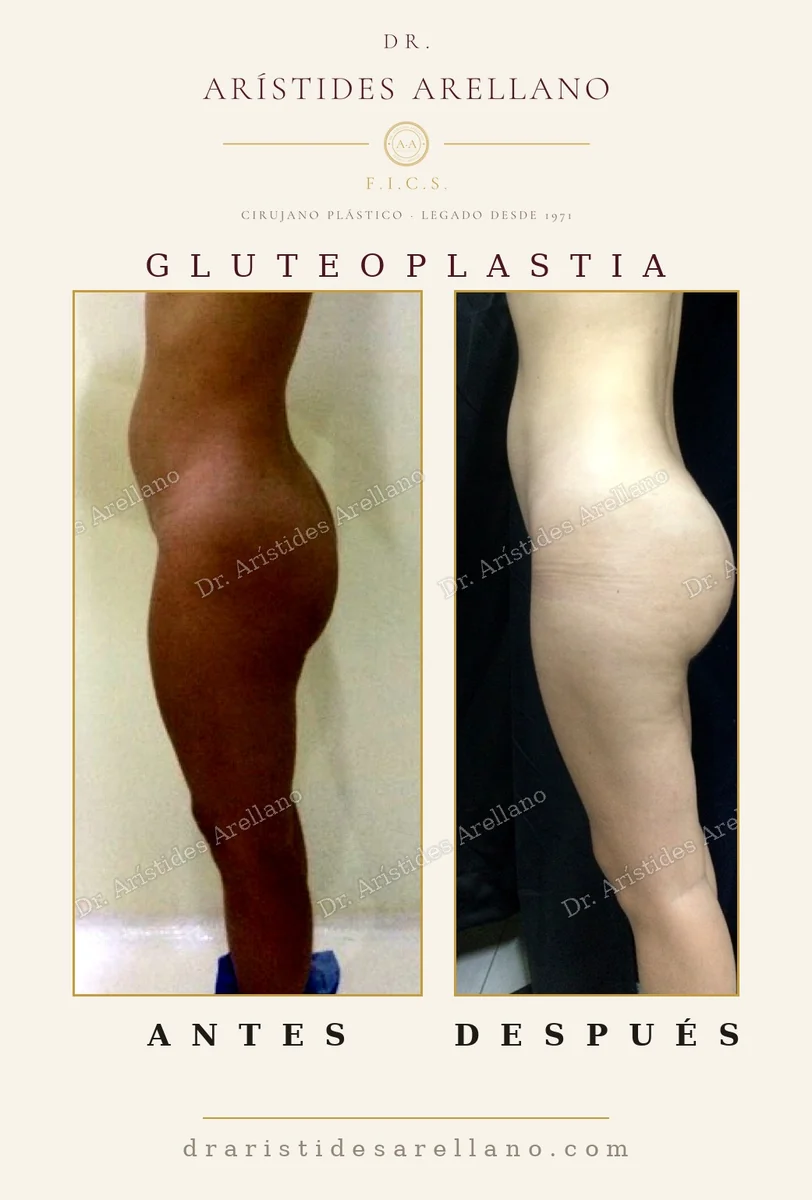
Before and after
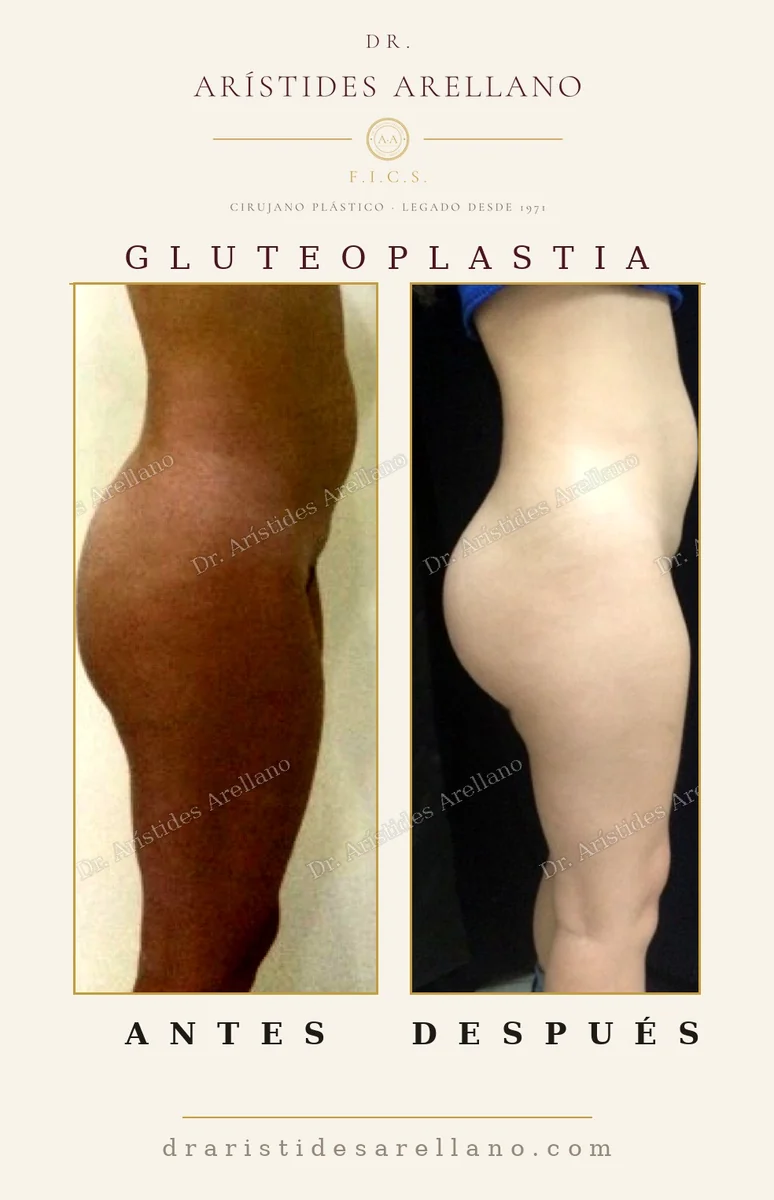
The cases below are real patients of Dr. Arístides Arellano, published with their written informed consent. Out of respect for each person’s privacy, only expressly authorised cases are published; at your in-person consultation Dr. Arístides can show you further cases with a starting point similar to yours. Results may vary from patient to patient.
Approximate price
The reference price starts at approximately $80,000 MXN, depending on the complexity of the case and the indicated technique. The price is all-inclusive: it covers use of the operating theatre and facilities, pre-operative laboratory work and the post-surgical recovery treatments. It is not the surgeon’s fee alone. Approximate price — the definitive cost is set at your private consultation with Dr. Arístides Arellano.
About Dr. Arístides Arellano
Dr. Arístides Arellano is a plastic surgeon holding a specialty licence: he practises under a Mexican medical licence (D.G.P. 1125959) and a specialty licence in Plastic & Reconstructive Surgery (0002008), both issued by the Directorate General of Professions (DGP), which reissued his certificate of professional standing in 2025. His career began before Mexico’s present-day specialty-board system existed: he belongs to the founding generation of plastic surgery in Puebla, the second generation of a surgical tradition started in 1971 by Dr. Francisco Arellano Ocampo. Trust is verified, not promised: both licences are public and anyone can look them up in the DGP’s National Registry of Professionals.
Related patient guide
Gluteoplasty places a permanent implant in a technically demanding area, so the choice of surgeon carries particular weight: How to choose a plastic surgeon in Puebla: the checklist, including how to verify a specialty licence with the DGP.
Trust is verified, not promised. All 210 scanned documents —degree, licences, diplomas, publications and certificates, from 1977 to 2025— are open in Dr. Arístides Arellano’s credential archive, alongside an explanation of the difference between a specialty licence and a board certification.
Recovery · step by step
- Weeks 1–3No sitting directly on the buttocks; an offloading cushion is used. Compression garment and strict wound care. Drains for the first days.
- Weeks 2–4Light activity; sitting and sleeping precautions continue. Sutures removed as healing allows.
- Weeks 4–6Progressive return to routine; intense effort and impact exercise are avoided.
- Months 2–3Swelling subsides and the definitive contour appears; full exercise is gradually cleared.
Frequently asked questions
What is the difference between buttock implants and a BBL?
Gluteoplasty uses a solid silicone implant to add volume; a BBL uses the patient’s own fat, grafted after liposuction. The practical difference is one of indication: the implant is the option when there is not enough donor fat, it provides permanent volume and projects the buttock, but it does not reshape the waist. A BBL, because it includes contouring liposuction, changes the whole silhouette, although part of the grafted fat is always reabsorbed. Which one is right depends on each patient’s anatomy and is decided at the consultation.
Which plane is the buttock implant placed in?
In the intramuscular plane, that is, inside the gluteus maximus muscle. It is the reference plane because the muscle covers the implant: it hides the edges, reduces how much it can be felt or seen under the skin, and lowers the risk of it shifting. An implant placed without muscular cover is more visible and more prone to migrate.
Are buttock implants permanent?
Yes. Unlike grafted fat, which is partly reabsorbed, the implant does not disappear over time or change with weight fluctuations. That does not mean it lasts a lifetime with no further thought: an implant is a device that may require revision surgery in the long term. Results may vary.
Can I have buttock implants if I am very slim?
Yes, and in fact that is the main indication. It is the opposite of the BBL case: a very slim person usually does not have enough donor fat for a graft, and there the implant is the route to gaining volume. What anatomy does limit is the size of the implant, because the available muscular space sets how far it is safe to go.
How much do buttock implants cost in Puebla?
The cost is defined at the in-person consultation rather than on a fixed list, because it depends on the type and size of the implant, on whether it is combined with contouring liposuction, and on hospital and anaesthetist fees. A figure is not given without examining the patient, because a price given without assessing the anatomy is an invented price.
When can I sit down after a gluteoplasty?
Avoiding direct pressure on the buttocks for the first weeks is advised, supporting yourself with an offloading cushion that shifts the weight to the thighs. It is one of the instructions that most influences how the wound heals and how the implant settles, so it is worth following with discipline.
Do buttock implants rupture or leak?
The buttock implant is a solid, cohesive silicone elastomer, not a liquid gel, so it does not leak the way a liquid filler could. It is designed to withstand the pressure and movement of the area. Like any device, it is not indestructible, which is why long-term follow-up is part of the procedure.
Can gluteoplasty be combined with liposuction?
Yes, and it is a frequent combination. Narrowing the waist, flanks or lower back with liposuction enhances the curve around the buttock as much as the implant itself, because contour is perceived by contrast. If combining them is appropriate, it is discussed at the consultation, according to each patient’s anatomy and goals.
Before and after
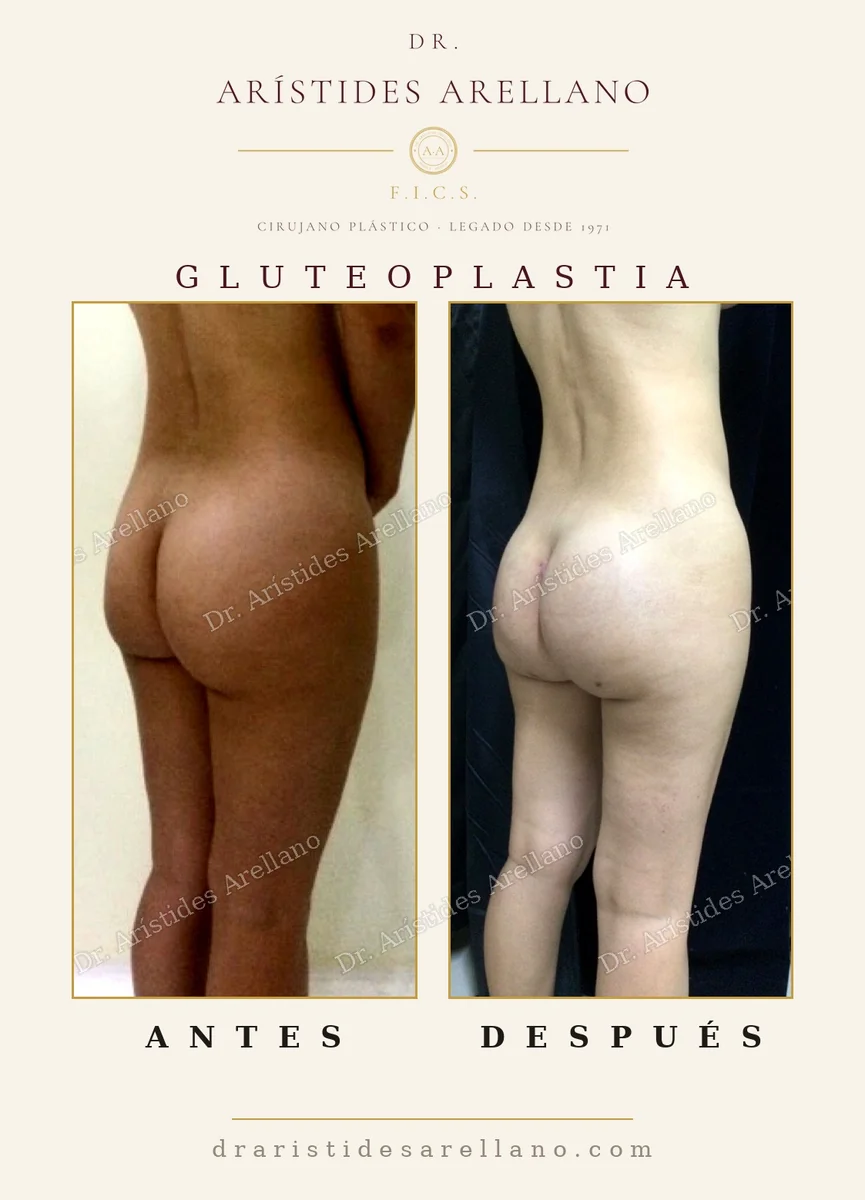
Implant or your own fat? It depends on whether there is fat to take. A slim patient has none, and forcing a fat transfer with scarce donor fat gives a small augmentation that then reabsorbs by 30 to 50 %. An implant does not depend on weight and does not reabsorb. Fat, when there is some to harvest, gives a more natural shape and narrows the waist as a bonus. All surgery carries risks and requires a prior medical assessment; results vary from person to person.
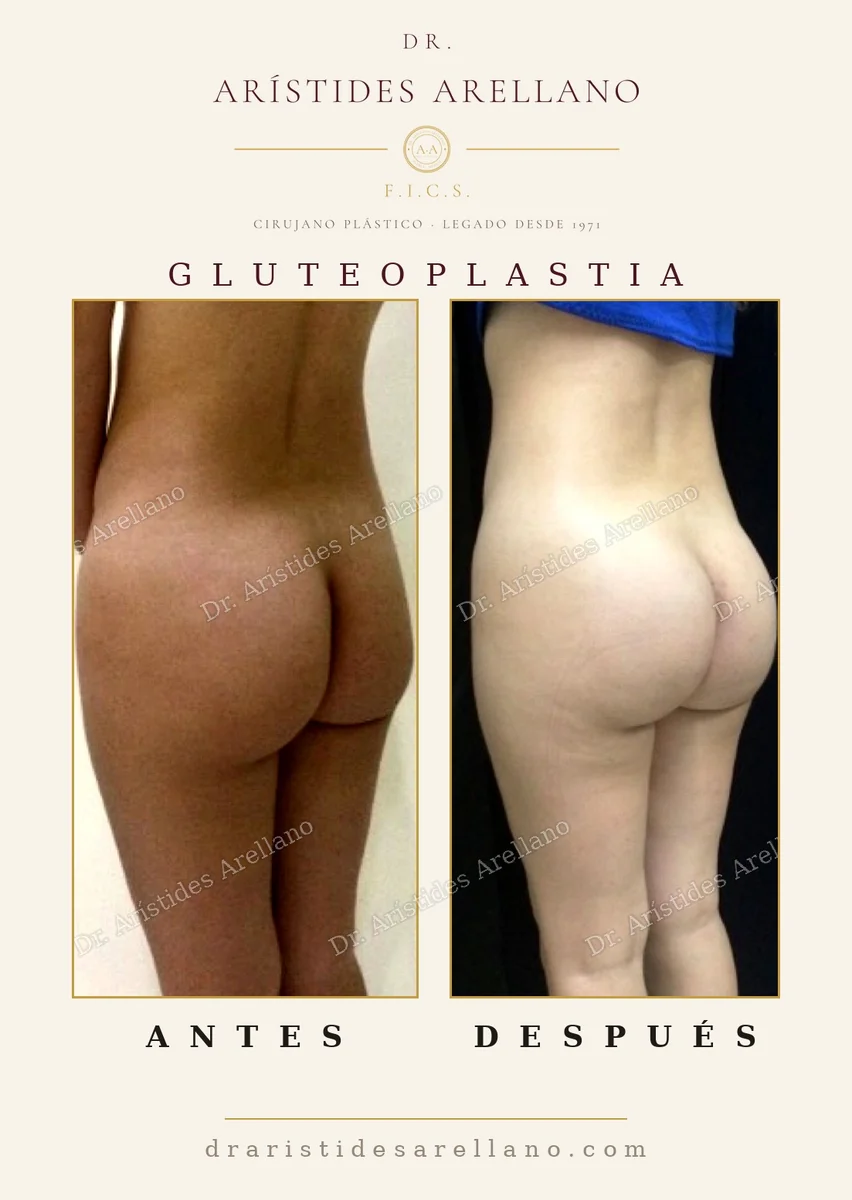
Where do the scar and the implant go? The scar sits in the vertical crease between the buttocks, hidden even in swimwear. The implant goes inside the muscle, not under the skin: that way it stays covered, the edge cannot be felt and it does not shift when sitting. Placing it under the fat — easier and faster — is what produces visible edges. All surgery carries risks and requires a prior medical assessment; results vary from person to person.
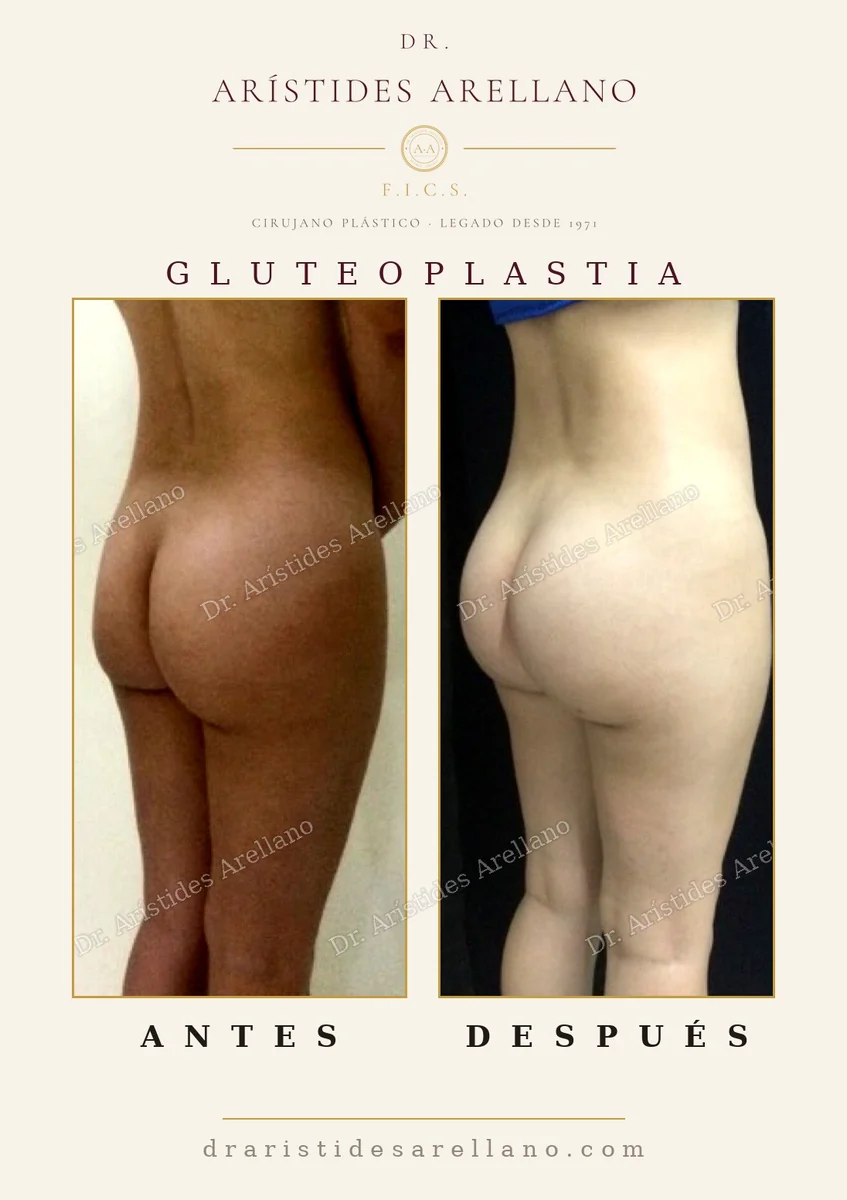
How much does gluteal implant surgery cost? Here it starts at approximately MX$80,000, with theatre, pre-operative labs and recovery included. It costs more than fat grafting because it includes the prosthesis, and in exchange the volume does not reabsorb: what is placed is what remains. The definitive cost of each case is set at the private assessment consultation. All surgery carries risks and requires a prior medical assessment; results vary from person to person.
How long is recovery? This is the uncomfortable part and it deserves to be said in full: you cannot sit directly on the buttock for two to three weeks, and you sleep face-down. Normal life resumes at four weeks and exercise at two months. It is a rougher recovery than a BBL, and it is the price of volume that does not reabsorb. All surgery carries risks and requires a prior medical assessment; results vary from person to person.
Photographs of real patients, published with their written informed consent. Results may vary from person to person; these images are not a promise of outcome.
Every case is different. Discuss yours in a personal consultation.
Book a consultation on WhatsAppEvery figure published on this site is approximate and is not a quote. Any procedure or treatment first requires a private assessment consultation with Dr. Arístides Arellano —$800 MXN, charged separately— and it is at that consultation that the definitive cost of your case is determined.
Educational content; it does not replace a medical consultation. Results may vary from person to person.