What are body implants?
Body implants are solid or semi-solid silicone prostheses —flexible and firm to the touch, not liquid— placed beneath the muscle or its fascia to add volume and contour to an area that does not respond to training. The two most requested regions are the calf and the chest (pectoral), though the principle is the same: to provide shape where genetics or a lack of muscle mass leave a deficit.
Unlike a breast implant, which is usually cohesive gel, a body implant is solid: it does not rupture or leak, and it is designed to tolerate the pressure and movement of a limb or the chest. This surgery is chosen when exercise, however consistent, fails to develop the area —common in people of slim build—, or to correct an asymmetry or a hypoplasia (underdevelopment) of congenital or post-traumatic origin.
Techniques used by Dr. Arístides Arellano
There is no single implant: size, shape and placement plane are chosen at the assessment according to your anatomy, your baseline muscle mass and the result you want. The rule is the same for calf and chest — a well-sized implant looks like your own muscle; an oversized one gives the surgery away.
- Calf implants: placed in the subfascial plane, over the gastrocnemius muscle, through a short incision hidden in the crease behind the knee. Depending on the case, one implant is used over the inner head of the calf (the most common deficit) or two per leg to give symmetry to the whole contour.
- Pectoral implants: placed beneath the pectoralis major muscle, through a discreet incision in the armpit, so the scar does not sit on the chest. They add projection and definition to the chest in men with little muscle mass or with chest asymmetry.
- Selection with sizers: before the size is set, trial sizers of different volumes are tested to choose the projection that suits your structure, avoiding an excessive or artificial result.
- Augmentation with your own fat (fat transfer): in patients who prefer to avoid an implant and have sufficient donor fat, the area can be augmented with a fat graft. It is a more moderate, natural-feeling option that also improves the contour of the donor area; it does not always reach the volume of an implant and is assessed case by case.
- Asymmetry or hypoplasia correction: when the goal is to match two uneven sides —from congenital underdevelopment or a post-traumatic sequela— each side is planned separately, seeking symmetry rather than an identical mould.
How is it performed?
Surgery is performed in a hospital operating room under general or regional anaesthesia, depending on the area and the case. It lasts approximately 1 to 2 hours and is usually outpatient or a short stay. A dressing or compression garment is applied at the end to hold the implant in position while it heals; for calf implants, the first hours require keeping the leg elevated and limiting walking.
All surgery carries risk and requires a prior medical assessment. Results may vary according to each patient, their anatomy and their individual healing process.
Who is a good candidate?
- People of slim build whose calf or chest does not develop despite consistent training.
- Noticeable asymmetry between one side and the other, from underdevelopment or a sequela of trauma or previous surgery.
- Congenital hypoplasia of the area (for example, underdevelopment of the pectoral muscle).
- Good general health, stable weight and no active skin infection in the area.
- Realistic expectations: the goal is a proportionate, natural-looking volume, reviewed in detail at the assessment.
Recommended post-surgical treatments
For a more comfortable recovery and to protect scar quality, Dr. Arístides may recommend manual lymphatic drainage and, when the case warrants it, supportive treatment on the scar. With calf implants, the progressive return to walking and exercise is closely supervised. See the full guide: Post-surgical recovery and care.
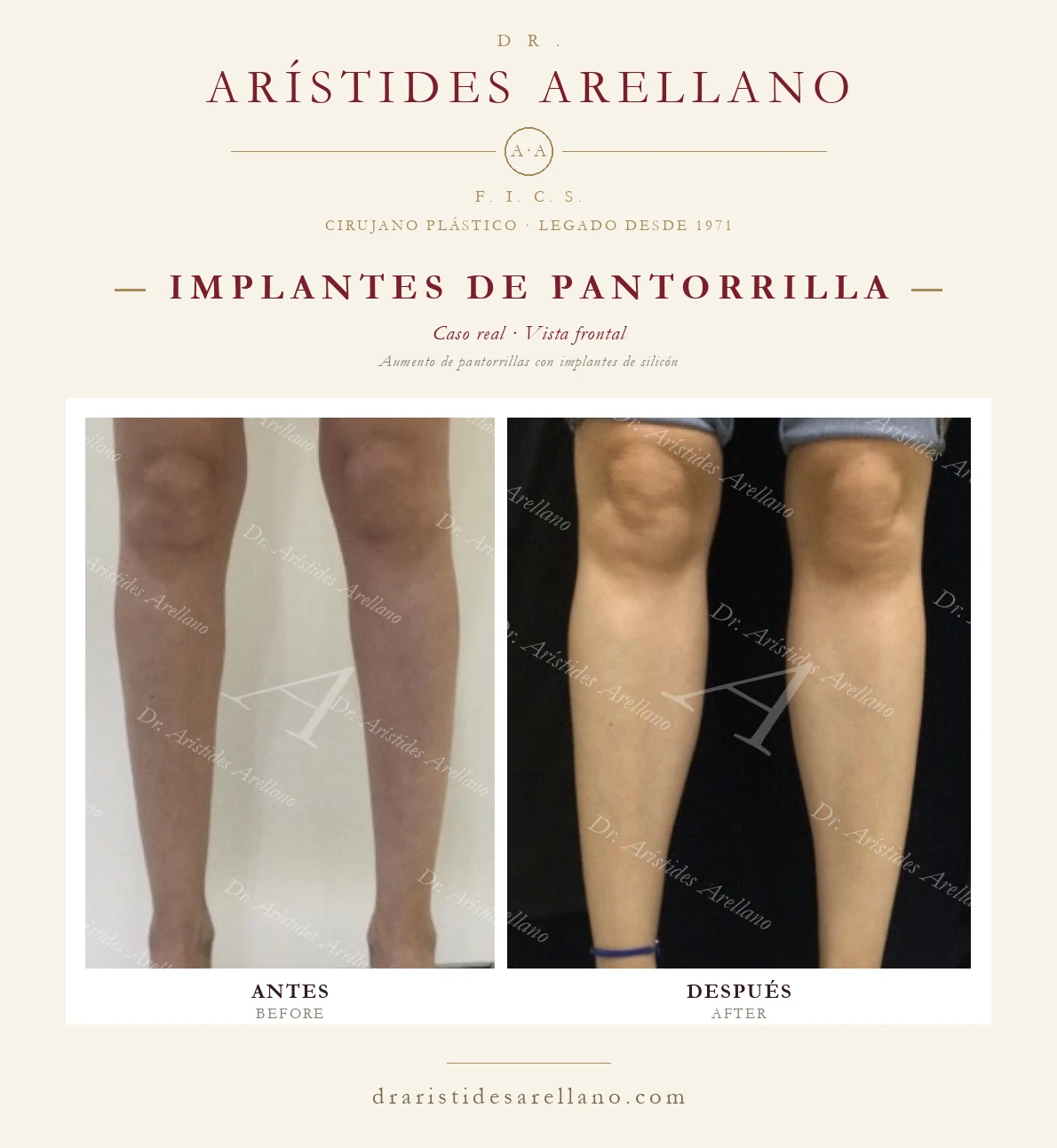
Before and after
The cases below are real patients of Dr. Arístides Arellano, published with their written informed consent. Out of respect for each person’s privacy, only expressly authorised cases are published; at your in-person consultation Dr. Arístides can show you further cases with a starting point similar to yours. Results may vary from patient to patient.
Approximate price
Reference prices: pantorrillas from $80,000 MXN and pectorales from $85,000 MXN, approximate, depending on the complexity of the case and the indicated technique. The price is all-inclusive: it covers use of the operating theatre and facilities, pre-operative laboratory work and the post-surgical recovery treatments. It is not the surgeon’s fee alone. Approximate price — the definitive cost is set at your private consultation with Dr. Arístides Arellano.
About Dr. Arístides Arellano
Dr. Arístides Arellano is a plastic surgeon holding a specialty licence: he practises under a Mexican medical licence (D.G.P. 1125959) and a specialty licence in Plastic & Reconstructive Surgery (0002008), both issued by the Directorate General of Professions (DGP), which reissued his certificate of professional standing in 2025. His career began before Mexico’s present-day specialty-board system existed: he belongs to the founding generation of plastic surgery in Puebla, the second generation of a surgical tradition started in 1971 by Dr. Francisco Arellano Ocampo. Trust is verified, not promised: both licences are public and anyone can look them up in the DGP’s National Registry of Professionals.
Related patient guide
If you are choosing a surgeon for a contouring procedure: How to choose a plastic surgeon in Puebla: the checklist, including how to verify a specialty licence with the DGP.
Trust is verified, not promised. All 210 scanned documents —degree, licences, diplomas, publications and certificates, from 1977 to 2025— are open in Dr. Arístides Arellano’s credential archive, alongside an explanation of the difference between a specialty licence and a board certification.
Recovery · step by step
- Days 1–3Dressing or compression garment, moderate discomfort and rest; for the calf, leg elevated and walking limited.
- Weeks 1–2Discomfort decreases; sutures removed where applicable; desk work can resume as medically advised.
- Weeks 3–4Marked improvement in swelling; progressive walking and light activity, avoiding strain on the treated area.
- Weeks 6–8Gradual return to exercise according to individual progress, avoiding impact and heavy load on the area.
- Months 3–6The implant settles into its definitive position and the contour fully stabilises.
Frequently asked questions
How much do calf or pectoral implants cost in Puebla?
The cost is defined at the in-person consultation, as it depends on the area, the number of implants, whether it is combined with your own fat, and hospital and anaesthetist fees. For that reason there is no single catalogue price; it is confirmed after reviewing your case.
What are body implants made of?
They are made of solid or semi-solid silicone, flexible and firm to the touch, not liquid. Unlike a gel breast implant, a body implant is designed not to rupture or leak and to tolerate the pressure and movement of a limb or the chest.
Where is the scar for calf implants?
The incision is made in the crease behind the knee, where it is naturally hidden and not visible from the front. Like any scar, it matures and fades over time. Results may vary.
Can I exercise again after calf implants?
Yes, progressively. Walking and strain on the area are limited in the first weeks; exercise resumes gradually, generally between 6 and 8 weeks, according to individual progress. Light walking is resumed sooner.
What is the difference between a body implant and augmentation with my own fat?
An implant gives a predictable, larger volume and does not depend on available fat. Fat transfer uses your own fat, feels natural and improves the donor area, but usually achieves a more moderate increase and part of the graft is reabsorbed. The right option is decided at the assessment.
Are pectoral implants only for men?
They are requested mainly by men, to add projection and definition to the chest when muscle mass is scarce or there is chest asymmetry. They can also be indicated to correct a congenital hypoplasia of the pectoral. Each case is assessed individually.
Do body implants have to be replaced periodically?
There is no fixed schedule. Being solid silicone, they do not leak; they are reviewed or replaced only when there is a medical indication, not automatically. Follow-up with your surgeon is advised.
Is it a painful surgery?
There is moderate discomfort in the first days, manageable with analgesics. With calf implants the sensation of tightness is greater when walking during the first week, so rest and leg elevation are advised. Results and recovery may vary.
Before and after
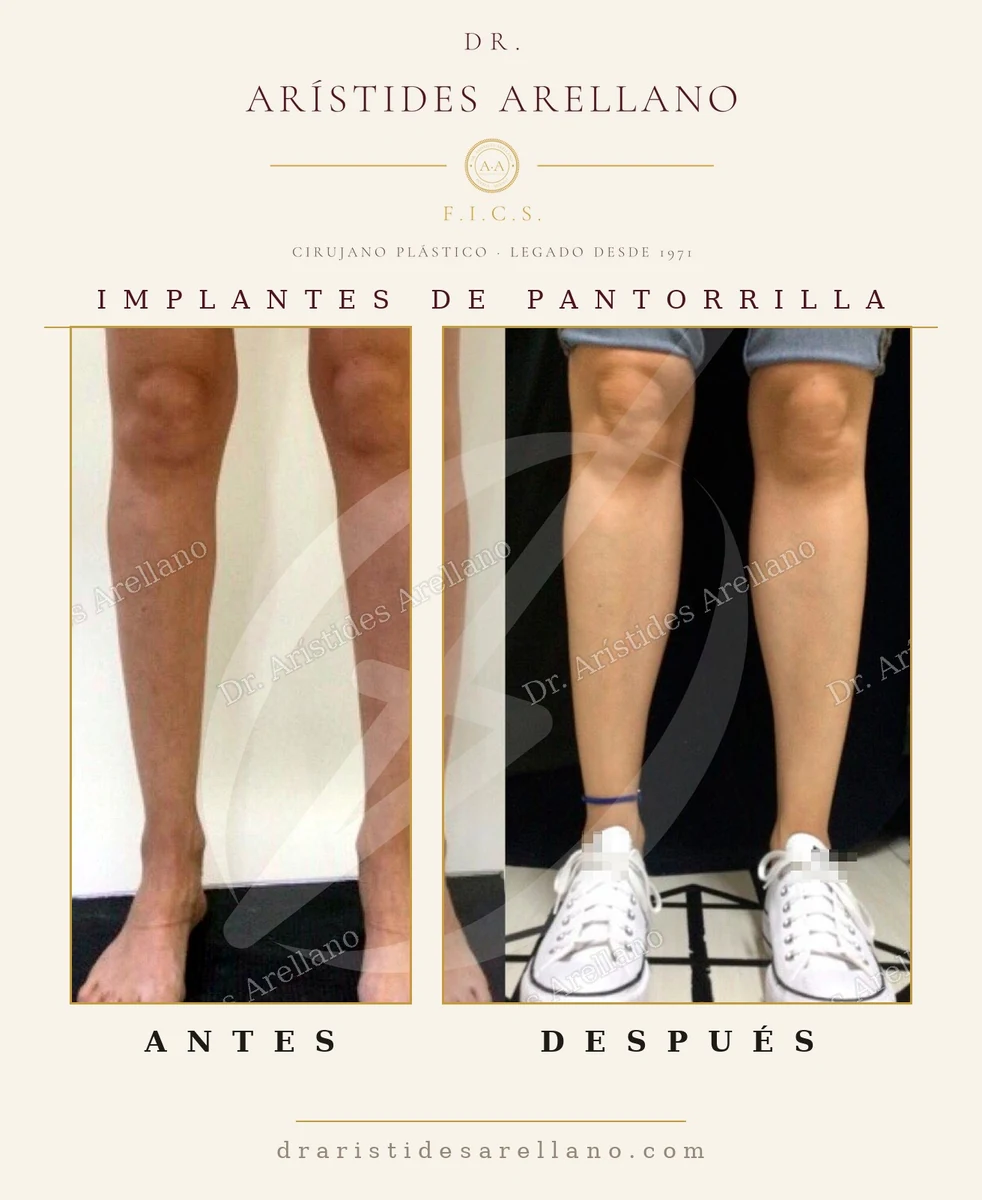
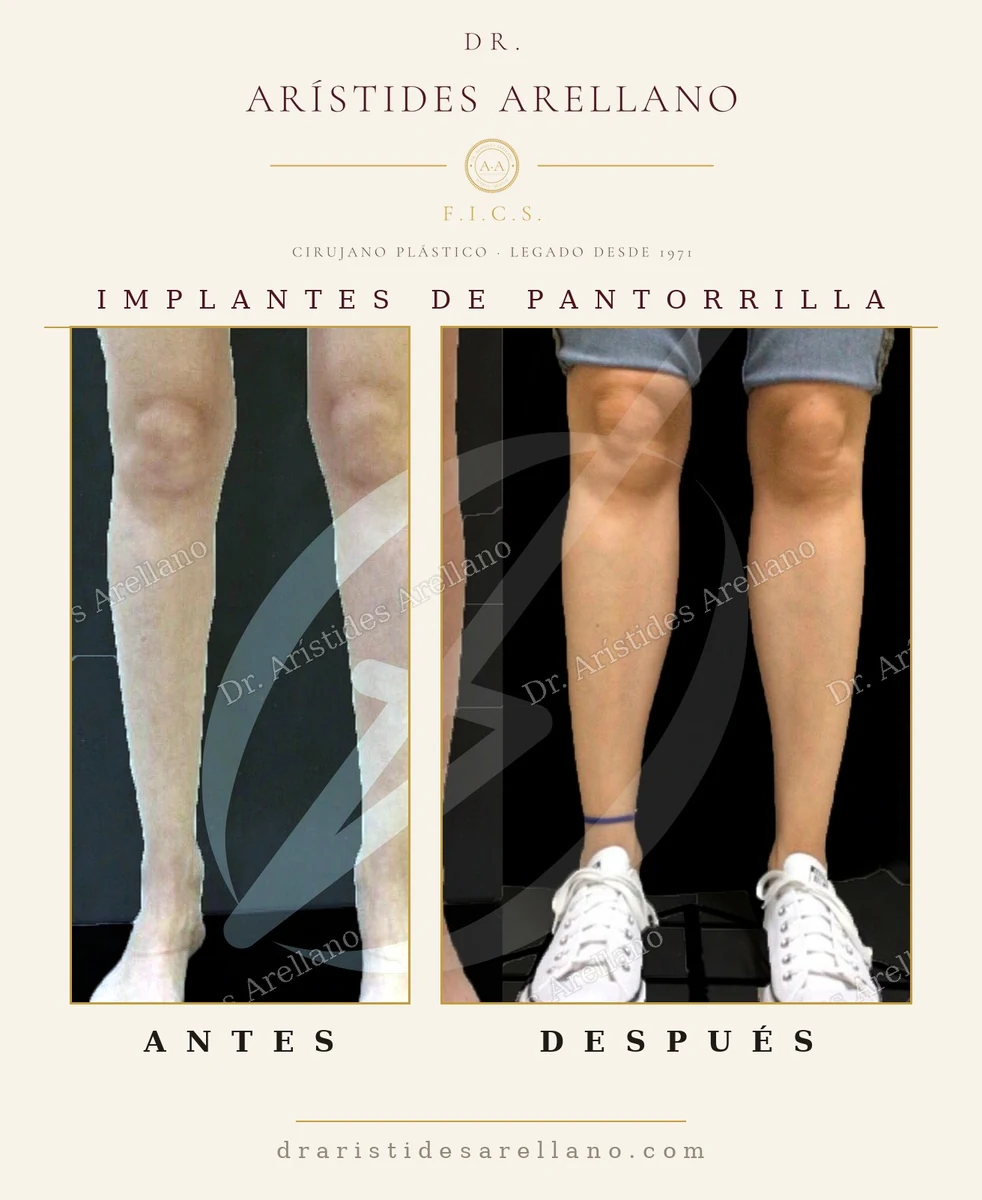
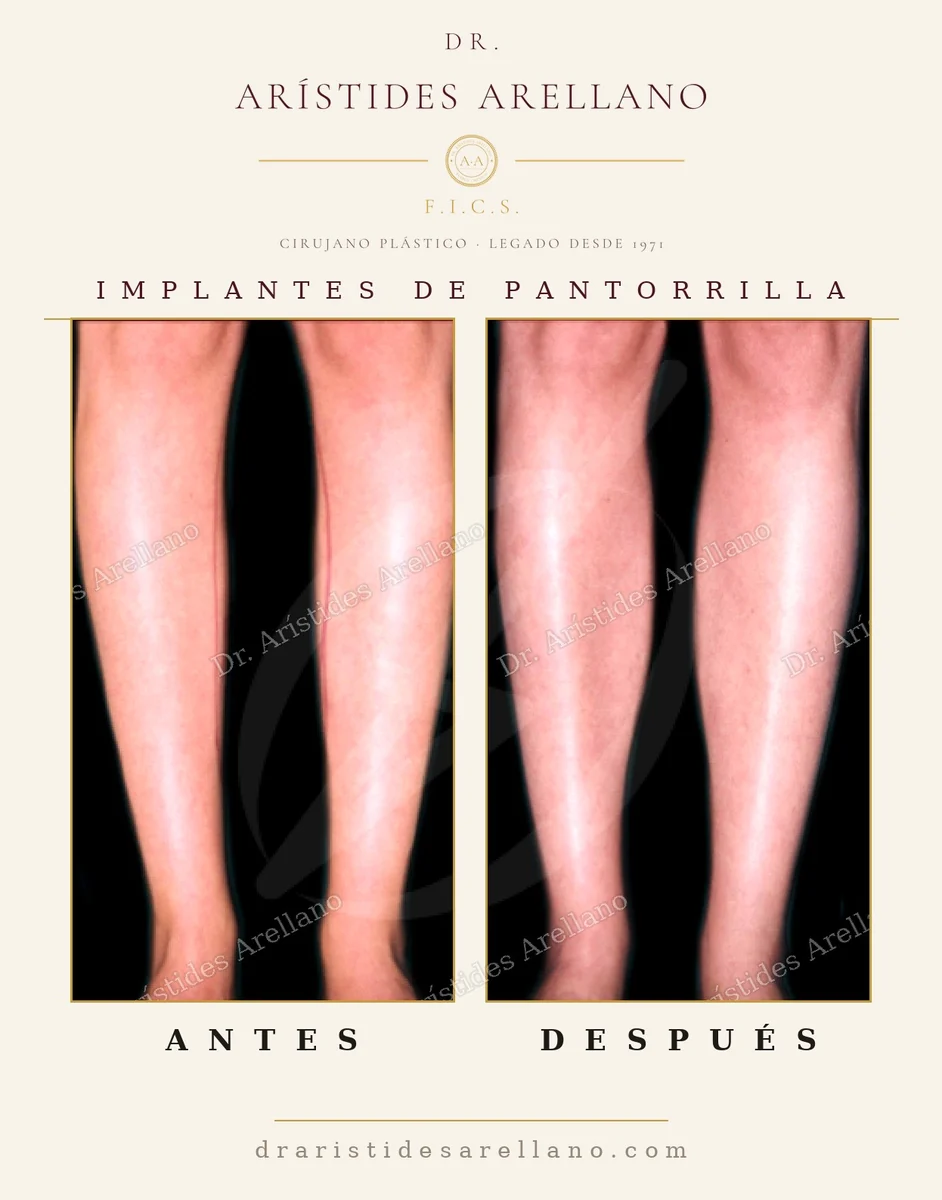
What is a calf implant? It is a solid silicone implant — not gel: it cannot rupture or leak — placed beneath the fascia of the calf muscle through an incision in the crease behind the knee. It corrects thin calves that do not respond to training, and asymmetry from polio or fracture. Walking is uncomfortable for the first few days because the implant sits directly over the muscle you walk with. All surgery carries risks and requires a prior medical assessment; results vary from person to person.
Photographs of real patients, published with their written informed consent. Results may vary from person to person; these images are not a promise of outcome.
Every case is different. Discuss yours in a personal consultation.
Book a consultation on WhatsAppEvery figure published on this site is approximate and is not a quote. Any procedure or treatment first requires a private assessment consultation with Dr. Arístides Arellano —$800 MXN, charged separately— and it is at that consultation that the definitive cost of your case is determined.
Educational content; it does not replace a medical consultation. Results may vary from person to person.