What does otoplasty correct?
Otoplasty corrects prominent ears —those that stand too far from the head—, the absence of the cartilage’s natural fold (the antihelix) and asymmetry between one ear and the other. It also treats a prominent earlobe and, in selected cases, deformities of the outer rim of the auricle.
It is one of the few aesthetic surgeries frequently performed in childhood, for a reason that is not aesthetic but social: teasing at school over protruding ears is a real and frequent reason for consultation. Once the cartilage has essentially reached adult size —around age 6— correction is possible, and doing it before a child accumulates years of discomfort is usually the better decision.
Techniques used by Dr. Arístides Arellano
The incision is made in the retroauricular sulcus —behind the ear— so the scar is hidden in a natural fold and is not visible in practice. From there, the technique is selected according to what each ear lacks:
- Mustardé sutures (antihelix creation): when the natural fold that turns the ear toward the head never formed, it is recreated with permanent sutures that shape the cartilage without cutting it. This is the central manoeuvre of most otoplasties.
- Furnas technique (conchal bowl): when the problem is a conchal bowl that is too deep and pushes the whole ear outward, the conchal cartilage is approximated to the mastoid with sutures, reducing the take-off angle.
- Cartilage-sparing reshaping: shaping and suturing the cartilage is prioritised over resecting it. Over-weakened cartilage produces sharp edges and unnatural results; only what is necessary is removed.
- Earlobe correction: a prominent lobe is addressed in the same operation. It is a detail that, if omitted, gives the surgery away: the ear sits flat above while the lobe still protrudes.
- Asymmetry correction: the two ears are rarely identical. Each is planned separately, seeking symmetry between them and with the rest of the face — not a single mould applied to both.
How is it performed?
In adults and adolescents it is generally performed under local anaesthesia with sedation, as an outpatient procedure; in young children general anaesthesia is usually preferred for comfort and safety. It lasts approximately 1 to 2 hours. The patient goes home the same day with a compression band that protects the cartilage’s new position while it heals.
All surgery carries risk and requires a prior medical assessment. Results may vary according to each patient, their anatomy and their individual healing process.
Who is a good candidate?
- Children from roughly age 6, once the auricle has essentially reached adult size.
- Adolescents and adults, with no age limit, who feel uncomfortable with the projection of their ears.
- Good general health, with no active skin infection in the area.
- In the case of children: that the child himself or herself wants the surgery. This criterion is taken seriously at the assessment.
- Realistic expectations: the goal is a natural-looking ear, not one pinned flat against the skull — that result looks operated.
The band: why it is not optional
The compression band is the most underestimated part of the treatment and the one that ruins the most results. Cartilage has memory: during the first weeks it tends to return to its original position, and the sutures need time for healing to back them up. It is worn continuously for the first days and then only at night for several weeks, as directed. It is the factor under the patient’s control that weighs most on the final result.
Recommended post-surgical treatments
Dr. Arístides may recommend supportive treatment on the retroauricular scar, particularly in patients prone to hypertrophic scarring or keloids — an area with a known predisposition. See the full guide: Post-surgical recovery and care.
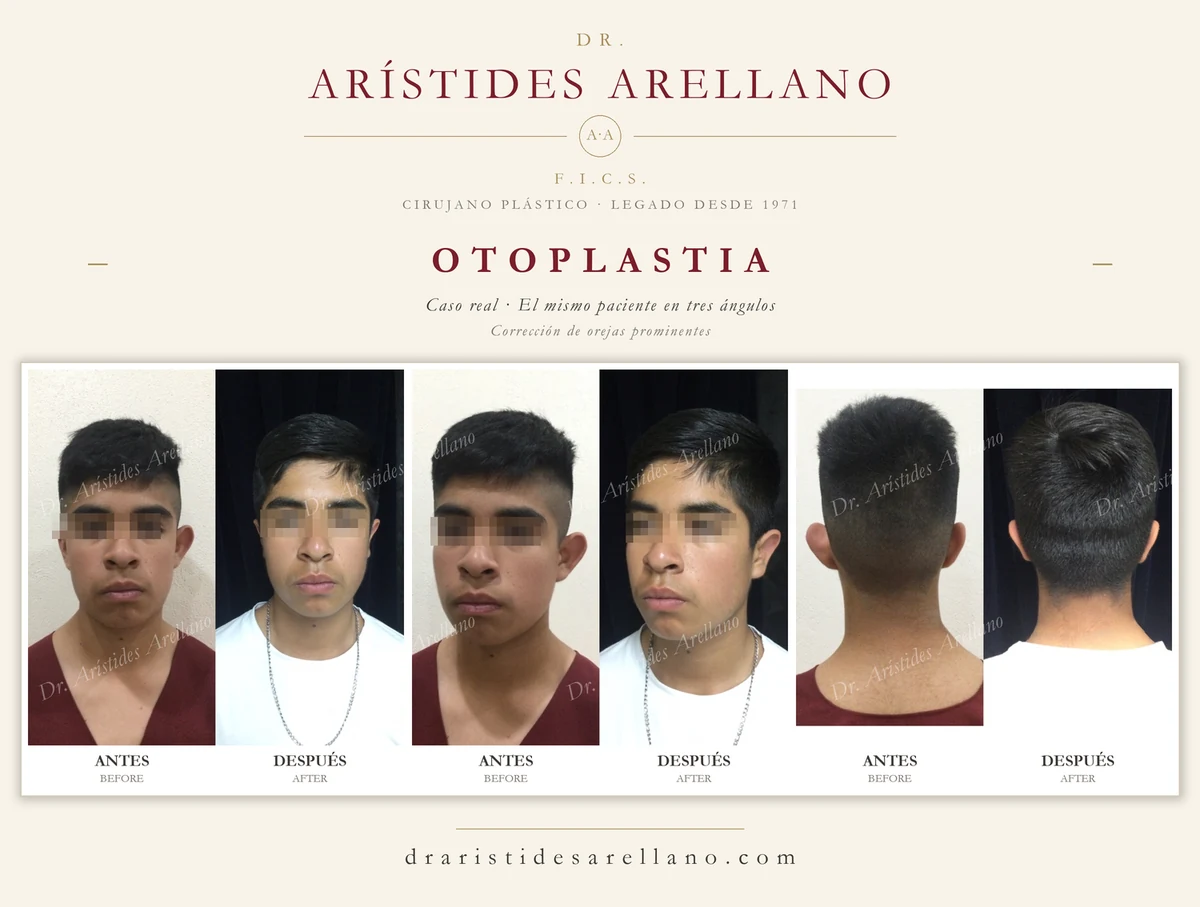
Before and after
The cases below are real patients of Dr. Arístides Arellano, published with their written informed consent. Out of respect for each person’s privacy, only expressly authorised cases are published; at your in-person consultation Dr. Arístides can show you further cases with a starting point similar to yours. Results may vary from patient to patient.
Approximate price
Otoplasty has a reference cost of $40,000 MXN. Approximate price — the definitive cost is set at your private consultation with Dr. Arístides Arellano. The final cost depends on whether one or both ears are treated and on the type of anaesthesia the case requires. All references are in the price list. Full breakdown: how much otoplasty costs in Mexico — the price table, what the figure includes and what it does not.
About Dr. Arístides Arellano
Dr. Arístides Arellano is a plastic surgeon holding a specialty licence: he practises under a Mexican medical licence (D.G.P. 1125959) and a specialty licence in Plastic & Reconstructive Surgery (0002008), both issued by the Directorate General of Professions (DGP), which reissued his certificate of professional standing in 2025. His career began before Mexico’s present-day specialty-board system existed: he belongs to the founding generation of plastic surgery in Puebla, the second generation of a surgical tradition started in 1971 by Dr. Francisco Arellano Ocampo. Trust is verified, not promised: both licences are public and anyone can look them up in the DGP’s National Registry of Professionals.
Related patient guide
If you are choosing a surgeon —especially if the surgery is for your child—: How to choose a plastic surgeon in Puebla: the checklist, including how to verify a specialty licence with the DGP.
The CO₂ laser in otoplasty
In otoplasty the surgical CO₂ laser is used for the skin and soft-tissue portion: the retroauricular incision and the dissection. The technique is described in the dermatosurgical literature as CO₂ laser-assisted otoplasty.
CO₂ emits at 10,600 nm, a wavelength that tissue water absorbs almost completely. It therefore cuts in a very thin layer and seals the finest vessels as it goes: it incises and coagulates in the same pass. The practical benefit is a cleaner field in a well-vascularised area, with less bleeding during the procedure.
Important: the cartilage is still reshaped surgically. The laser does not bend or reposition the ear on its own, and there is no such thing as non-surgical laser otoplasty. Dr. Arístides Arellano, plastic surgeon in Puebla, uses the NovaPulse (Lumenis · Luxar) for this part of the procedure and defines the right technique for each ear at the consultation.
Documented training in facial and paediatric plastic surgery
Otoplasty is frequently performed on children, and that is a different surgical decision. Dr. Arístides Arellano is accredited before the DGP as a specialist in Plastic & Reconstructive Surgery, and his training includes paediatric plastic surgery:
- International symposium: plastic surgery in childhood — Río de Janeiro, agosto de 1989
- Facial surgery course — Sociedade Brasileira de Cirurgia Plástica · Río de Janeiro
- Course: Applied anatomy for plastic surgery — Sociedade Brasileira de Cirurgia Plástica — Regional do Rio de Janeiro
- Postgraduate diploma in Plastic Surgery (Argentina) — Hospital General de Agudos Dr. Abel Zubizarreta, Municipalidad de Buenos Aires · diciembre de 1989
Trust is verified, not promised. All 210 scanned documents —degree, licences, diplomas, publications and certificates, from 1977 to 2025— are open in Dr. Arístides Arellano’s credential archive, alongside an explanation of the difference between a specialty licence and a board certification.
Recovery · step by step
- Days 1–5Continuous protective band; mild discomfort.
- Weeks 1–2Return to school or work; nighttime band.
- Weeks 3–4Return to sport avoiding contact.
- Months 1–3The result stabilizes.
Risks and contraindications
Otoplasty is cartilage surgery, and cartilage has rules of its own: elastic memory, a tendency to recur, and little tolerance for infection. Its risks:
- Auricular hematoma: the emergency of the immediate post-operative period. Increasing pain or pressure under the dressing requires same-day review, because an undrained hematoma damages the cartilage permanently.
- Infection and chondritis: cartilage infection is uncommon but serious; the dressing and post-operative care exist to prevent it, and it is treated immediately if it appears.
- Recurrence: cartilage memory can undo part of the correction, especially in the upper third of the ear; some cases need a touch-up.
- Overcorrection: ears pinned too close to the head or with artificial-looking contours; the surgical goal is a normal-looking ear, not a flat one.
- Residual asymmetry: the two ears were not identical before surgery and will not be identical after; the goal is harmony, not absolute symmetry.
- Keloid or hypertrophic scarring: the area behind the ear is prone to it in predisposed skins; it is watched for and treated early.
- Suture extrusion: the stitches shaping the cartilage can become palpable or surface over time and need office removal.
- Sensory changes: temporary numbness of the ear, usually resolving over weeks to months.
Otoplasty is postponed or reconsidered in these situations:
- Active infection of the ear or the surrounding skin: it is treated first.
- A strong keloid tendency: not always a contraindication, but it requires discussing the scar-management plan before operating.
- In children, before age 5 to 6: surgery waits until the cartilage is developed enough and the child can cooperate with aftercare.
- Expecting perfect symmetry: the operation corrects projection; it cannot make identical two ears that never were.
Frequently asked questions
How much does otoplasty cost in Puebla?
The reference price is approximately $40,000 MXN. The exact amount depends on whether one or both ears are treated and on the type of anaesthesia required, and is confirmed at your in-person consultation.
At what age can a child have ear surgery?
From roughly age 6, once the auricle has essentially reached adult size. Operating before or during the school years usually spares the child years of discomfort. It is also performed in adolescents and adults, with no age limit.
Does otoplasty leave a visible scar?
The incision is made in the fold behind the ear, so the scar is hidden in a natural crease and is not visible from the front in practice. Like any scar, it matures over time.
Can the ears protrude again after surgery?
Cartilage has memory and during the first weeks tends to return to its original position, so the compression band is not optional: it protects the result while healing backs up the sutures. With the instructions followed, the technique aims for a stable result. Results may vary.
What are Mustardé sutures?
They are permanent sutures that recreate the antihelix —the natural fold that turns the ear toward the head— when it never formed, shaping the cartilage without cutting it. It is the central manoeuvre of most otoplasties.
Are both ears operated on, or only one?
It depends on the case. Many patients have one ear more prominent than the other, and both are frequently addressed to achieve symmetry, even when one appears "normal". This is defined at the assessment.
Is otoplasty painful?
Discomfort is mild and controlled with standard analgesia. Recovery is among the quickest in plastic surgery: most patients return to school or work between days 5 and 7.
Does otoplasty improve hearing?
No. It is surgery of the external auricle —the visible part of the ear— and does not involve the middle or inner ear, so it does not change hearing.
Is there non-surgical laser otoplasty?
No. The CO₂ laser can be used for the incision and the soft-tissue work, but correcting a prominent ear requires reshaping or fixing the cartilage, and that is surgery. Be wary of any offer of ears corrected with a laser and no operating room.
Before and after
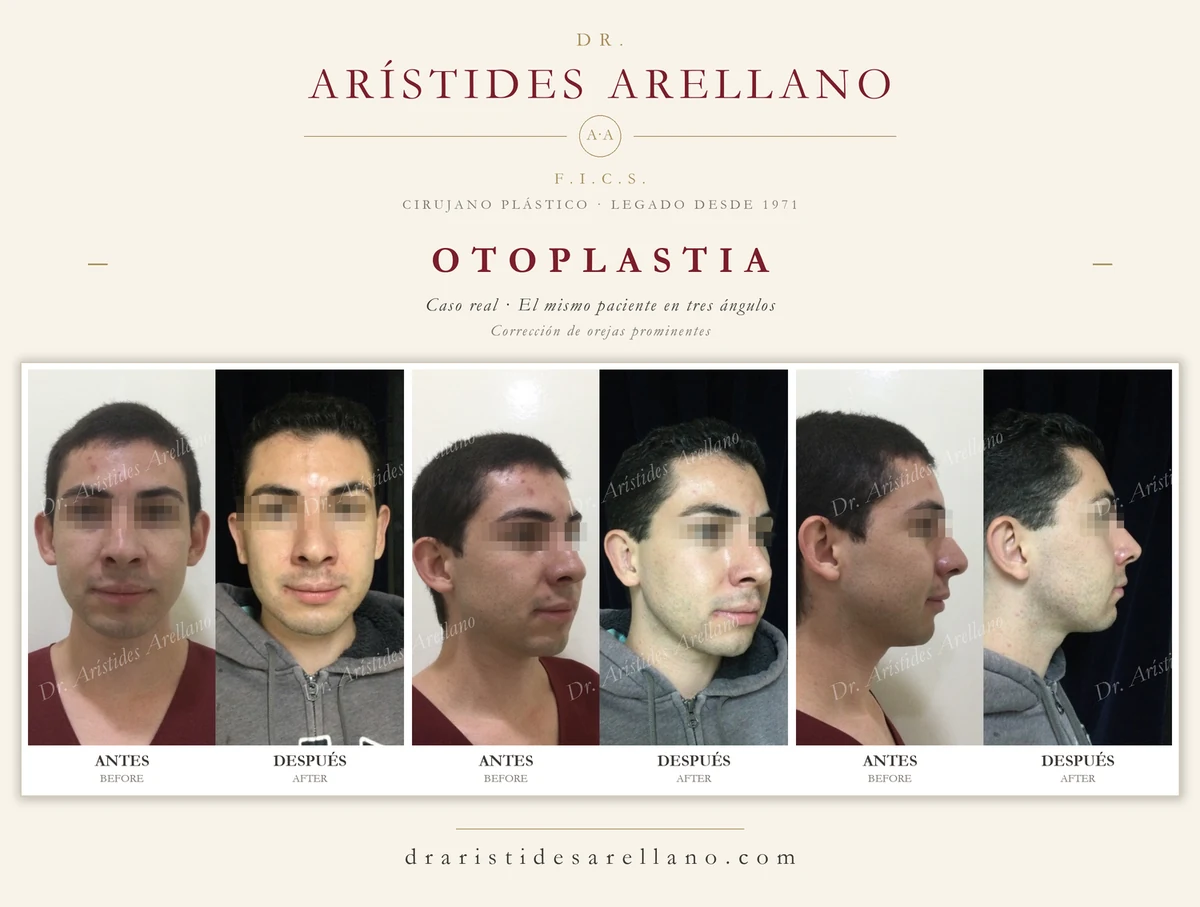
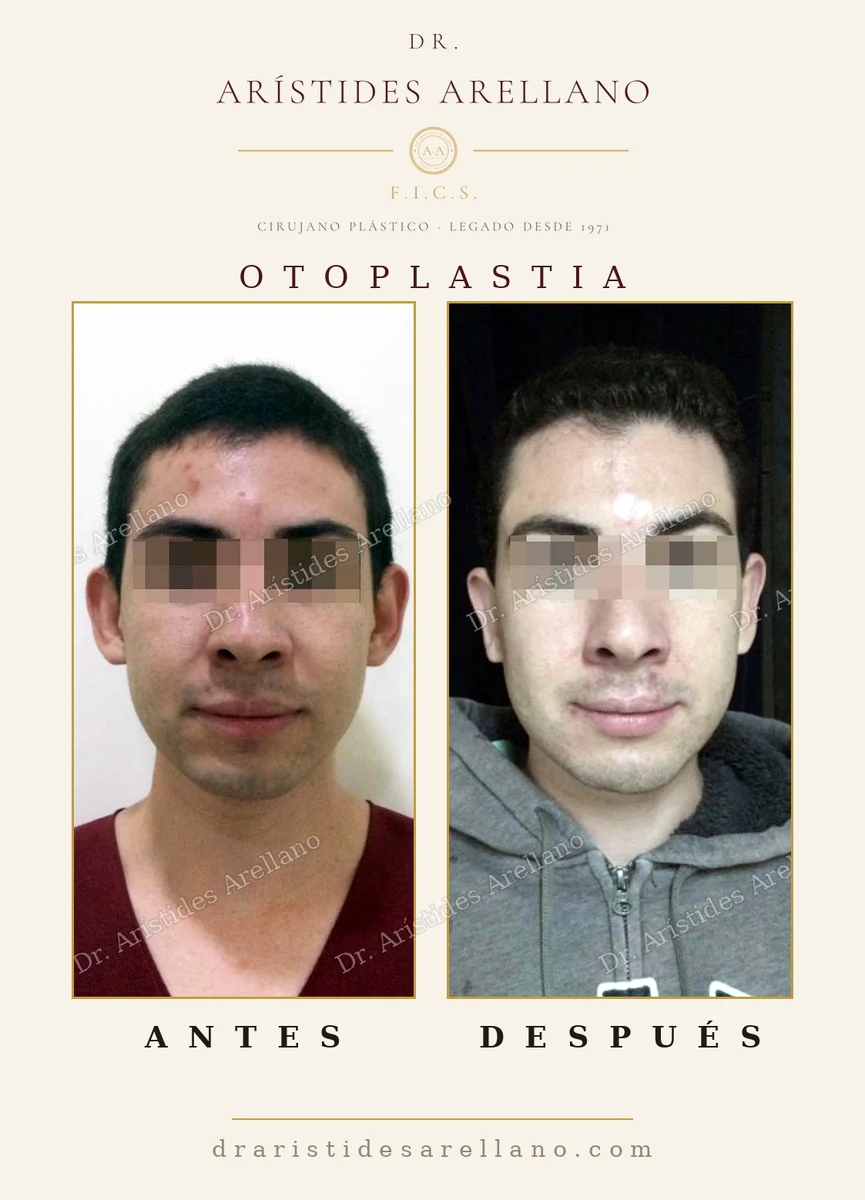
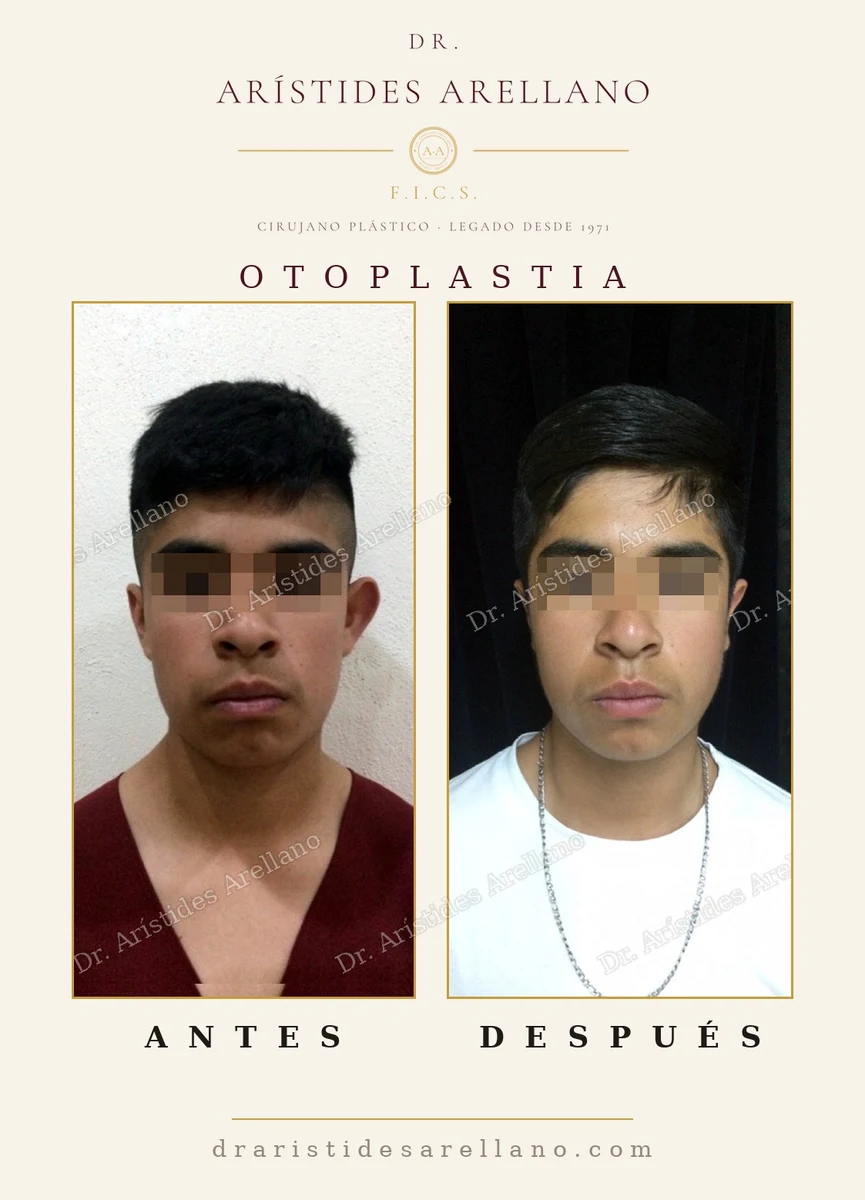
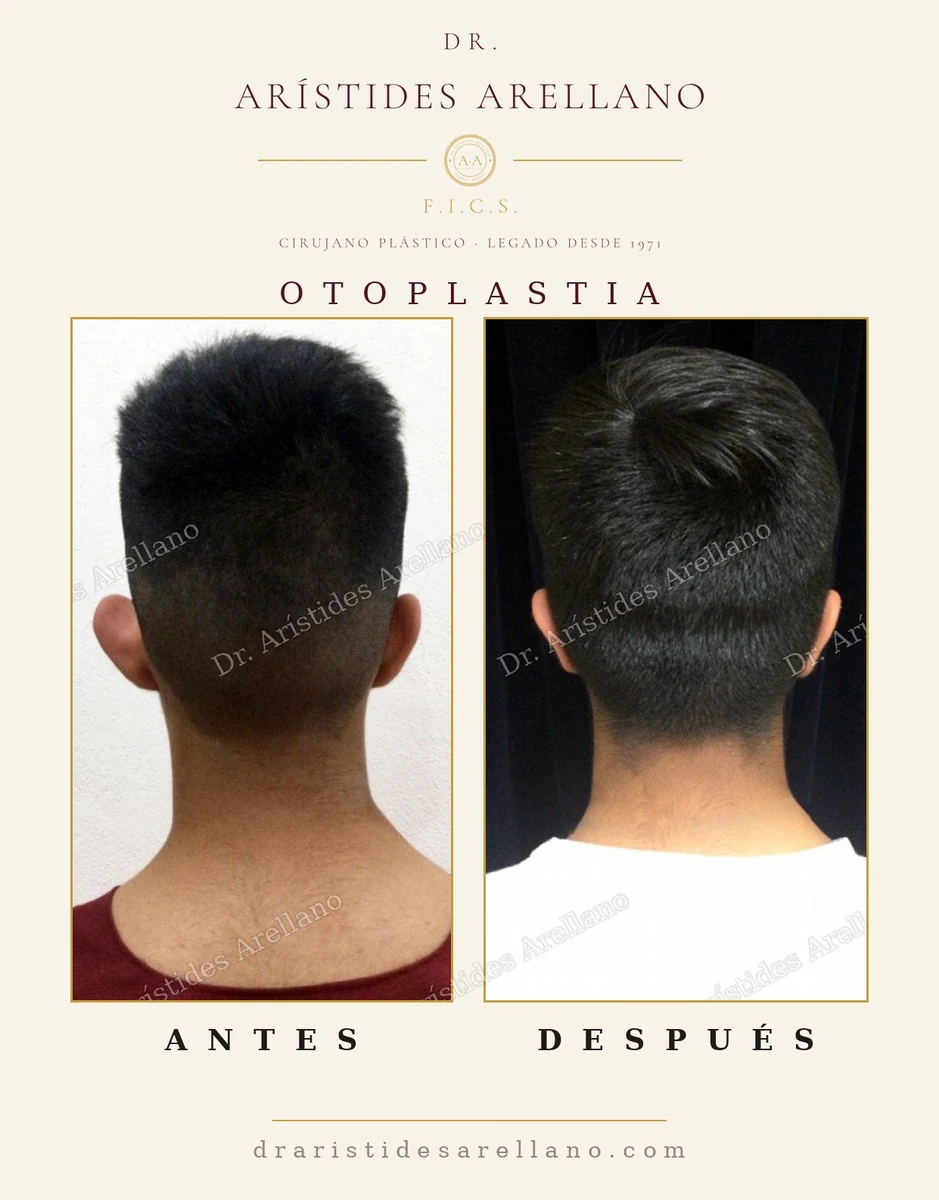
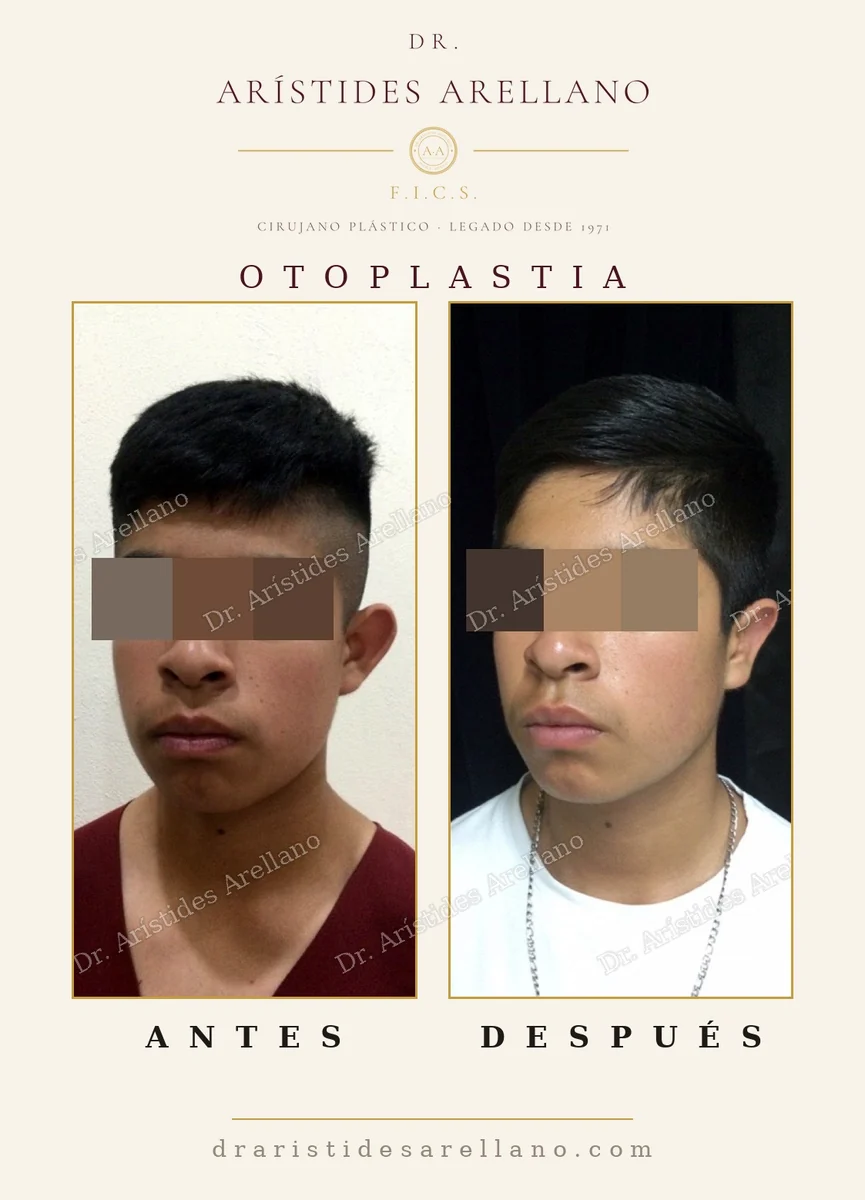
What are prominent ears and at what age are they operated? They stand away from the head because the antihelical fold is missing or the concha is too large. The ear reaches nearly adult size by age 5 or 6, so surgery is possible from then — and it is best done before primary school, where the teasing starts. Adults are operated the same way, under local anaesthetic. All surgery carries risks and requires a prior medical assessment; results vary from person to person.
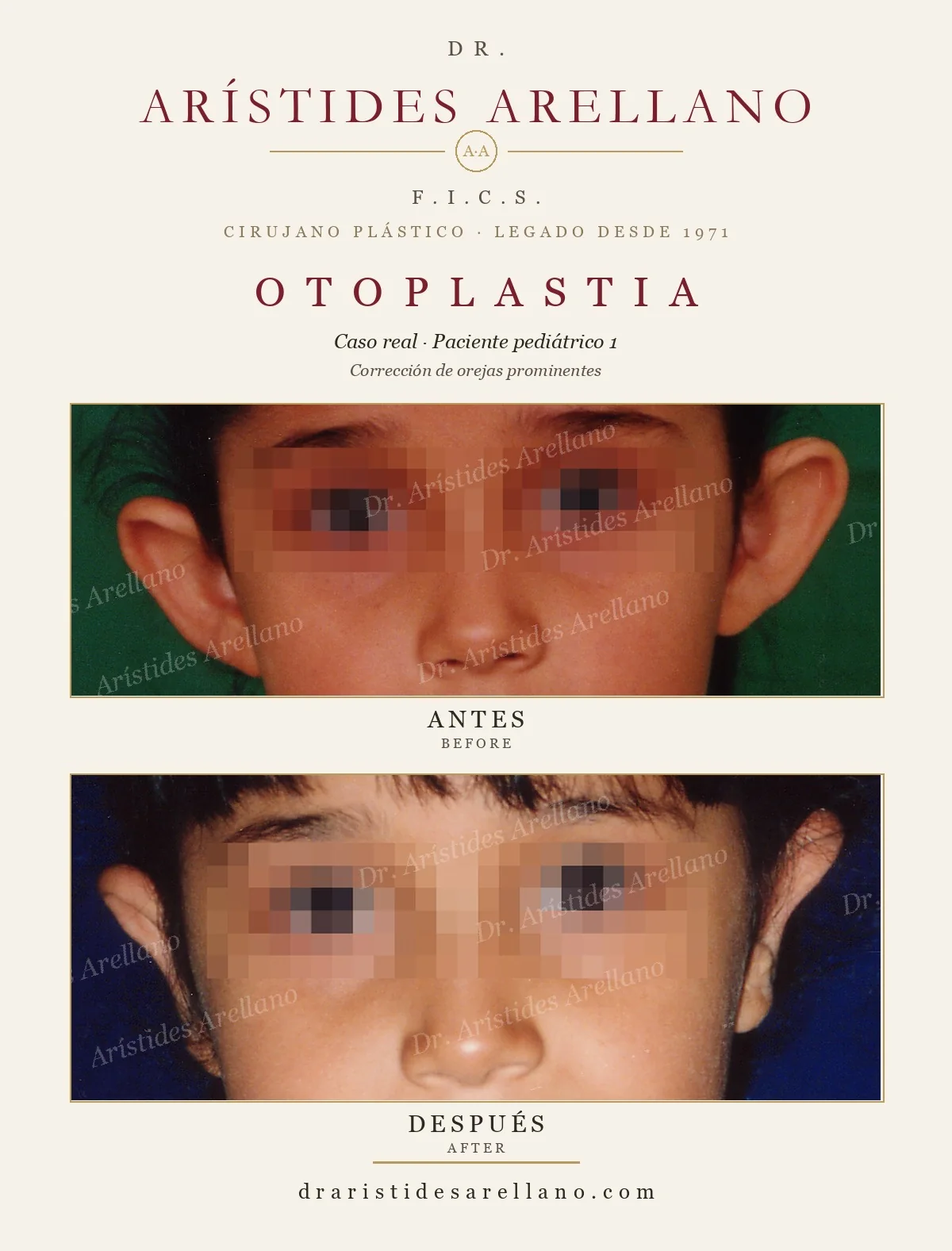
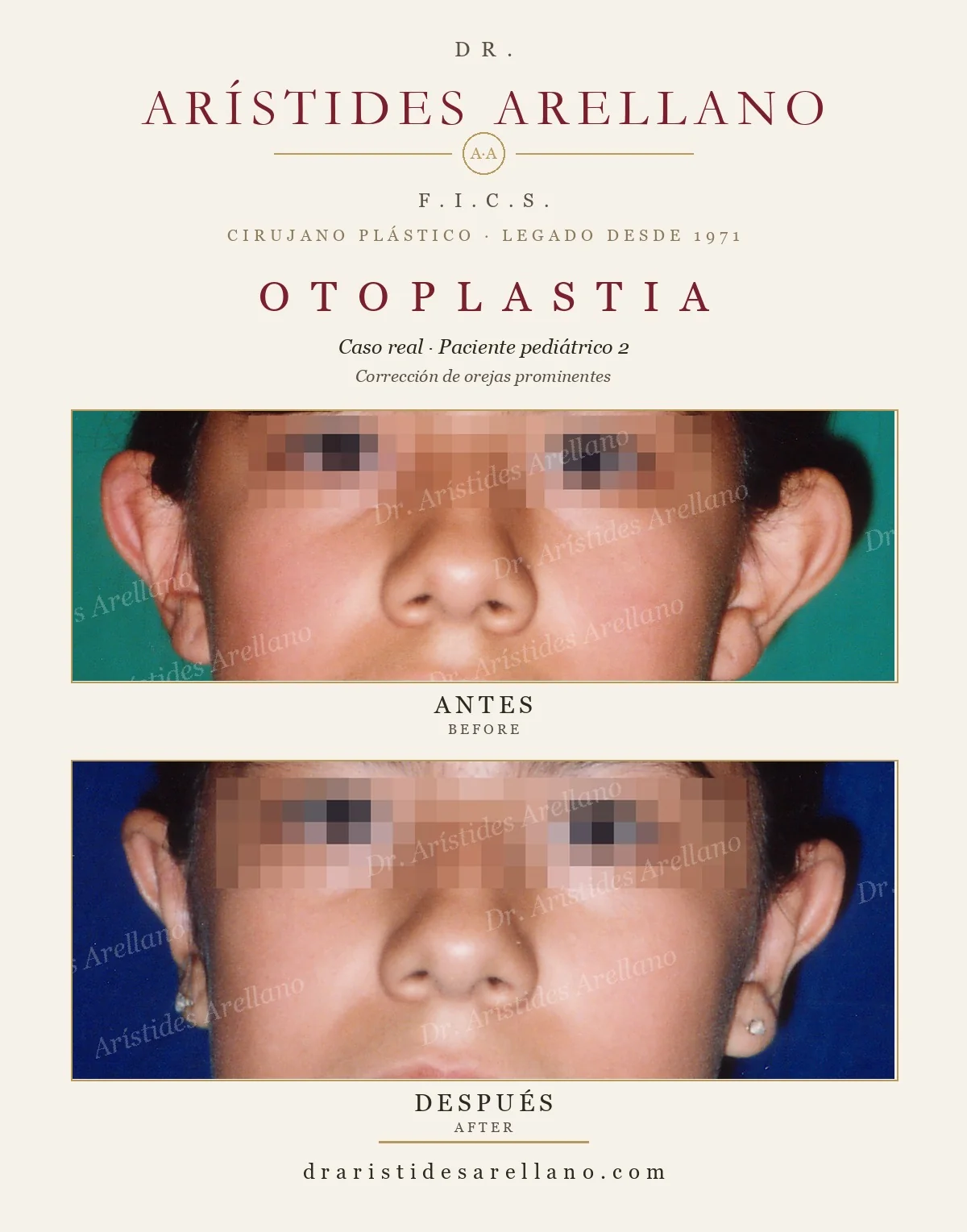
Photographs of real patients, published with their written informed consent. Results may vary from person to person; these images are not a promise of outcome.
Every case is different. Discuss yours in a personal consultation.
Book a consultation on WhatsAppEvery figure published on this site is approximate and is not a quote. Any procedure or treatment first requires a private assessment consultation with Dr. Arístides Arellano —$800 MXN, charged separately— and it is at that consultation that the definitive cost of your case is determined.
Educational content; it does not replace a medical consultation. Results may vary from person to person.