
First: acne is not dirt
This needs dismantling before anything else, because the opposite belief does real harm: acne does not appear because you fail to wash your face, and washing more — or harder — makes it worse. Scrubbing, over-exfoliating and using harsh products irritate the skin, increase inflammation and multiply lesions.
What actually happens inside the follicle is four things at once: more oil (sebum) is produced under hormonal stimulus; the pore becomes plugged because its lining cells fail to shed properly; a bacterium that normally lives on skin proliferates in that environment; and the immune system answers with inflammation. The red, painful pimple is the end of that chain, not the beginning.
That is why effective treatment acts on all four mechanisms — not on the surface of the skin.
Grades: not all acne is the same problem
The grade determines the treatment, the timeline and — above all — the risk of permanent scarring:
- Comedonal: blackheads and whiteheads, without significant inflammation. Low scarring risk.
- Papulopustular (mild to moderate): red, inflamed lesions with or without pus. Intermediate risk.
- Nodular / cystic (severe): deep, painful lesions persisting for weeks. High risk of permanent scarring — and here, time genuinely matters.
- Adult acne, especially in women, favouring the jawline and chin, frequently with a hormonal component. It is not "acne that never left": it is investigated and treated differently.
The only real urgency in acne
A pimple resolves in days. A scar never resolves — it is only partially improved, with procedures costing far more than treating the acne on time would have.
Deep inflammatory acne destroys dermis. Every nodule that sits under the skin for weeks is leaving a depression that will later need subcision, excision or laser. Put uncomfortably: every month of untreated nodular acne is a scar being written into the face.
That is the entire argument against waiting. It is not cosmetic: it is preventing structural damage that cannot be undone. It is also why severe acne in a teenager should not be "left to pass" until puberty ends. If the scars are already there, they are treated — see acne scars.
How is acne treated? The staircase
Treatment is matched to grade, skin type, age and — in women — hormonal profile. It is always medical and by prescription; nothing below is a product to select on your own:
- Topical therapy: topical retinoids (which normalise pore plugging), benzoyl peroxide (which addresses the bacterium) and topical antibiotics. This is the foundation of nearly all mild and moderate cases.
- Oral therapy: oral antibiotics in defined courses for the inflammatory component; hormonal therapy where the pattern indicates it, in women and after assessment.
- Oral isotretinoin: the treatment for severe nodular acne and for acne that does not respond. It is effective and changes the prognosis, but it requires prescription, monitoring bloodwork and medical supervision, and is contraindicated in pregnancy. It is not a treatment to take "because it worked for a friend".
- Adjuncts: phototherapy and superficial chemical peels, which accompany medical treatment. They never replace it.
What does NOT treat acne (and actively makes it worse)
This section will save you money:
- Aggressive "facials" and badly done extractions. Squeezing an inflamed lesion drives its contents deeper, increases inflammation, and is one of the most efficient ways to turn a pimple into a scar. Active inflammatory acne is not squeezed: it is treated.
- Constant exfoliation and products "to dry the pimple out". They irritate, damage the skin barrier and usually worsen the picture.
- Laser on active acne. Laser treats sequelae: scars, texture, residual redness. It is not a treatment for active acne, and applying it to inflamed skin is counterproductive. If a clinic offers you a laser package to "get rid of acne", it is selling you the wrong tool at the wrong moment.
- Unsupported supplements and remedies. On diet, the evidence is limited and highly individual; no single food "causes" acne, and no diet cures it.
Marks, scars and acne: three different things
When acne settles, what remains falls into three categories, and confusing them is expensive: a red or brown mark is colour and fades on its own with time and photoprotection (see melasma & pigmentation); a scar is a change in contour and does not fade (see acne scars); and active acne is the disease itself, which must be switched off first.
The order never changes: control the acne → stabilise the skin → treat the sequelae.
Where it is treated — and who does what
Precision is worth insisting on here, because in medicine precision is part of seriousness.
The medical control of acne — prescribing, follow-up, isotretinoin — belongs to the dermatology consultation at the Clínica Dermatológica y Cirugía Estética de Puebla, founded in 1971 by Dr. Francisco Arellano Ocampo: it is, literally, the specialty this house was born from. See Dermatology.
The treatment of the sequelae — scars, subcision, excision, resurfacing — belongs to the plastic surgeon. That is where Dr. Arístides Arellano works, holding the specialty licence in Plastic & Reconstructive Surgery.
Both halves, under one roof, for more than half a century. That continuity is what spares a patient from having to choose between getting their acne controlled and getting fixed what the acne left behind.
Dr. Arístides Arellano is a plastic surgeon holding a specialty licence: he practises under a Mexican medical licence (D.G.P. 1125959) and a specialty licence in Plastic & Reconstructive Surgery (0002008), both issued by the Directorate General of Professions (DGP), which reissued his certificate of professional standing in 2025. His career began before Mexico’s present-day specialty-board system existed: he belongs to the founding generation of plastic surgery in Puebla, the second generation of a surgical tradition started in 1971 by Dr. Francisco Arellano Ocampo. Trust is verified, not promised: both licences are public and anyone can look them up in the DGP’s National Registry of Professionals.
Before-and-after photographs
Most patients want to see before-and-after photographs before deciding. Out of respect for each person’s privacy, Dr. Arístides Arellano shows real cases —always with documented consent— during your in-person consultation, where you can review results from patients with a starting point similar to yours. Results may vary from patient to patient.
Risks and expectations
Every medical treatment —topicals, peels and energy-based devices included— carries risk and requires a prior assessment. In darker skin (Fitzpatrick IV–VI, the most common phototypes in Mexico) a poorly indicated procedure can darken the patch instead of lightening it. Results may vary according to each patient, their phototype and their individual triggers.
What does acne treatment cost?
A session starts at $400 MXN and the course of 12 sessions at $4,000 MXN, approximate figures depending on the area treated and how many sessions your response calls for. Approximate price — the definitive cost is set at your private consultation with Dr. Arístides Arellano.
Trust is verified, not promised. All 210 scanned documents —degree, licences, diplomas, publications and certificates, from 1977 to 2025— are open in Dr. Arístides Arellano’s credential archive, alongside an explanation of the difference between a specialty licence and a board certification.
Treatment plan · what to expect month by month
- Weeks 1–4It is normal for the skin to become irritated and to appear to worsen at the start of topical therapy. This is not an allergy and not a failure: it is the adjustment phase. Quitting here is the commonest mistake.
- Months 2–3Real improvement begins: fewer new lesions, less inflammation. The regimen is adjusted or escalated if the response is insufficient.
- Months 3–6The condition is controlled in most cases. This is when we assess which marks will fade on their own and which scars remain to be treated later.
- MaintenanceAcne is recurrent: when everything is stopped, many cases return. Topical maintenance is what holds clear skin over the long term.
- If the case is severeOral treatments have their own timeline, monitoring bloodwork and medical supervision. They are explained in full before they are started.
Frequently asked questions
Is acne curable?
Acne is controlled very effectively, and in many cases enters prolonged remission. But it is a recurrent condition: when all treatment stops, a proportion of cases return. That is why maintenance therapy exists. Results may vary.
Do chocolate and fatty foods cause acne?
Not in the way the myth claims. Evidence on diet is limited and highly individual: no single food causes acne, and no diet cures it. Acne is an inflammatory disease with a hormonal basis, not a consequence of what you had for dinner.
Do facials help?
Extractions on inflamed lesions usually make things worse: squeezing a pimple drives its contents deeper, increases inflammation and is a direct route to scarring. Active acne is treated medically, not squeezed. Inflammatory acne is not a cleanliness problem.
Does laser get rid of acne?
No. Laser treats the sequelae of acne — scars, texture, residual redness — not active acne, and applying it to inflamed skin is counterproductive. If you are offered a laser package to "get rid of acne", it is the wrong tool at the wrong moment.
How long before I see improvement?
Skin often becomes irritated and may even look worse during the first weeks of topical therapy; real improvement appears around the second or third month, and control of the condition between the third and sixth. Quitting during the first phase is the most frequent mistake.
I have severe acne. Should I wait for it to pass with age?
No. Deep nodular acne destroys dermis while it is active: every untreated month is permanent scarring being formed. Waiting is not a neutral option — it is the expensive one, because afterwards you have to surgically correct what could have been prevented.
Who treats acne at the clinic?
Medical control of acne belongs to the dermatology consultation at the Clínica Dermatológica y Cirugía Estética de Puebla — the specialty the clinic was founded on in 1971. Dr. Arístides Arellano, a plastic surgeon, treats the sequelae: scars, subcision, excision and resurfacing. Both, under one roof.
The equipment used
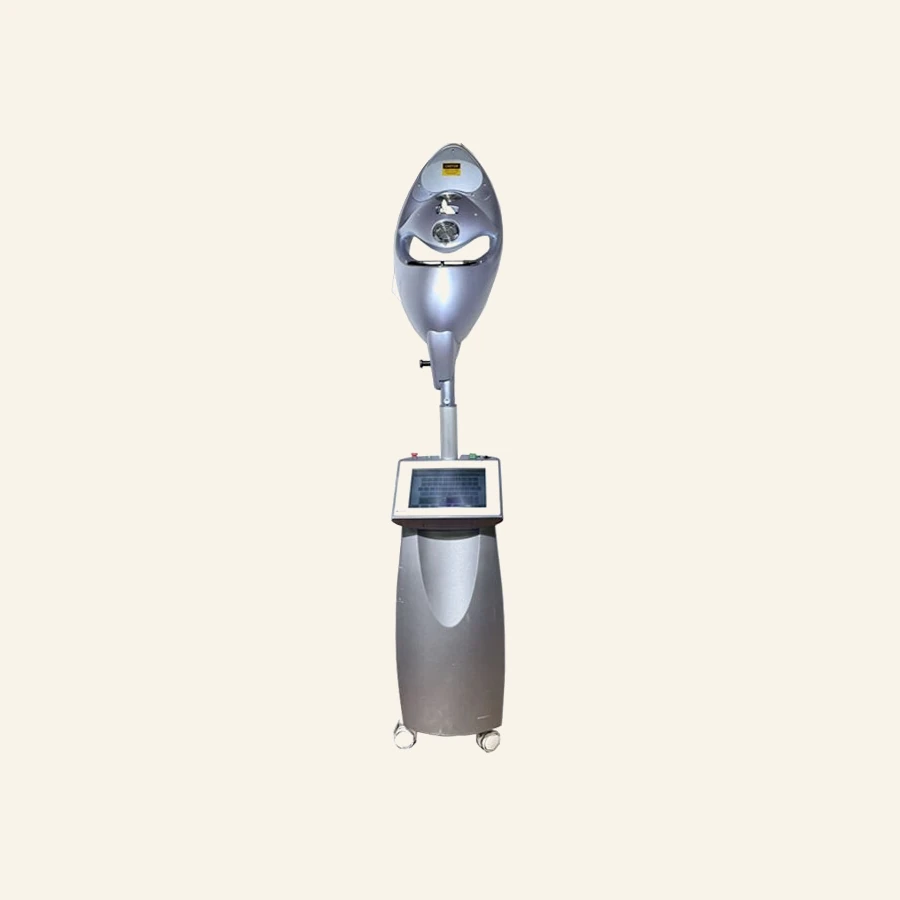
Every case is different. Discuss yours in a personal consultation.
Book a consultation on WhatsAppEvery figure published on this site is approximate and is not a quote. Any procedure or treatment first requires a private assessment consultation with Dr. Arístides Arellano —$800 MXN, charged separately— and it is at that consultation that the definitive cost of your case is determined.
Educational content; it does not replace a medical consultation. Results may vary from person to person.