
What is blepharoplasty?
It is the surgery that corrects excess skin, laxity and/or fat pads on the upper eyelids, lower eyelids, or both. It can be aesthetic (refreshing the gaze, softening a tired appearance) or functional (when excess upper-lid skin obstructs the visual field), and both goals can be addressed in the same operation when warranted.
Under-eye bags, droopy or puffy eyelids? When it is surgery
Most people do not arrive searching for the word «blepharoplasty» — they arrive describing what they see in the mirror: under-eye bags, a droopy eyelid, puffy eyelids in the morning, or a tired look that does not match how they feel. Not all of these are corrected the same way, and not all are surgery:
- Under-eye bags: these are lower-lid fat that herniates forward. No cream dissolves that fat — they are corrected with lower blepharoplasty, removing or repositioning the protruding fat.
- Droopy eyelid (excess skin): the upper-lid fold hangs and gives a heavy, tired appearance. When that excess skin begins to obstruct vision, the correction is no longer only aesthetic and becomes functional.
- Puffy eyelids: a distinction is needed. If the swelling is daily and structural (fat), it is surgical; if it comes and goes with sleep, salt or fluid, the cause is studied first — not every puffy eyelid is surgery.
- Dark circles: honesty matters here. If the dark circle is the shadow cast by a bag, surgery improves it. If it is pigment (dark colour in the skin) or a hollow/tear trough, the scalpel does not correct that — it is treated with laser, filler or depigmenting agents. Your case is defined at the assessment.
Techniques used by Dr. Arístides Arellano
Technique is defined at the assessment, according to which eyelids are treated and the goal:
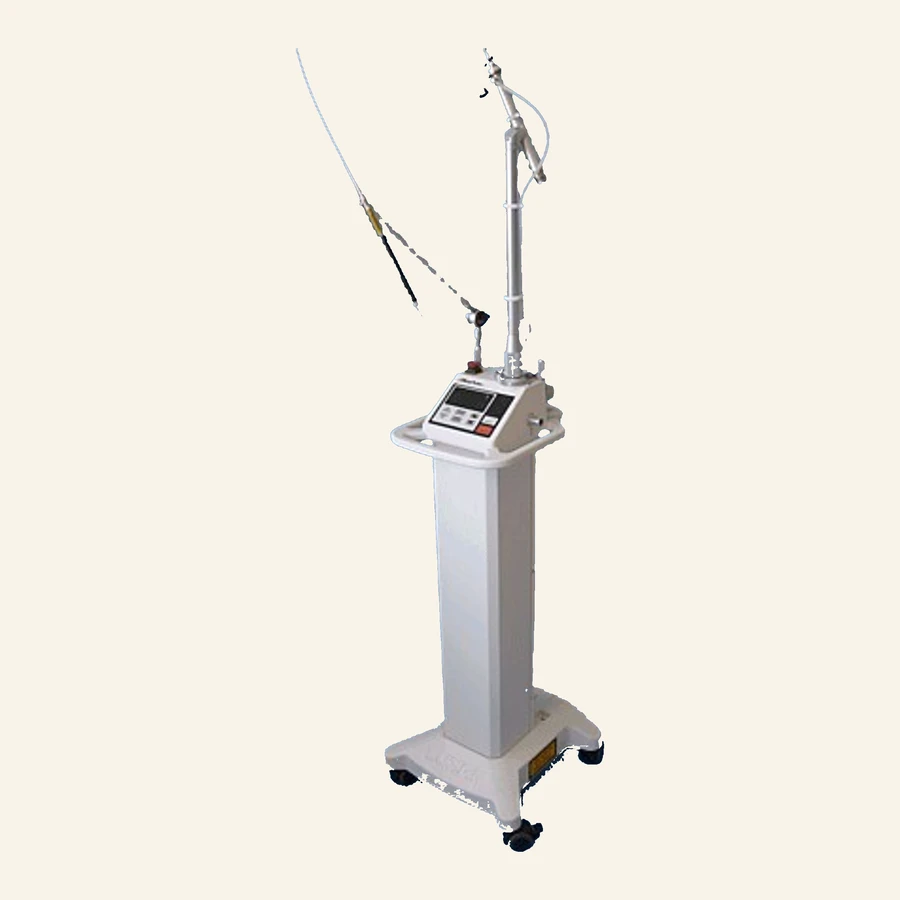
- CO₂ laser blepharoplasty (Lumenis AcuPulse): instead of a cold scalpel, Dr. Arístides uses the CO₂ laser as the cutting tool. The laser seals vessels as it cuts, so there is less bleeding in theatre and, afterwards, less bruising and swelling than with the traditional technique. Closing with less myofibroblast formation, the scar also tends to contract less.
- Upper blepharoplasty: removes excess skin (and, if needed, some muscle or fat) from the upper lid through an incision hidden in the natural lid crease.
- Lower blepharoplasty: addresses fat pads and/or excess skin of the lower lid, with an incision just below the lash line or, in selected cases, inside the lid (transconjunctival, with no external scar).
- Functional blepharoplasty: when the purpose is to improve a visual field obstructed by a drooping lid, the assessment includes the corresponding documentation.
HD blepharoplasty: the surgery and the skin quality, in one session
There is something eyelid surgery alone does not correct: the texture of the skin around the eye. You can remove the excess skin and the bags and still be left with crepey skin, fine lines and crow’s feet intact. Repositioning is not the same as improving skin quality — they are two different problems.
That is why, when the case warrants it, periocular fractional CO₂ laser resurfacing is applied over the surrounding skin in the same session: the laser vaporises the damaged superficial layers and stimulates new collagen, softening fine lines and refining texture. It is the difference between operated eyelids and a fully rejuvenated gaze — what we call a high-definition result.
The clinic has the CO₂ laser arsenal to do it: the Lumenis AcuPulse (precision surgical-aesthetic CO₂ with SurgiTouch) and the Alma Hybrid for the resurfacing work. The exact combination is defined at your assessment. When there is also mid-face or neck laxity, blepharoplasty is combined with a facelift for a congruent result — a smooth face with drooping eyelids, or the reverse, looks incongruent.
How is it performed?
It is performed under local anaesthesia with sedation, or general anaesthesia depending on the case and whether it is combined with other facial procedures. It lasts approximately 1 to 2 hours when all four eyelids are treated. It is an outpatient procedure: the patient goes home the same day.
All surgery carries risk and requires a prior medical assessment. Results may vary according to each patient, their anatomy and their individual healing process.
Who is a good candidate?
- Excess upper-lid skin producing a tired appearance or, in advanced cases, obstructing part of the visual field.
- Fat pads or laxity of the lower eyelid.
- Good general health and no uncontrolled ocular disease (reviewed at the assessment).
- Realistic expectations about refreshing the gaze, without modifying other facial structures.
Post-surgical care and treatments included
Post-operative follow-up is included in the procedure — you are not charged consultation by consultation. The goal is to make your recovery as fast and comfortable as possible, and the scar as good as possible:
- Facial manual lymphatic drainage: reduces periorbital swelling and bruising faster.
- Hyperbaric chamber (in selected cases): oxygenates the tissues and can speed de-swelling and healing.
- Laser sessions on the scars, once mature, to soften them as much as possible.
- Follow-up visits at no additional cost until discharge.
Note:
See the full guide: Post-surgical recovery and care.
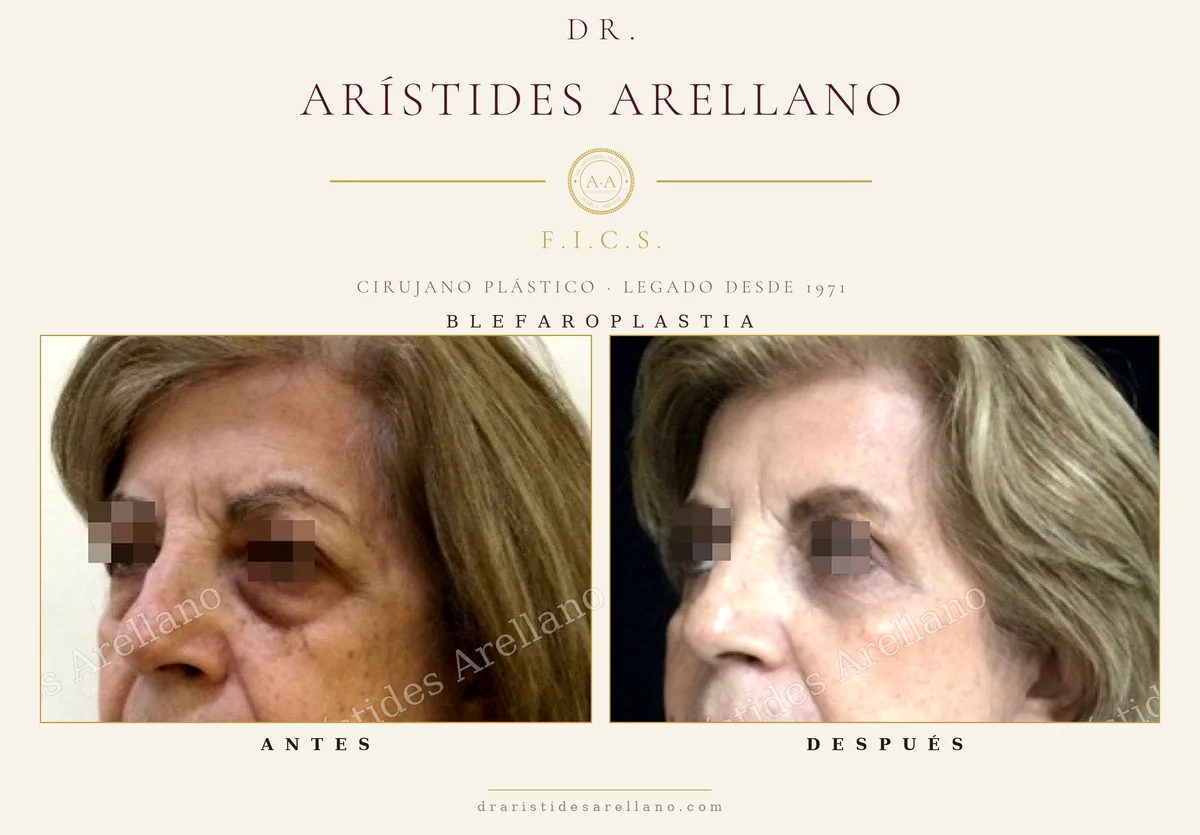
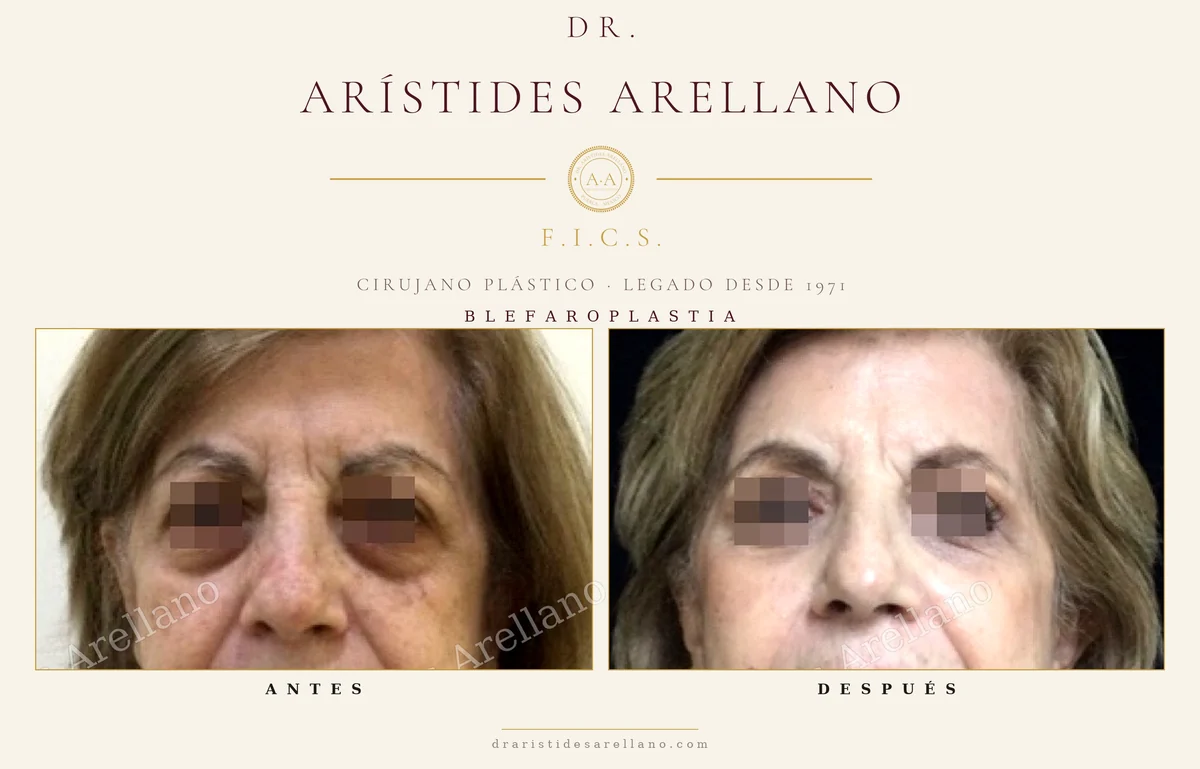
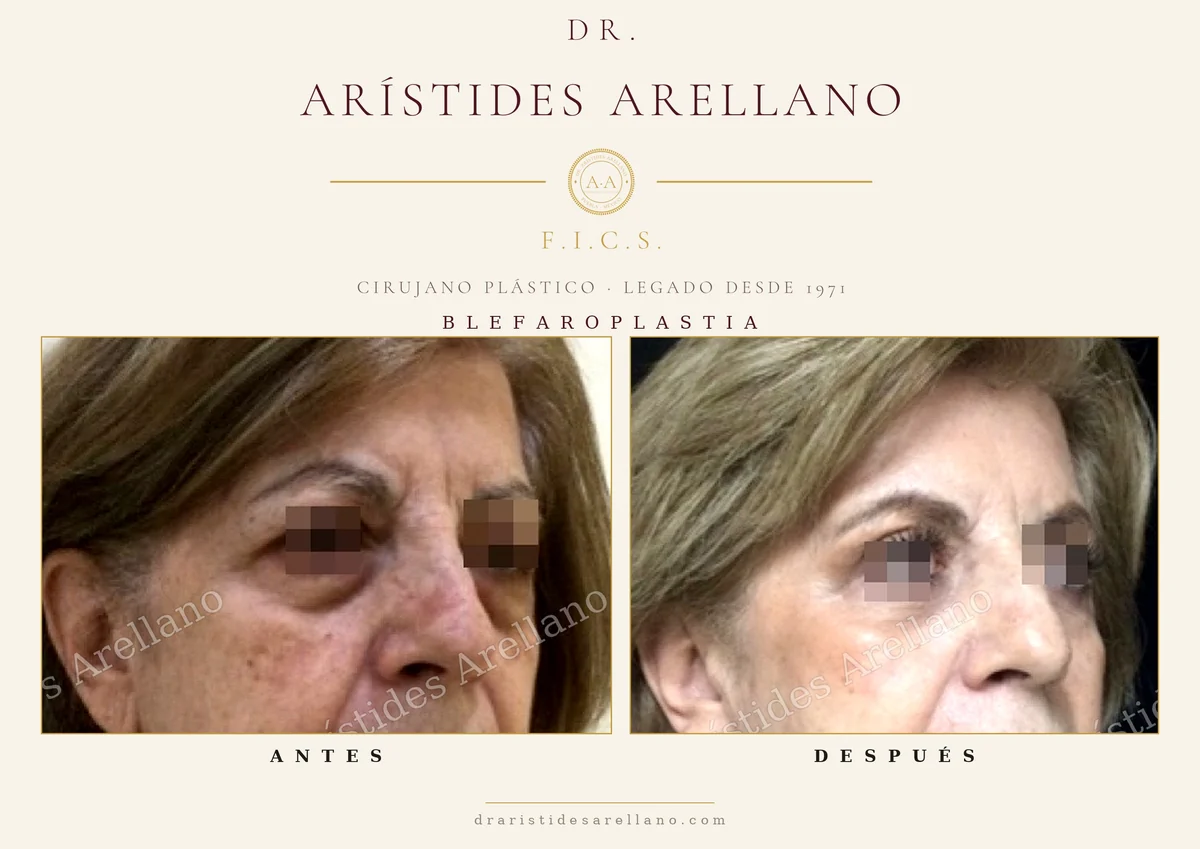
Before and after
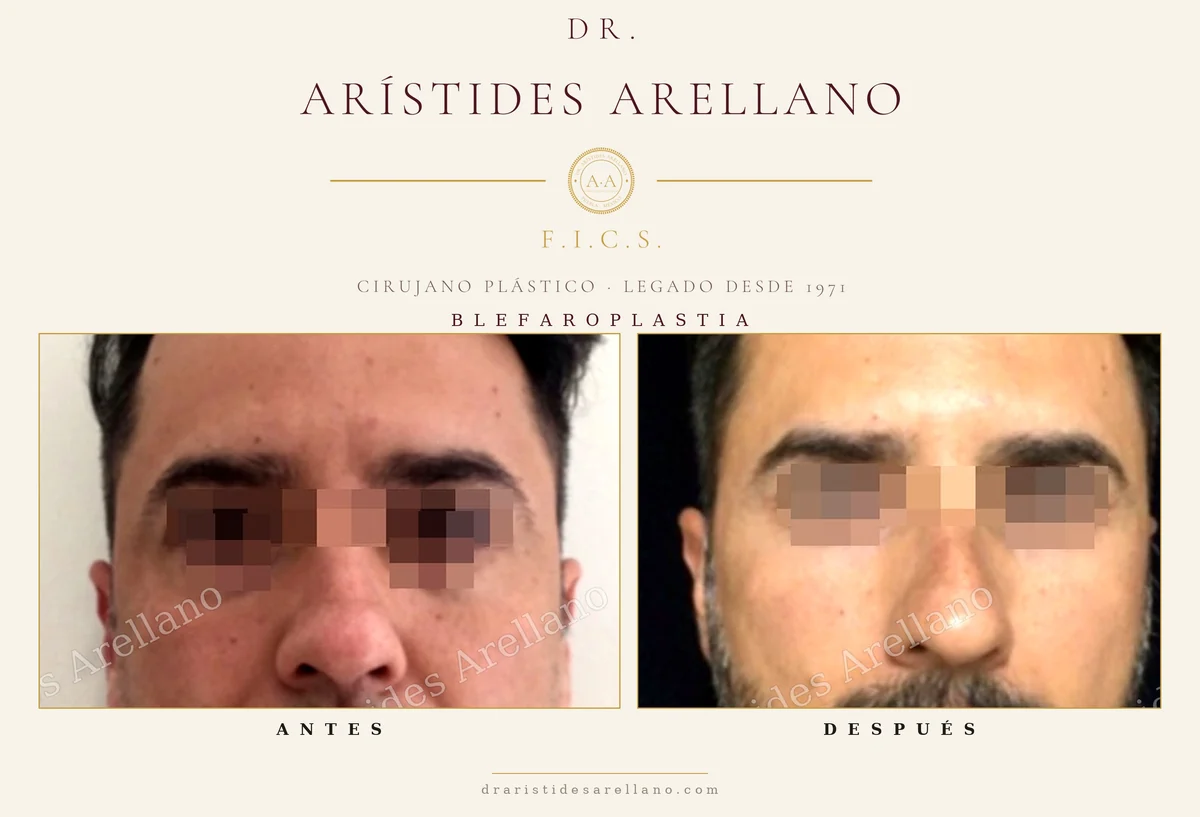
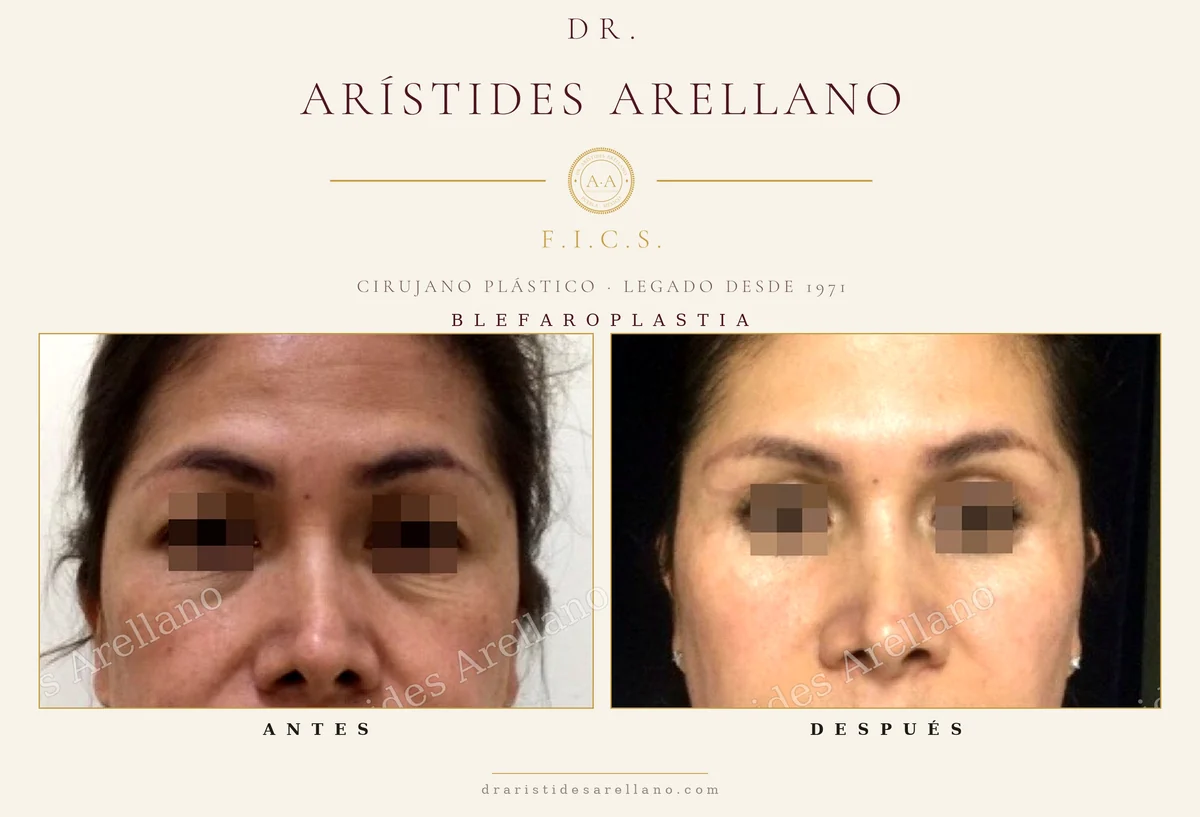
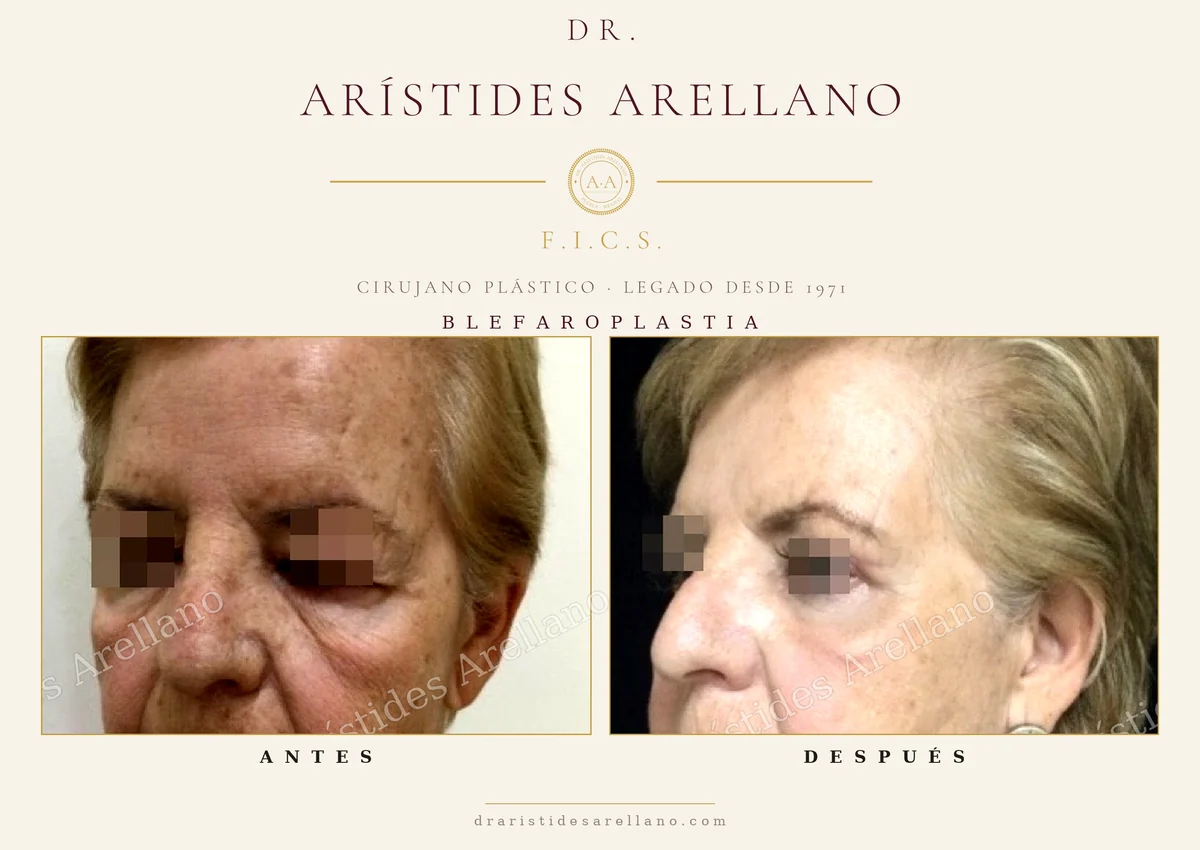
The cases below are real patients of Dr. Arístides Arellano, published with their written informed consent. Out of respect for each person’s privacy, only expressly authorised cases are published; at your in-person consultation Dr. Arístides can show you further cases with a starting point similar to yours. Results may vary from patient to patient.
Approximate price
Blepharoplasty (with CO₂ laser technique) has a reference cost of $40,000 MXN. Approximate price — the definitive cost is set at your private consultation with Dr. Arístides Arellano. The final cost depends on whether only the upper lid, only the lower lid, or all four eyelids are treated, and on whether the purpose is aesthetic, functional or both. Full breakdown: how much blepharoplasty costs in Mexico — the price table, what the figure includes and what it does not.
About Dr. Arístides Arellano
Dr. Arístides Arellano is a plastic surgeon holding a specialty licence: he practises under a Mexican medical licence (D.G.P. 1125959) and a specialty licence in Plastic & Reconstructive Surgery (0002008), both issued by the Directorate General of Professions (DGP), which reissued his certificate of professional standing in 2025. His career began before Mexico’s present-day specialty-board system existed: he belongs to the founding generation of plastic surgery in Puebla, the second generation of a surgical tradition started in 1971 by Dr. Francisco Arellano Ocampo. Trust is verified, not promised: both licences are public and anyone can look them up in the DGP’s National Registry of Professionals.
Related patient guide
To go deeper before or after your consultation: Blepharoplasty: at what age, and how long do results last? — part of the informational guide series reviewed by Dr. Arístides Arellano.
The laser in blepharoplasty: cutting and renewing, two different roles
The eyelid is highly vascular tissue, and that is where the CO₂ laser offers a real advantage. As a scalpel of light (the focused surgical beam) it makes the incision cauterising the vessels as it cuts, so the field stays drier — which tends to mean less bleeding and less bruising. A second, different role is that of fractional CO₂, which can renew the thin skin around the eye (the crow's feet) as a cosmetic complement. Two tools for two goals — to cut and to renew — and not every blepharoplasty needs both.
Blepharoplasty with a surgical CO₂ laser
Yes, blepharoplasty can be performed using a CO₂ laser as the scalpel. In Puebla, Dr. Arístides Arellano works with a NovaPulse (Lumenis · Luxar), a focused-beam surgical CO₂. What changes is how the incision is made — not the surgical plan, and not the result being sought.
CO₂ emits at 10,600 nm, a wavelength that tissue water absorbs almost completely. It therefore cuts in a very thin layer and seals the finest vessels as it goes: it incises and coagulates in the same pass. On an eyelid — thin, highly vascular tissue — that means less bleeding during surgery, a cleaner surgical field and, according to the literature, less bruising and swelling in the first days.
What the laser does NOT do: it does not turn blepharoplasty into a non-surgical procedure, it does not avoid anaesthesia or sutures, and on its own it does not remove eyelid laxity. It remains surgery and requires a prior assessment. It is also not the same device as the fractional AcuPulse, which resurfaces the skin instead of cutting it. Dr. Arístides Arellano, plastic surgeon in Puebla, decides at the consultation which of the two suits your case.
Documented training in eyelid surgery and facial aesthetics
The eyelid is the least forgiving structure of the face: millimetres decide the result. Dr. Arístides Arellano is a specialist in Plastic & Reconstructive Surgery authorised by the DGP since 1990, and his training in facial surgery and aesthetics is documented from his postgraduate years onward:
- Facial surgery course — Sociedade Brasileira de Cirurgia Plástica · Río de Janeiro
- Course: facial aesthetics — XXVI Congresso Brasileiro de Cirurgia Plástica · Blumenau, 1989
- 1st International Facial Plastic Surgery Course: the nose, its function and appearance — U. de Montréal / Canadian Academy of Facial Plastic Surgery / Soc. de Otorrinolaringología del Sureste · Puebla, 18–21 de octubre de 1990
- Postgraduate diploma in Plastic Surgery (Argentina) — Hospital General de Agudos Dr. Abel Zubizarreta, Municipalidad de Buenos Aires · diciembre de 1989
- DGP specialty authorization — AE-002008 — Dirección General de Profesiones (DGP) · México D.F., 27 de marzo de 1990
Trust is verified, not promised. All 210 scanned documents —degree, licences, diplomas, publications and certificates, from 1977 to 2025— are open in Dr. Arístides Arellano’s credential archive, alongside an explanation of the difference between a specialty licence and a board certification.
Dr. Arístides explains it
Informational video by Dr. Arístides Arellano. Every case is different: the details of your procedure are defined at your consultation.
Recovery · step by step
- Days 1–3Swelling and periorbital bruising (more visible than the actual discomfort); rest with head elevated and cold compresses.
- Days 5–7Suture removal where applicable; most bruising begins to fade.
- Week 2Social activity can resume; residual swelling is usually concealable with makeup, once authorised.
- Weeks 3–4Residual swelling resolves and the result is seen more clearly.
Risks and contraindications
Blepharoplasty risks differ from those of other facial surgery because the operative field sits next to the eye. These are the ones reviewed with you at the consultation:
- Hematoma: a collection of blood under the skin. Most are superficial; a retrobulbar hematoma (behind the eye) is exceptional but is an emergency because of the risk to vision, and it is the reason for close monitoring in the first hours.
- Incomplete eyelid closure (lagophthalmos): usually temporary while swelling subsides; if too much skin was removed it can persist and require correction.
- Dry eye: a gritty, burning or dry sensation, more frequent in patients who already had it; managed with lubricants and usually improving over weeks.
- Ectropion or lower-lid retraction: the lid margin pulls away from the eye or sits lower; mild cases improve with massage and time, marked ones require surgical revision.
- Asymmetry: no two eyelids heal identically; a marked difference may require a touch-up.
- Visible scarring: incisions are designed inside the lid crease and under the lash line, but the final quality of the scar depends on each skin.
- Visual disturbances: temporary blurred vision from swelling or ointments; loss of vision is exceptional.
Blepharoplasty is postponed or reconsidered in these situations:
- Severe dry eye or active, uncontrolled eye disease (decompensated glaucoma, conjunctivitis): these are managed with ophthalmology first.
- Active thyroid eye disease: surgery waits until the condition has been stable for some time.
- Uncontrolled hypertension, or anticoagulants that cannot be paused with the prescribing doctor’s authorisation.
- Active smoking, because of its effect on healing.
- Expecting blepharoplasty to correct hollow under-eye circles, crow’s feet or brow position: those changes belong to other procedures, and telling them apart is part of the consultation.
Frequently asked questions
How much does blepharoplasty cost in Puebla?
The reference price is approximately $40,000 MXN. The final cost depends on how many eyelids are treated and whether the goal is aesthetic, functional or mixed; it is confirmed at your in-person consultation.
What is CO₂ laser blepharoplasty?
It is the technique in which a carbon-dioxide laser is used as a cutting and coagulating tool during eyelid surgery. It can support more controlled bleeding in theatre and contribute to periocular skin quality afterwards.
What is the difference between upper and lower blepharoplasty?
The upper corrects excess skin of the top eyelid, which in advanced cases can obstruct vision. The lower treats fat pads and/or laxity of the bottom eyelid. They can be done separately or in the same surgery.
Does blepharoplasty leave a scar?
Incisions sit in the natural upper-lid crease and just below the lash line —or inside the lid, transconjunctivally— on the lower lid, so in most cases the scar is barely perceptible once healed. Results may vary from patient to patient.
What is functional blepharoplasty?
It is correction of the upper eyelid when excess skin obstructs the visual field: a medical-functional purpose, not only aesthetic, which can be documented during the assessment.
How long is recovery after blepharoplasty?
Visible swelling and bruising improve considerably within 1 to 2 weeks; the definitive result is seen between the third and fourth week. Results may vary.
Does CO₂ laser blepharoplasty leave less bruising than a scalpel?
It usually does. Because the laser seals blood vessels as it cuts, there is less bleeding during surgery and, in general, less bruising and swelling afterwards than with a traditional scalpel. Results may vary from person to person.
Does the CO₂ laser remove crow’s feet and wrinkles around the eyes?
The surgery removes excess skin and fat pads, but on its own it does not change skin texture. For fine lines and crow’s feet, periocular fractional CO₂ laser resurfacing can be added in the same session, stimulating new collagen and smoothing the skin. It is assessed case by case.
What does the blepharoplasty package include?
The surgical package includes operating-room costs, medical fees and post-operative follow-up: check-up visits at no additional cost and, depending on the case, lymphatic drainage, hyperbaric chamber and laser sessions on the scars. The exact detail is confirmed at your assessment.
At what age should a blepharoplasty be done?
There is no single age. It is done when excess skin or bags begin to give a tired appearance or, in more advanced cases, to obstruct the visual field — often from the 40s onward, but it is judged by tissue quality, not by the number of years.
When can I return to work and wear makeup?
Most patients resume social activities within 7 to 10 days, as swelling and bruising subside. Makeup is usually resumed once sutures are removed and the incisions have closed, as Dr. Arístides indicates. Timelines may vary.
Why do I get bags under my eyes?
Bags are lower-lid fat that, with age or genetics, herniates forward and becomes visible; fluid retention and fatigue accentuate them. When they are structural and permanent, they are corrected with lower blepharoplasty. It is assessed case by case.
Can under-eye bags be removed with a cream, or do I need surgery?
No cream removes the fat or the excess eyelid skin: that is structural. Creams can improve skin texture or colour, but bags and droopy eyelids are corrected with surgery (blepharoplasty). It is the most important distinction to be clear about before spending on products.
Is a droopy eyelid dangerous or only cosmetic?
In most cases it is cosmetic: it gives a tired, heavy appearance. But when excess upper-lid skin obstructs the visual field, it has a functional component and the correction is no longer only cosmetic. That is documented at the assessment.
Does blepharoplasty remove dark circles?
It depends on the cause. If the dark circle is the shadow cast by a bag, surgery improves it. If it is pigment (dark colour in the skin) or a tear-trough hollow, surgery does not correct that: it is treated with laser, filler or depigmenting agents. Your case is identified at the assessment.
Is laser blepharoplasty without surgery?
No. Laser blepharoplasty is still surgery: the laser is the instrument used to cut and coagulate, but skin and fat are operated on, removed or repositioned, and there is a recovery. What is usually advertised as blepharoplasty without surgery is something else — plasma or non-ablative tightening treatments — which do not replace surgery when there is excess skin or bags. Your consultation defines which one applies to your case.
The equipment used
Before and after
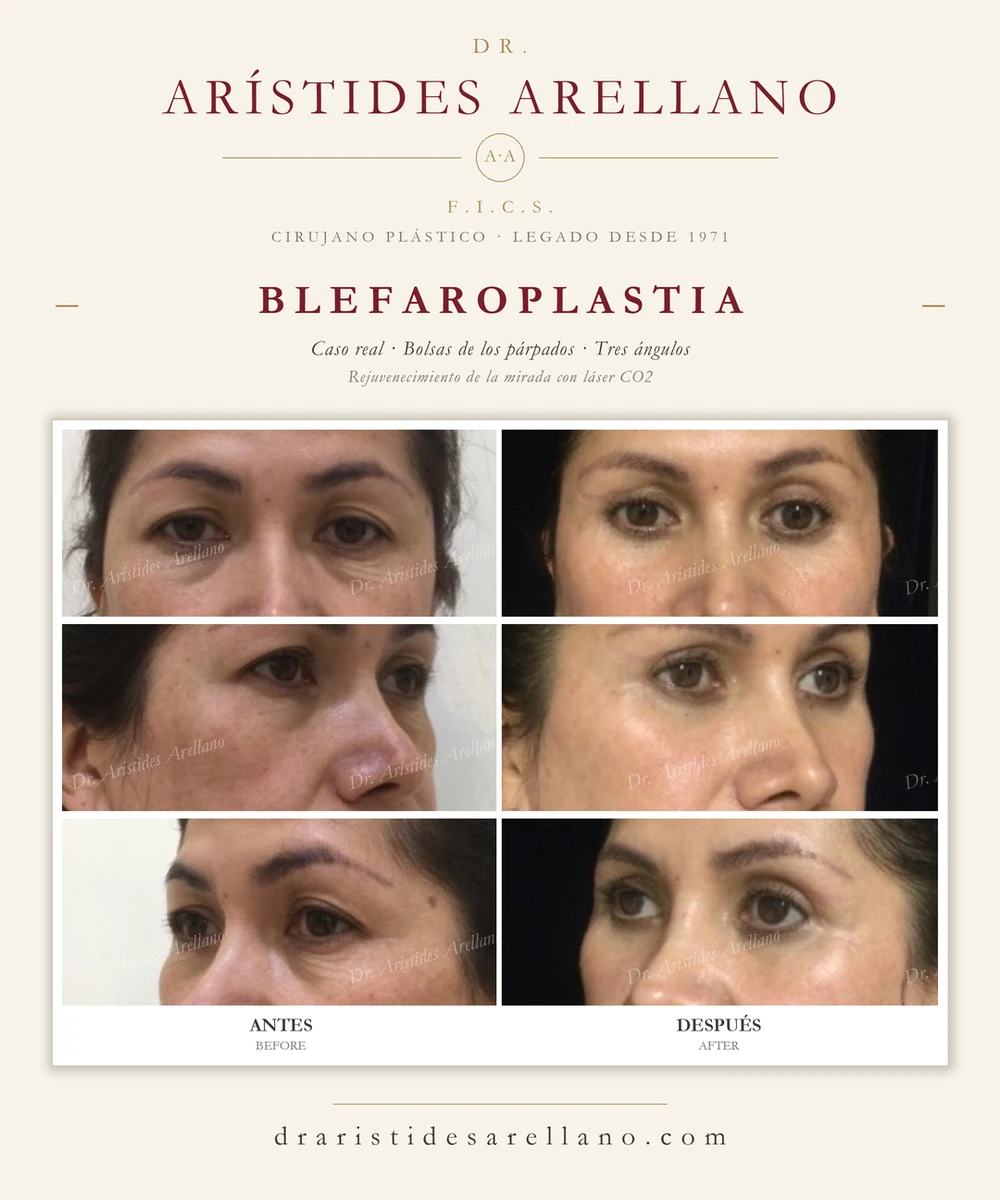
Blefaroplastia inferior: corrección de las bolsas y la flacidez del párpado inferior en tres ángulos. La imagen muestra solo el detalle de la mirada para proteger la identidad de la paciente. Rejuvenecimiento periocular con láser CO2. Caso real del Dr. Arístides Arellano en Puebla. Los resultados pueden variar de una persona a otra.
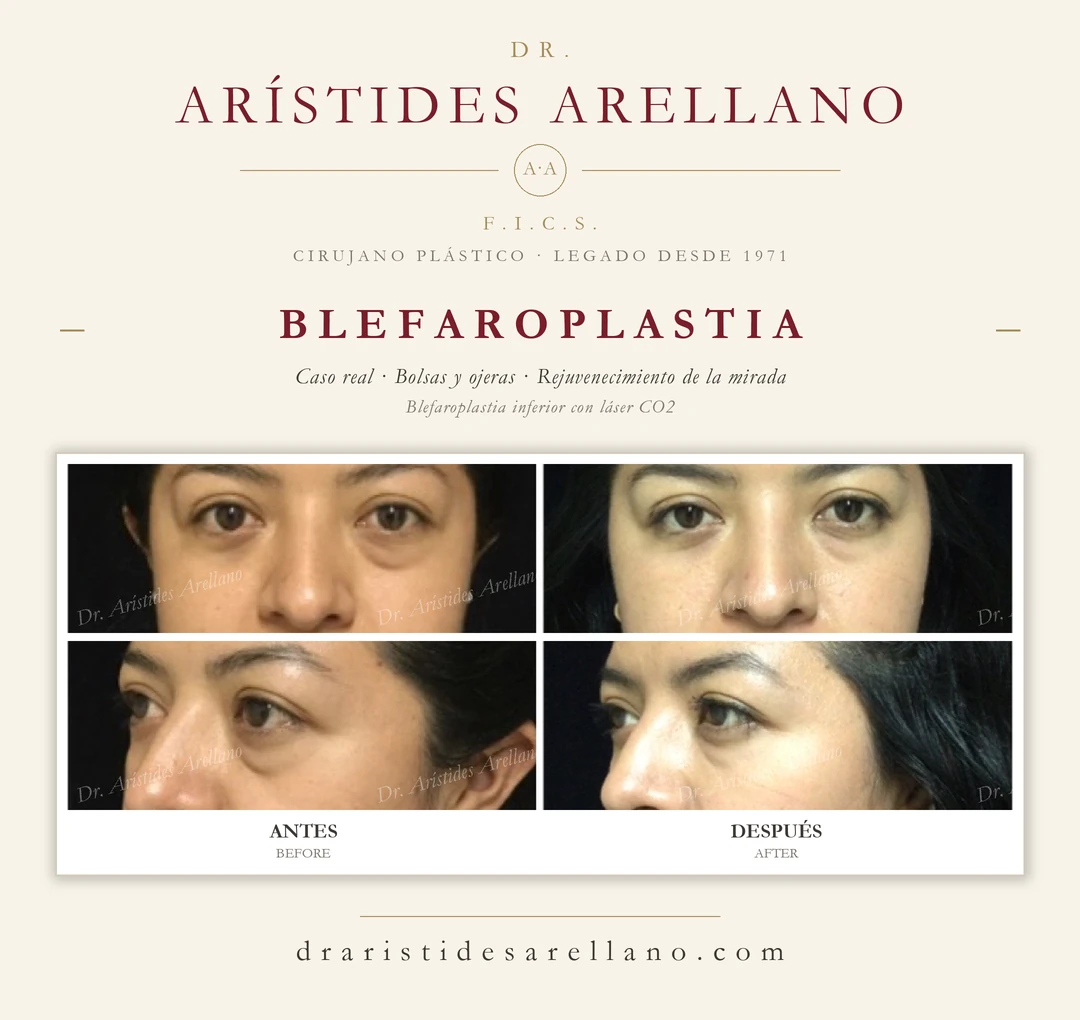
Blefaroplastia inferior en una paciente joven: corrección de las bolsas y ojeras del párpado inferior. La imagen muestra solo el detalle de la mirada para proteger la identidad de la paciente. Rejuvenecimiento periocular con láser CO2. Caso real del Dr. Arístides Arellano en Puebla. Los resultados pueden variar de una persona a otra.
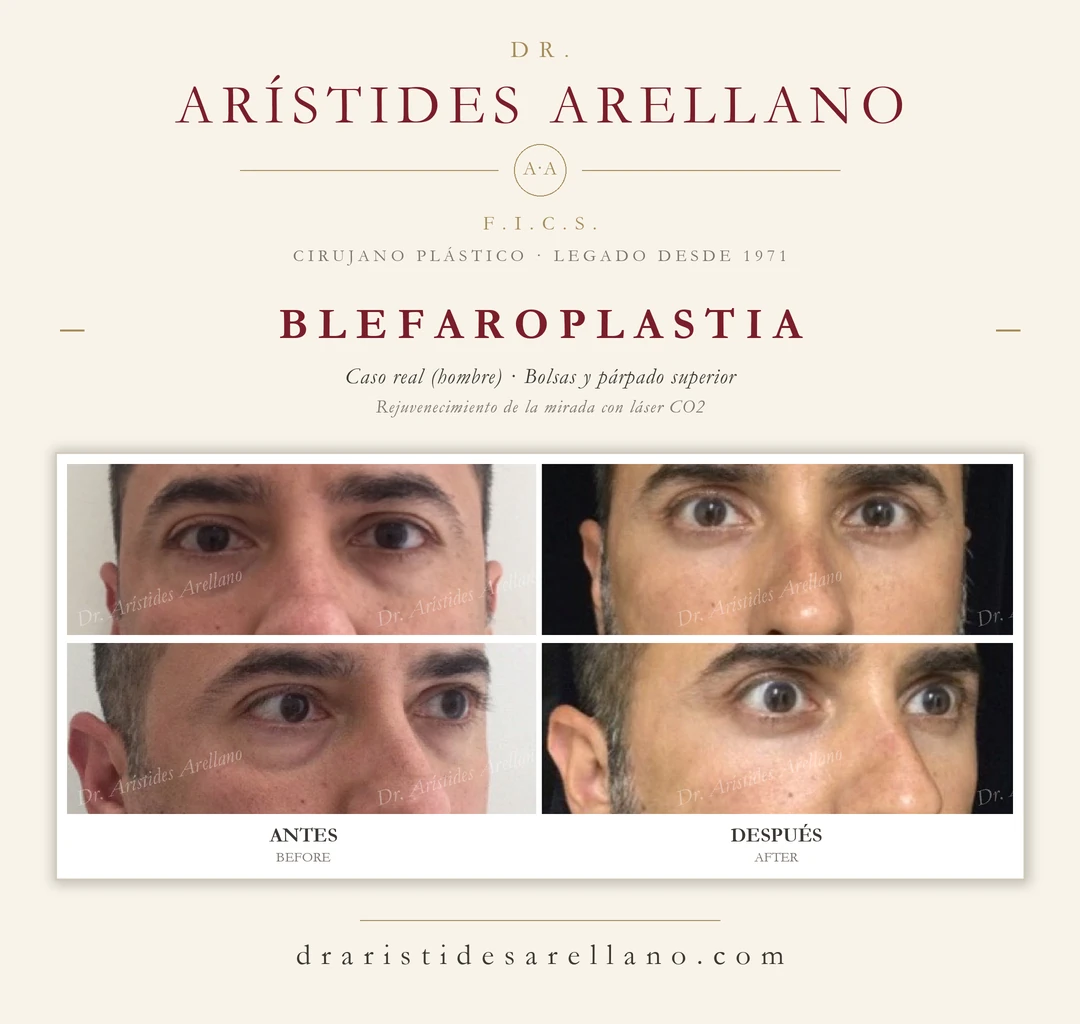
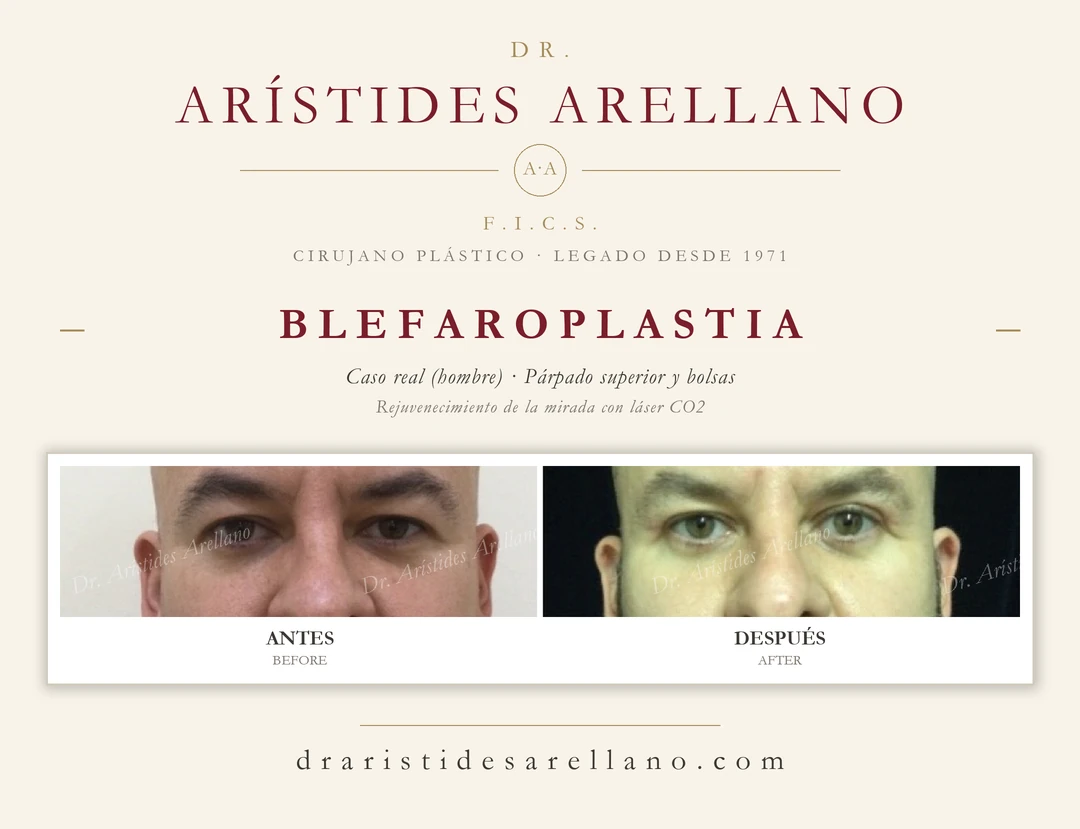
Blefaroplastia superior e inferior en un paciente hombre: corrección del párpado superior y de las bolsas del párpado inferior. La imagen muestra solo el detalle de la mirada para proteger la identidad del paciente. Rejuvenecimiento periocular con láser CO2. Caso real del Dr. Arístides Arellano en Puebla. Los resultados pueden variar de una persona a otra.
What is blepharoplasty? It is eyelid surgery. Above, it removes the excess skin that can hang over the lashes; below, it removes or repositions the fat that forms the bag. It is not a facelift and it does not erase crow's feet — that is something else. It corrects the eyelid, which is what makes a well-rested person look tired. All surgery carries risks and requires a prior medical assessment; results vary from person to person.
How much does blepharoplasty cost? Here it starts at approximately MX$40,000, including theatre, pre-operative laboratory work and post-surgical recovery. The figure changes depending on whether the upper lids, the lower lids or all four are operated, and that is decided by examining you, not over the phone. The definitive cost of each case is set at the private assessment consultation. All surgery carries risks and requires a prior medical assessment; results vary from person to person.
Does it fix drooping eyelids? It depends on what is dropping. If it is eyelid skin, yes: it is removed and the eye opens again. If it is the eyebrow that has descended, operating on the lid alone gives a half result and the brow must be lifted too. And if the lid droops because the levator muscle is weak — ptosis — that is a different operation. Telling them apart is half the job. All surgery carries risks and requires a prior medical assessment; results vary from person to person.
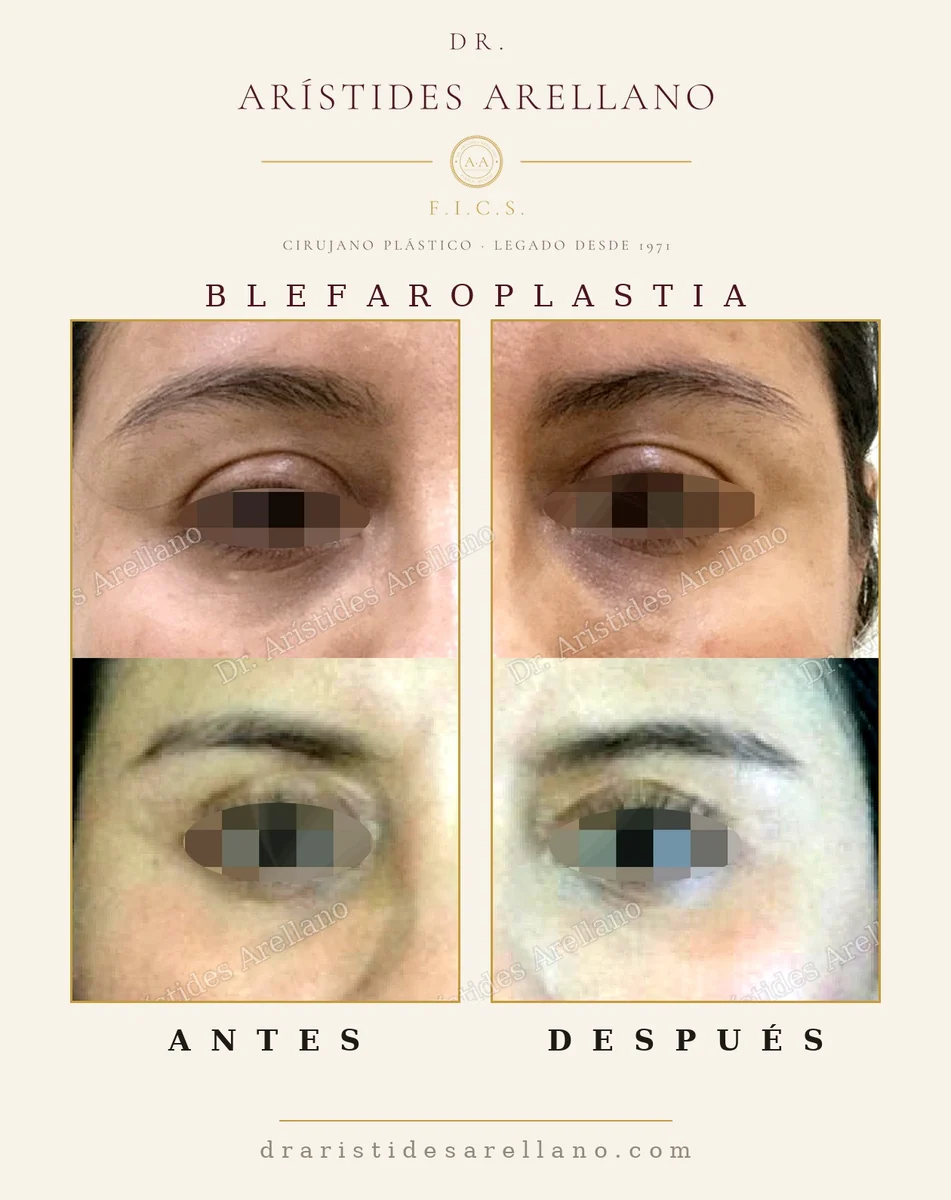
Does blepharoplasty remove eye bags? Yes, when the bag is fat pushing forward — the most common case, and one that no amount of sleep or cream will fix. But not every dark circle is a bag: a purple circle is pigment, a hollow one is lost volume. Each is treated differently, and confusing them is why someone has surgery and still looks the same. All surgery carries risks and requires a prior medical assessment; results vary from person to person.
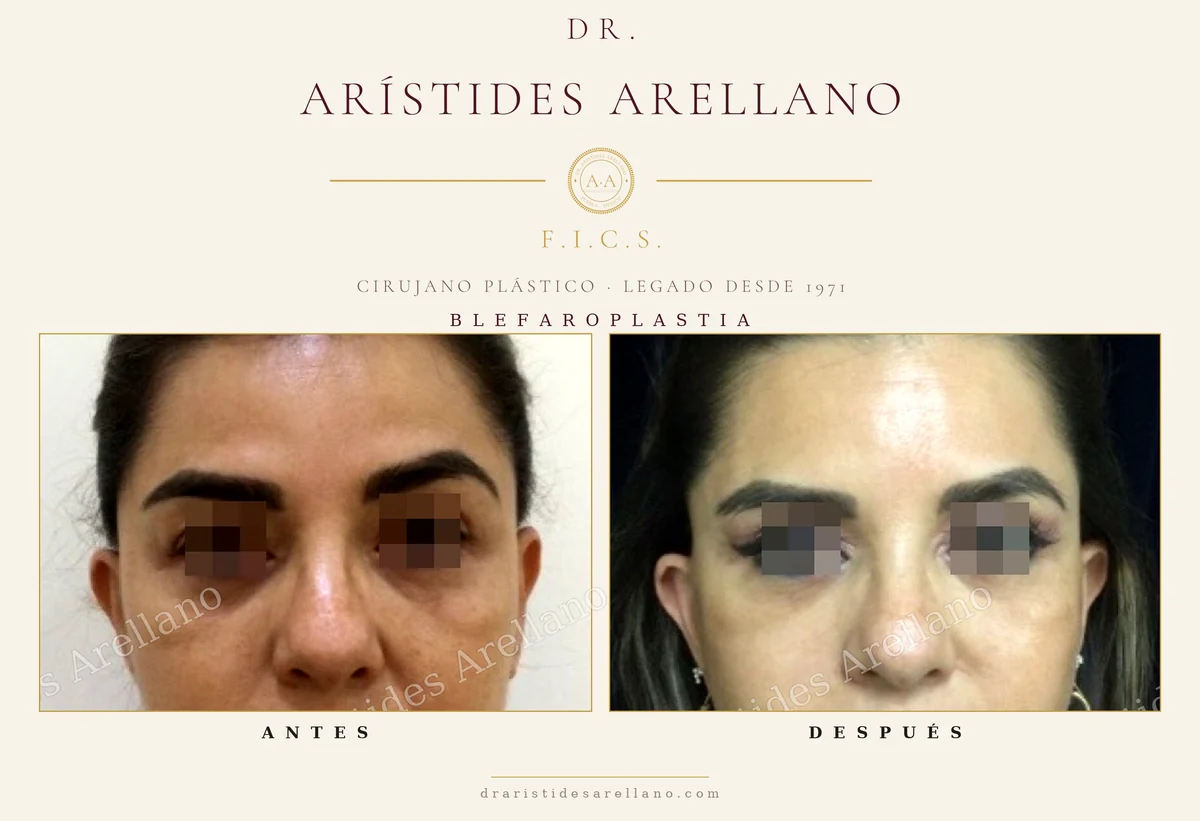
Where does the scar go? Above, inside the natural eyelid crease: with the eye open, the crease hides it. Below, it can run just under the lash line or, when only fat needs moving, inside the lid — with no visible scar at all. These heal better than almost any scar on the body, because eyelid skin is the thinnest there is. All surgery carries risks and requires a prior medical assessment; results vary from person to person.
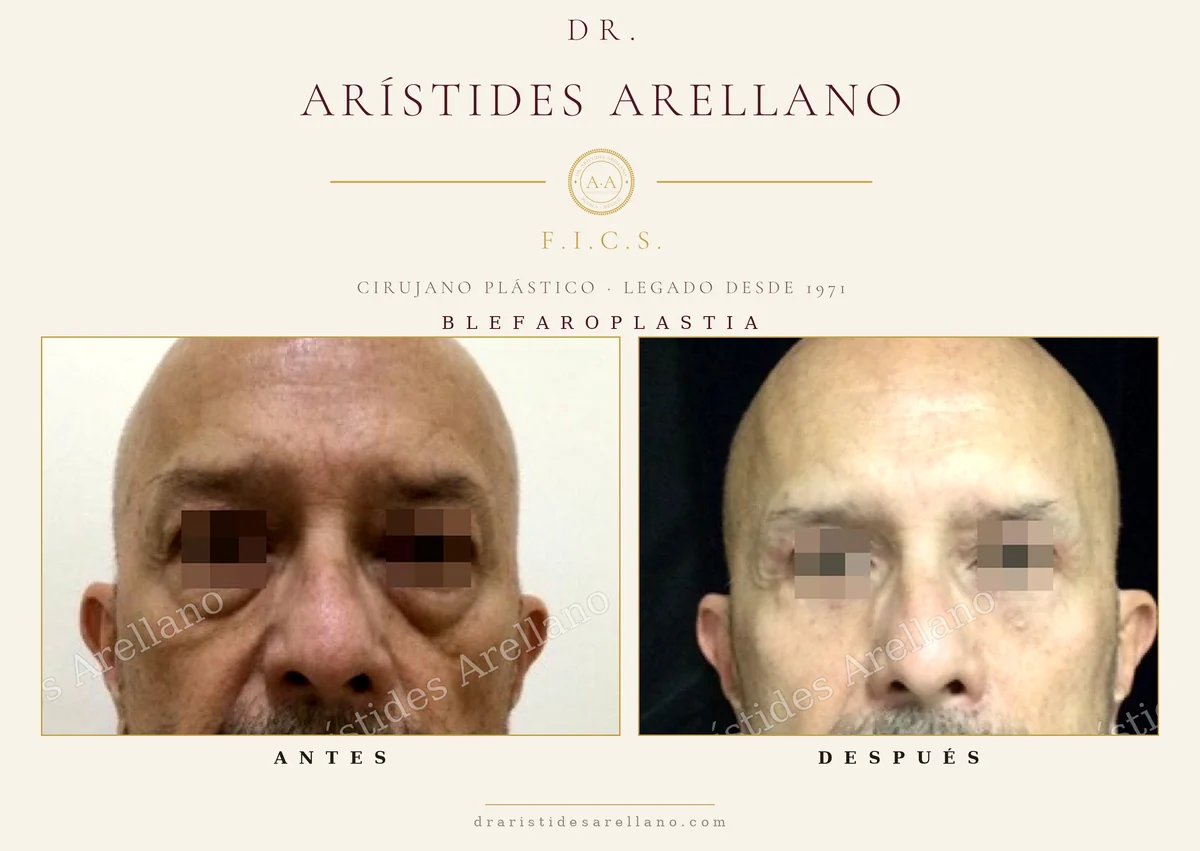
Do men have it done? It is one of the most requested, and the technique changes. In men you do not aim to open or lift too much: an over-raised brow or an over-cleaned lid feminises the look. Less skin is removed and the weight of the upper lid is respected, so the result is looking rested rather than looking operated on. All surgery carries risks and requires a prior medical assessment; results vary from person to person.
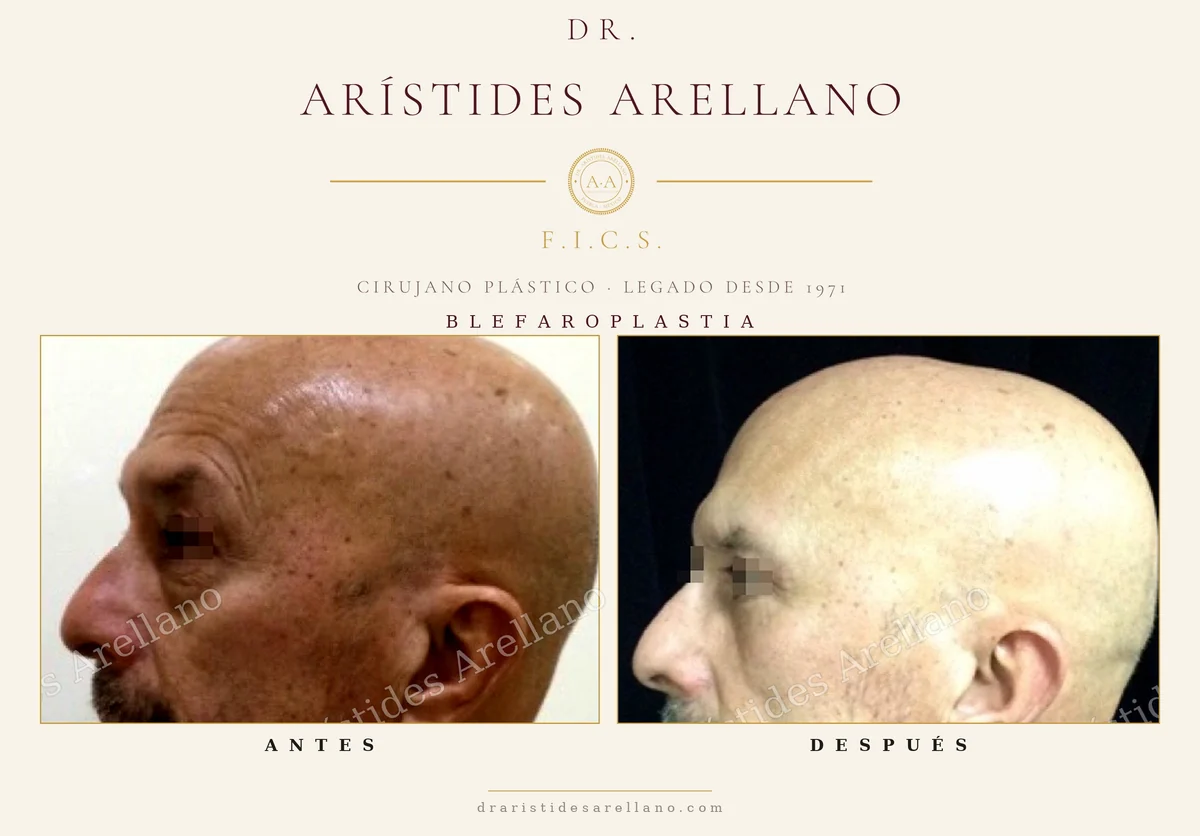
Upper, lower, or both? The upper treats hanging skin and changes the gaze most; the lower treats the bag and changes the tiredness most. Many patients only need one. The profile is the view that decides it, because from the side you can see how far the fat projects and how heavy the upper lid is. All surgery carries risks and requires a prior medical assessment; results vary from person to person.
How long does it last? The skin and fat removed do not come back, so upper blepharoplasty usually lasts ten to fifteen years and many people never have it done again. What keeps advancing is the ageing of the rest of the face: the brow descends, skin loses firmness. That is why the lid still looks good long after its surroundings have changed. All surgery carries risks and requires a prior medical assessment; results vary from person to person.
One eye looks more open than the other — can that be corrected? Almost every face is asymmetric and most people do not notice until they see a photograph. If the difference is skin, it is adjusted by removing different amounts on each side. If it comes from a lower brow or a lid with ptosis, that is what gets treated, not the lid. The honest statement upfront: it improves, it is not matched to the millimetre. All surgery carries risks and requires a prior medical assessment; results vary from person to person.
How long is recovery? Stitches come out between day four and day six. Bruising sets the social calendar: one to two weeks, and it can be covered with make-up as soon as the wound has closed, usually around day ten. Fine swelling can linger a couple of months, but by then only the patient notices it. All surgery carries risks and requires a prior medical assessment; results vary from person to person.
Photographs of real patients, published with their written informed consent. Results may vary from person to person; these images are not a promise of outcome.
Every case is different. Discuss yours in a personal consultation.
Book a consultation on WhatsAppEvery figure published on this site is approximate and is not a quote. Any procedure or treatment first requires a private assessment consultation with Dr. Arístides Arellano —$800 MXN, charged separately— and it is at that consultation that the definitive cost of your case is determined.
Educational content; it does not replace a medical consultation. Results may vary from person to person.