
What is muscle electrostimulation?
Muscle electrostimulation is the application of low-intensity electrical impulses, through electrodes placed on the skin, to trigger an involuntary contraction of the muscle. It is a non-invasive technique: there is no surgery, no needles and no anaesthesia, and it is done with the patient at rest or combined with exercise.
The current mimics, in a controlled way, the signal the nerve normally sends to the muscle. That is why the muscle contracts even though the patient does not activate it voluntarily. It is the same family of technology used for decades in physical rehabilitation to reactivate muscles weakened after an injury or a period of immobility.
It is worth being clear about what it is not, because this is where advertising most exaggerates. Electrostimulation does not remove fat, does not reduce measurements on its own and does not replace a diet or real exercise. It is not liposuction —which removes localised fat— nor does it repair the separation of the abdominal muscles, which is the job of a tummy tuck. Its honest place is that of a complement within a broader plan.
Techniques used by Dr. Arístides Arellano
There is no single electrostimulation protocol: the parameters —intensity, frequency, duration and area— are adjusted to each patient’s goal and state of health. That is why it starts with an assessment and not with the machine switched on. The uses with reasonable evidence are:
- Muscle re-education and reinforcement — as support for activating a muscle weakened by disuse, a sedentary period or recovery from an injury, always alongside the patient’s own active work.
- Complementary toning — to accompany an exercise programme, not to replace it. The provoked contraction can add stimulus, but real change in body composition comes from training and nutrition.
- Application by area — abdomen, buttocks, thighs, arms or back, according to what the patient wants to reinforce. The area and electrode placement are defined at each session.
- A monitored series protocol — the work is done over several spaced sessions and progress is reassessed, because a single session changes nothing fundamental. The plan is individual and documented.
- Ruling out contraindications — before the first session it is checked that there is no pacemaker or other implanted electronic device, pregnancy, epilepsy or other situations where it must not be applied. Saying no when appropriate is part of the treatment.
How is it performed?
The session is done in the office, clothed or in comfortable clothing, with no surgery and no anaesthesia. Electrodes are placed on the skin of the target area and the intensity is raised gradually until a visible but tolerable contraction is achieved. Most patients describe a tingling and the sensation of the muscle tightening on its own; it should not hurt.
Each session usually lasts 20 to 30 minutes. It is not a one-off treatment: the effect on muscle tone is progressive and reversible —that is, it is built up with repeated sessions and lost if it is not then sustained with physical activity. That is why it is planned as a series, whose number is set at the consultation according to the goal and the starting point.
Here the honest conversation is repeated. If what the patient wants is to lose weight or reduce localised fat, electrostimulation is not the right tool, and you are told so before a series is sold. If the goal is to support a muscle that responds poorly after an injury, it does make sense, within a plan that includes active movement. The technology is a means, not a promise of a result.
Every medical treatment —topicals, peels and energy-based devices included— carries risk and requires a prior assessment. In darker skin (Fitzpatrick IV–VI, the most common phototypes in Mexico) a poorly indicated procedure can darken the patch instead of lightening it. Results may vary according to each patient, their phototype and their individual triggers.
Who is a good candidate?
- People in good general health who already do or are about to start physical activity and want a complement to reinforce their muscle work.
- Patients recovering from an injury or a period of immobility, indicated to reactivate a weakened muscle, as support for rehabilitation.
- Those with realistic expectations: they understand it is a complement, that the result is progressive and that it is maintained only with continued physical activity.
- It is not for anyone with a pacemaker or other implanted electronic device, who is pregnant, has epilepsy, thrombosis, an infection or wound on the skin of the area, or who wants to lose weight or remove fat: for that, this is not the route.
- With significant laxity or excess fat and skin, the honest answer is not electrostimulation but assessing other options in consultation. It is defined at your consultation.
Recommended post-treatment care
Electrostimulation has no recovery: you can return to your routine the same day. The best "aftercare" is not another machine but sustaining the result with regular exercise and good nutrition, because the tone gained is lost if the muscle stops working. A slight worked-muscle sensation, like after exercise, may remain and resolves on its own. If you combine this treatment with a surgical procedure, See the full guide: Post-surgical recovery and care.
Before and after
Most patients want to see before-and-after photographs before deciding. Out of respect for each person’s privacy, Dr. Arístides Arellano shows real cases —always with documented consent— during your in-person consultation, where you can review results from patients with a starting point similar to yours. Results may vary from patient to patient.
Approximate price
Muscle electrostimulation has no single fee: the cost depends on the number of sessions in the series and the areas to be worked, so it is set at the consultation and not over the phone. This site does not publish a loose figure that might not match your case. Approximate price — the definitive cost is set at your private consultation with Dr. Arístides Arellano. See the price list.
About Dr. Arístides Arellano
Dr. Arístides Arellano is a plastic surgeon holding a specialty licence: he practises under a Mexican medical licence (D.G.P. 1125959) and a specialty licence in Plastic & Reconstructive Surgery (0002008), both issued by the Directorate General of Professions (DGP), which reissued his certificate of professional standing in 2025. His career began before Mexico’s present-day specialty-board system existed: he belongs to the founding generation of plastic surgery in Puebla, the second generation of a surgical tradition started in 1971 by Dr. Francisco Arellano Ocampo. Trust is verified, not promised: both licences are public and anyone can look them up in the DGP’s National Registry of Professionals.
Related patient guide
Aesthetics is full of easy promises, and electrostimulation is a field where exaggerated results abound. Knowing whom you trust with your body matters as much as the equipment used. To learn what to verify before deciding, read How to choose a plastic surgeon in Puebla, with criteria that apply to a non-surgical treatment too.
Trust is verified, not promised. All 210 scanned documents —degree, licences, diplomas, publications and certificates, from 1977 to 2025— are open in Dr. Arístides Arellano’s credential archive, alongside an explanation of the difference between a specialty licence and a board certification.
Recovery · step by step
- Before — the assessmentThe goal and state of health are reviewed and contraindications such as a pacemaker, pregnancy or epilepsy are ruled out. If it is not the right route, you are told.
- Day of the sessionAn outpatient procedure of 20 to 30 minutes, without anaesthesia. Tolerable tingling and contraction. Normal activity resumes immediately.
- After each sessionA slight worked-muscle sensation, like after exercise, may remain and resolves on its own. No downtime.
- Across the seriesThe effect on tone is progressive; the work is done in spaced sessions and progress is reassessed. The number is set at the consultation.
- MaintenanceThe result is sustained with exercise and nutrition; without activity, the tone gained is lost. Results may vary from patient to patient.
Frequently asked questions
Does muscle electrostimulation help you lose weight?
No. Electrostimulation triggers muscle contraction, but it does not remove fat or reduce measurements on its own, and it does not replace diet or exercise. It is a complement within a broader plan. Anyone selling it as a weight-loss method is promising a result you will not see.
Does it replace exercise?
No. The contraction provoked by the current can add stimulus to a muscle, but real change in strength and body composition comes from active training and nutrition. Its best use is as support for exercise or rehabilitation, not as a substitute.
Does it hurt?
It should not hurt. Most patients describe a tingling and the sensation of the muscle tightening on its own. The intensity is raised gradually to a tolerable point, and it is done without anaesthesia. Afterwards a slight worked-muscle sensation, like after exercise, may remain.
Who should not have it?
It is not indicated for people with a pacemaker or other implanted electronic device, pregnancy, epilepsy, thrombosis, or an infection or wound on the skin of the area to be treated. That is why there is always a prior assessment: ruling out these situations is part of the treatment.
How many sessions do I need and how long does the result last?
The work is done in a series of spaced sessions, because the effect on tone is progressive; the number is set at the consultation according to the goal. The result is reversible: it is maintained with exercise and nutrition, and lost if the muscle stops working. Results may vary from patient to patient.
How much does it cost in Puebla?
There is no single fee, because it depends on the number of sessions in the series and the areas worked. It is set at the consultation, not over the phone. Be wary of anyone who quotes without knowing your case or confirming this is the right treatment for you.
The equipment used
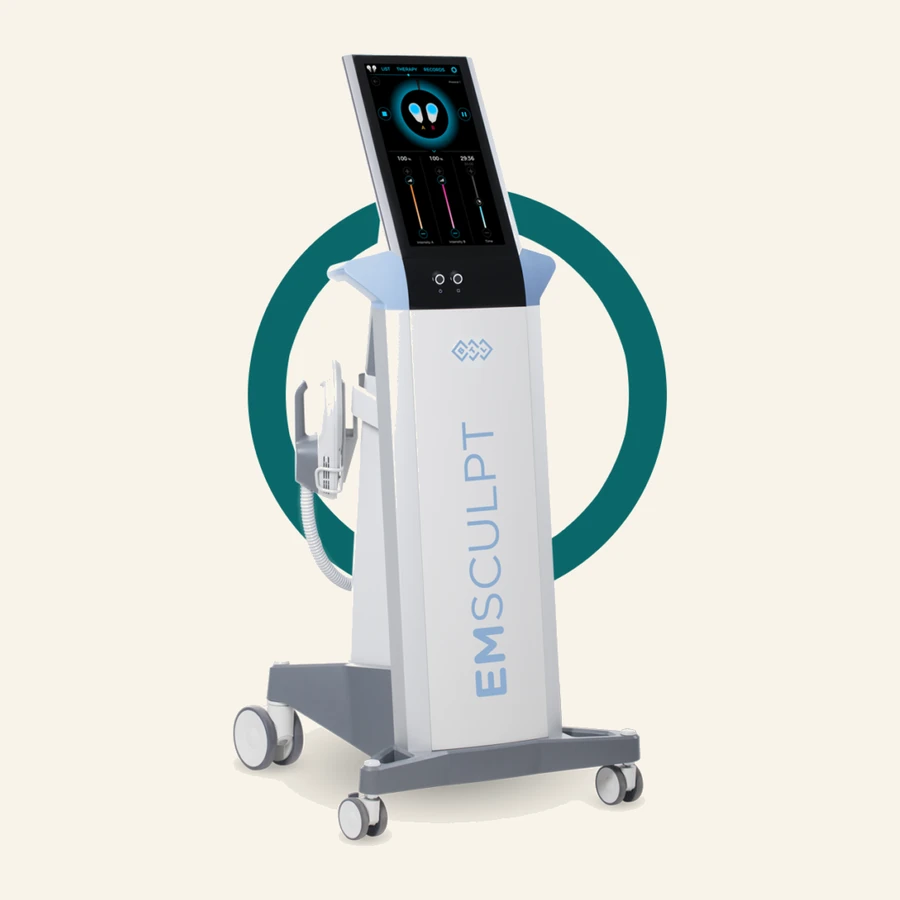
Every case is different. Discuss yours in a personal consultation.
Book a consultation on WhatsAppEvery figure published on this site is approximate and is not a quote. Any procedure or treatment first requires a private assessment consultation with Dr. Arístides Arellano —$800 MXN, charged separately— and it is at that consultation that the definitive cost of your case is determined.
Educational content; it does not replace a medical consultation. Results may vary from person to person.