What is fat transfer?
Fat transfer —also called autologous fat grafting or filling with your own fat— is the procedure that moves fat from an area of the body where there is excess to another where added volume or contour correction is wanted. It is performed in two stages within the same surgery: first the fat is harvested through a gentle liposuction of the donor zone (usually the abdomen, flanks or thighs), and then, after purifying it, it is reinjected in small amounts into the recipient zone.
Its main advantage is that it uses the patient own tissue: there are no synthetic materials, the result feels natural and there is no risk of immune rejection. The trade-off is that grafted fat does not survive completely —part of it is reabsorbed in the first months— so the graft is planned by over-correcting the volume and, in some cases, may require a touch-up session.
Techniques used by Dr. Arístides Arellano
Dr. Arístides Arellano selects the technique for harvesting, processing and grafting the fat according to the area treated and the goal of each patient, handling the tissue gently to help as much of the grafted fat as possible survive:
- Facial fat transfer: fat grafting to restore volume in the cheeks, folds, tear troughs, temples and chin, or to harmonise the face. It often accompanies rejuvenation procedures such as a facelift.
- Buttock augmentation with your own fat (BBL): combining liposuction of the trunk with reinjection of fat into the buttocks to improve volume and projection. It is described in detail in buttock augmentation with your own fat.
- Structural layered grafting: the fat is deposited in small aliquots across several planes, rather than in a single lump, so each portion sits near a nourishing vessel and survival improves.
- Microfat: fat processed into fine particles, indicated to add volume in thin-skin areas such as the face and the back of the hands.
- Nanofat: emulsified fat that does not add volume but is used to improve skin quality and texture in selected areas.
- Contour irregularity correction: fat grafting to fill depressions, asymmetries or the aftermath of a previous, unevenly distributed liposuction.
How is it performed?
The surgery is performed in two phases. In the first, fat is harvested through low-pressure liposuction of the donor zone in order to preserve cell viability. In the second, that fat is purified —by decantation, filtering or centrifugation— to separate the usable tissue from blood, serum and debris, and it is then reinjected with fine cannulas through multiple tunnels and planes of the recipient zone.
It is performed under general anaesthesia or sedation with local/regional anaesthesia, depending on the extent of treatment, and lasts approximately 1 to 4 hours depending on the donor and recipient zones and the volume of fat handled. It is an outpatient or short-stay procedure. A compression garment is placed on the donor zone, and pressure on the recipient zone is avoided during the first weeks so as not to compromise the newly grafted fat; in buttock augmentation this means limiting sitting time.
Because of partial reabsorption, the final volume is appreciated from the third to the sixth month, once the surviving fat has stabilised. In some patients a second session is planned to reach the desired result.
All surgery carries risk and requires a prior medical assessment. Results may vary according to each patient, their anatomy and their individual healing process.
Who is a good candidate?
- People with enough available fat in a donor zone to obtain the graft.
- Those seeking to add volume or correct contour with their own tissue, without implants or synthetic fillers.
- Patients with depressions, asymmetries or the aftermath of previous liposuction they wish to correct.
- Stable weight: significant later weight changes alter both the donor zone and the grafted fat.
- Realistic expectations about partial fat reabsorption and the possible need for a touch-up.
- Good general health, with no contraindications to surgery.
Recommended post-surgical treatments
A compression garment on the donor zone and protection of the recipient zone are essential. Dr. Arístides may recommend manual lymphatic drainage and other measures to reduce swelling and support good graft integration, always avoiding direct pressure on the newly placed fat. See the full guide: Post-surgical recovery and care.
Before and after
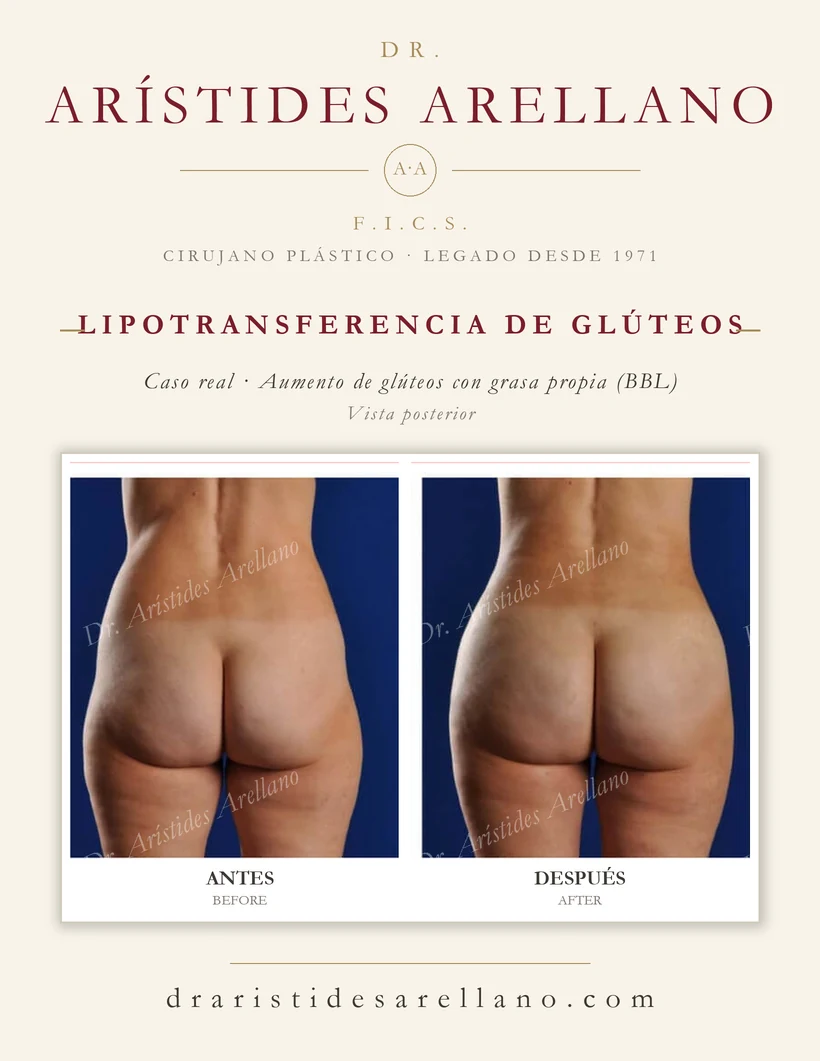
The cases below are real patients of Dr. Arístides Arellano, published with their written informed consent. Out of respect for each person’s privacy, only expressly authorised cases are published; at your in-person consultation Dr. Arístides can show you further cases with a starting point similar to yours. Results may vary from patient to patient.
How much does fat transfer cost?
It depends where the fat goes. To the glutes, from $70,000 MXN approx.; to facial folds and depressions, from $25,000 MXN. To the breast it is quoted case by case, because the extent of the donor liposuction changes the operating time entirely. The price is all-inclusive: it covers use of the operating theatre and facilities, pre-operative laboratory work and the post-surgical recovery treatments. It is not the surgeon’s fee alone. Approximate price — the definitive cost is set at your private consultation with Dr. Arístides Arellano.
The final amount also depends on the donor zones, the volume of fat required and whether it is combined with other surgery; it is set at your in-person consultation. Full price table: how much liposuction costs in Mexico.
About Dr. Arístides Arellano
Dr. Arístides Arellano is a plastic surgeon holding a specialty licence: he practises under a Mexican medical licence (D.G.P. 1125959) and a specialty licence in Plastic & Reconstructive Surgery (0002008), both issued by the Directorate General of Professions (DGP), which reissued his certificate of professional standing in 2025. His career began before Mexico’s present-day specialty-board system existed: he belongs to the founding generation of plastic surgery in Puebla, the second generation of a surgical tradition started in 1971 by Dr. Francisco Arellano Ocampo. Trust is verified, not promised: both licences are public and anyone can look them up in the DGP’s National Registry of Professionals.
Related patient guide
To go deeper before or after your consultation: How to choose a plastic surgeon in Puebla — part of the informational guide series reviewed by Dr. Arístides Arellano.
Trust is verified, not promised. All 210 scanned documents —degree, licences, diplomas, publications and certificates, from 1977 to 2025— are open in Dr. Arístides Arellano’s credential archive, alongside an explanation of the difference between a specialty licence and a board certification.
Dr. Arístides explains it
Informational video by Dr. Arístides Arellano. Every case is different: the details of your procedure are defined at your consultation.
Recovery · step by step
- Days 1–5Swelling, tenderness and bruising in the donor and recipient zones; compression garment on the donor zone; pressure on the grafted fat is avoided.
- Week 2Discomfort decreases; sutures removed where applicable; light activity can resume while still protecting the grafted zone.
- Weeks 3–6Swelling decreases progressively; exercise is gradually authorised as medically advised; the volume begins to stabilise.
- Months 3–6Surviving fat becomes integrated and the final volume is clearly appreciated; in some cases a touch-up session is considered.
Frequently asked questions
How much does fat transfer cost in Puebla?
The price is defined at your in-person consultation, because it depends on the donor zones, the areas treated, the volume of fat required and whether it is combined with other surgery. The exact amount is confirmed for your case at the consultation.
What is autologous fat transfer?
It is the procedure that removes fat from an area of the body where there is excess, purifies it and reinjects it into another where added volume or contour correction is wanted. Because it uses the patient own tissue the result is natural and there is no risk of rejection.
Does grafted fat get reabsorbed?
Yes, part of the grafted fat is reabsorbed during the first months; the fat that survives stays stably in place. That is why the graft is planned by over-correcting the volume and, in some cases, may require a touch-up session.
How is it different from hyaluronic acid fillers?
Hyaluronic acid fillers are a temporary injectable product applied without surgery. Fat transfer uses your own fat, requires surgery to harvest it and, once integrated, offers a longer-lasting result.
Your own fat or implants?
Your own fat adds volume with natural tissue and no synthetic material, but depends on having enough donor fat and on partial reabsorption. Implants offer a more predictable volume. The best option for your case is defined at the assessment.
Is fat transfer a way to lose weight?
No. Although it includes a liposuction to harvest the fat, its goal is to relocate volume and improve contour, not to reduce weight. Being close to a stable weight before the procedure is recommended.
How long until the result is visible?
The final volume is clearly appreciated between the third and sixth month, once the surviving fat is integrated and residual swelling resolves. Results may vary from patient to patient.
Which areas can it be applied to?
Most often the face (cheeks, folds, tear troughs, temples), the buttocks, the back of the hands and the correction of body contour irregularities, including the aftermath of previous liposuction.
Before and after
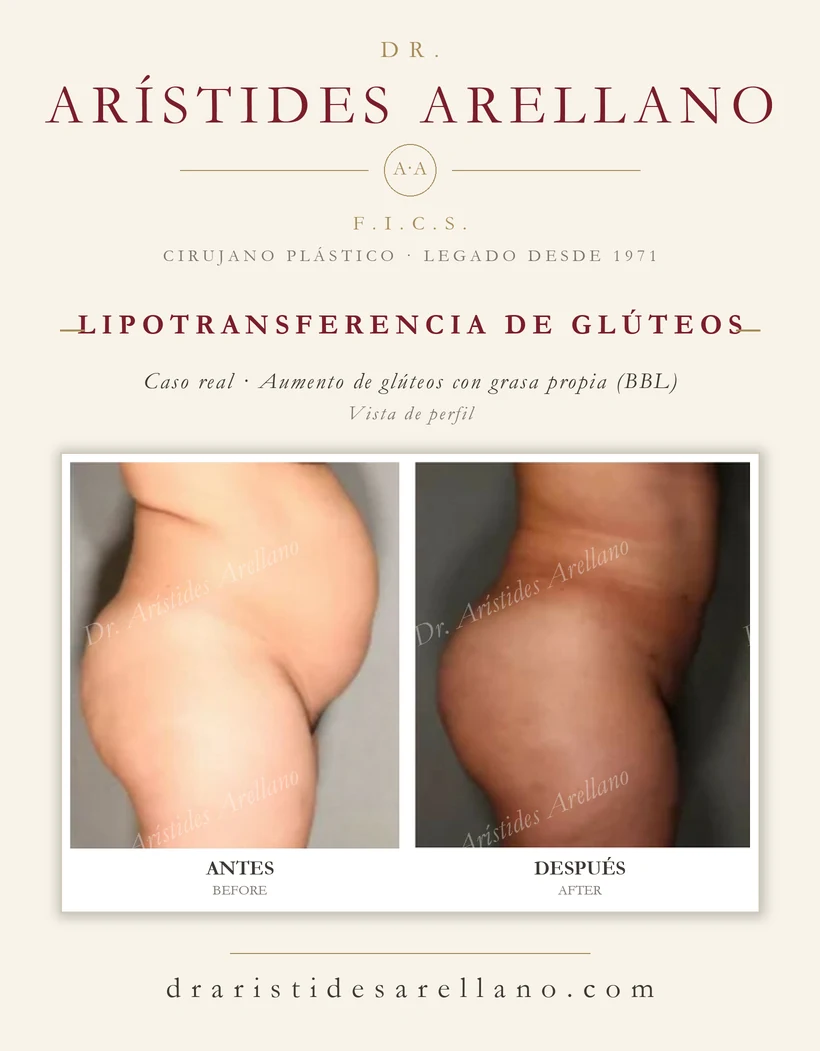
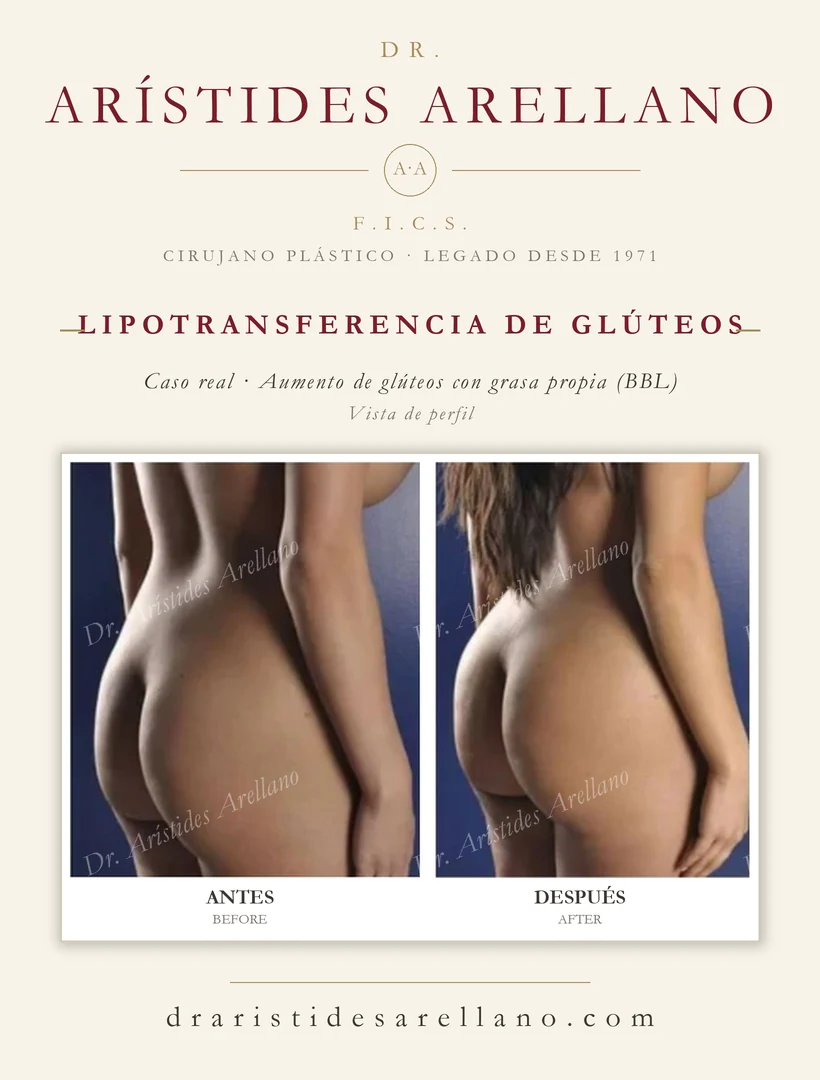
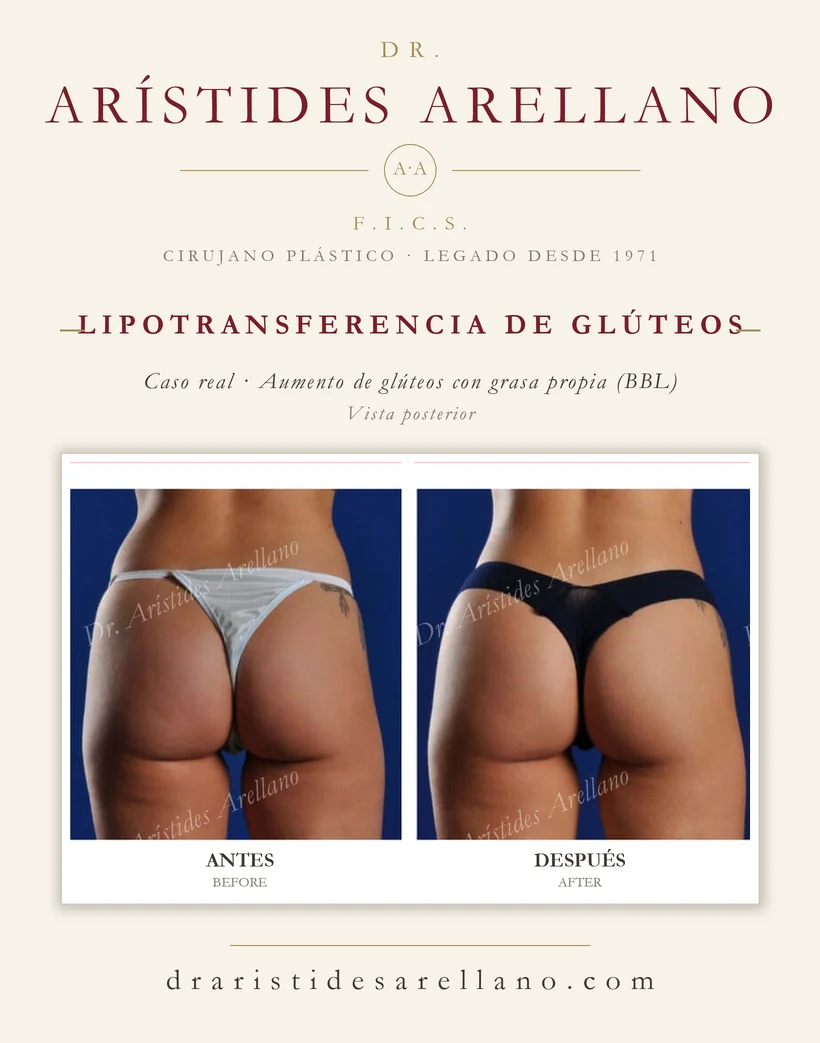
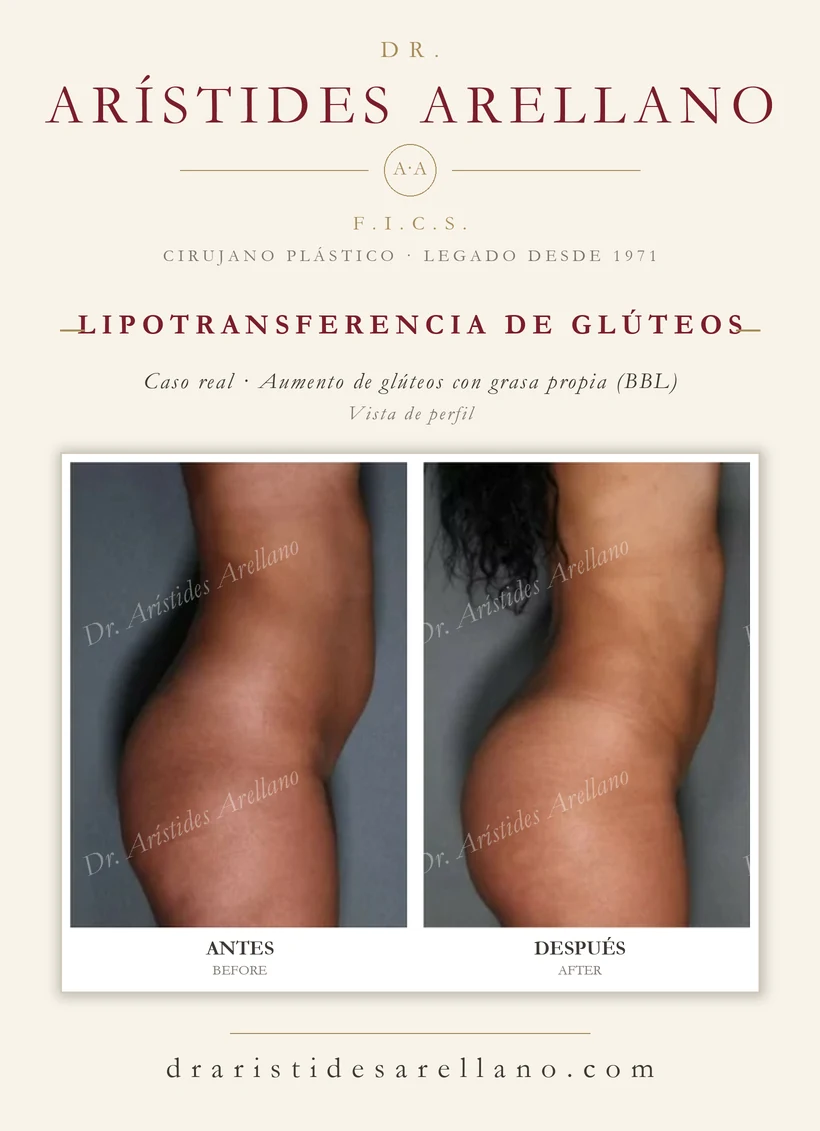
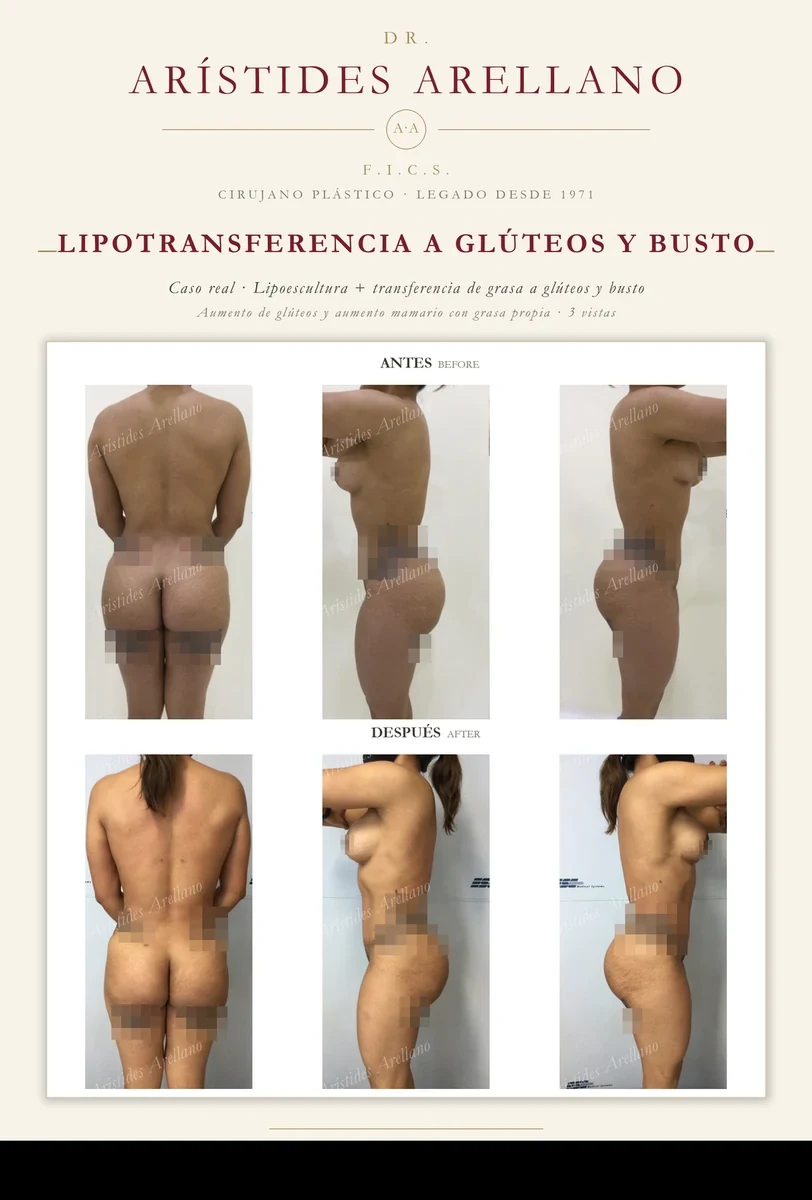
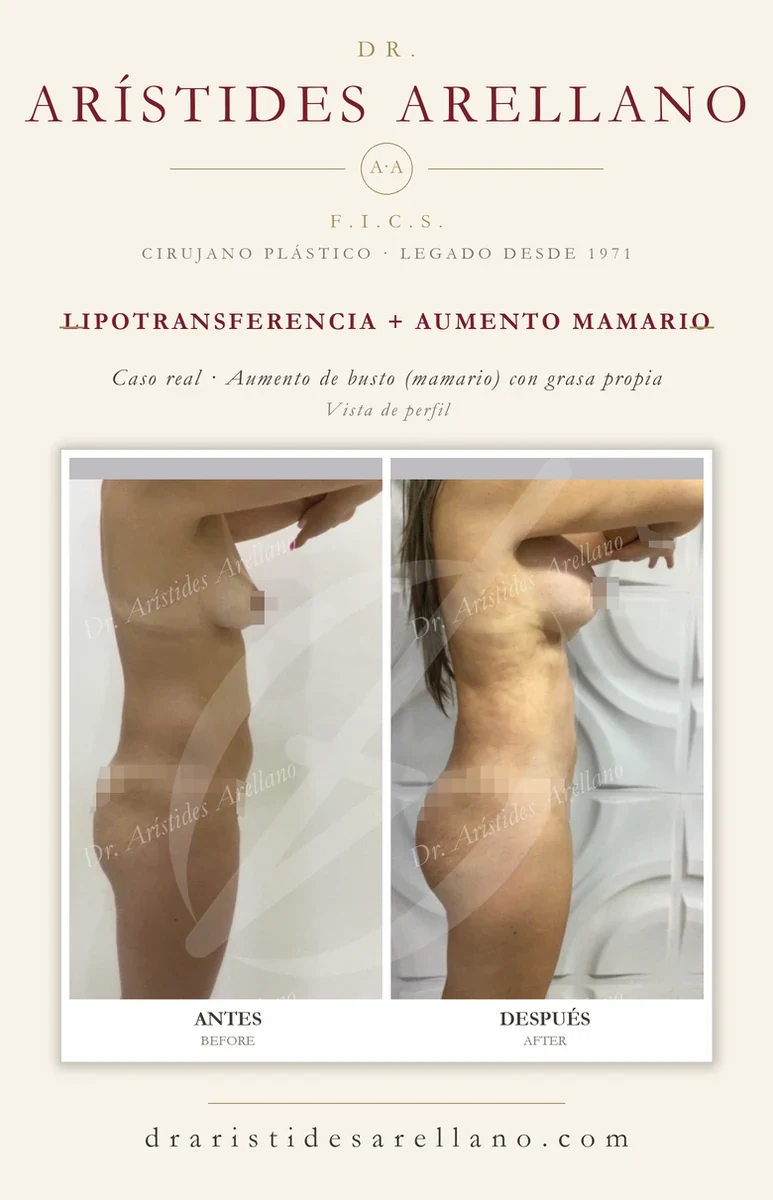
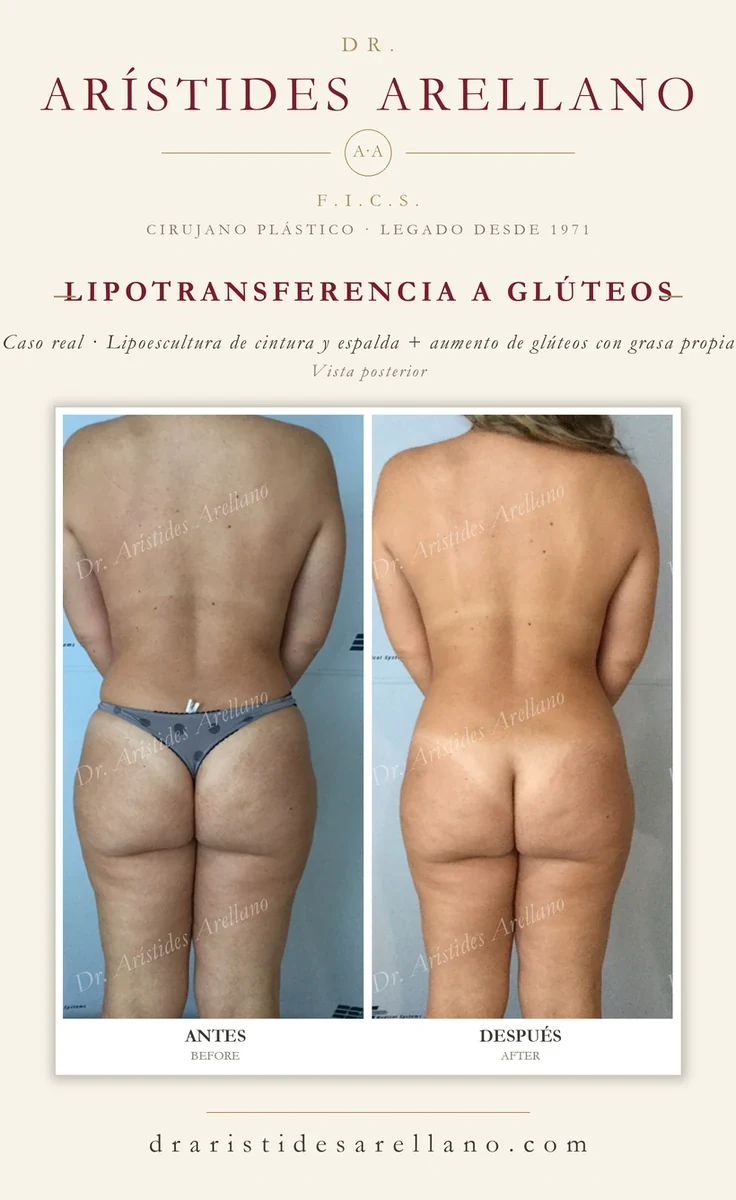
Photographs of real patients, published with their written informed consent. Results may vary from person to person; these images are not a promise of outcome.
Every case is different. Discuss yours in a personal consultation.
Book a consultation on WhatsAppEvery figure published on this site is approximate and is not a quote. Any procedure or treatment first requires a private assessment consultation with Dr. Arístides Arellano —$800 MXN, charged separately— and it is at that consultation that the definitive cost of your case is determined.
Educational content; it does not replace a medical consultation. Results may vary from person to person.