
What is IncontiLase?
IncontiLase is a Fotona Er:YAG laser protocol applied inside the vagina to treat mild-to-moderate stress urinary incontinence, with no cutting, no surgery and no need for general anaesthesia. The laser gently heats the mucosa of the anterior vaginal wall —the wall that supports the urethra— and stimulates new collagen. That collagen tightens the supporting tissue and reduces leakage on coughing, laughing, sneezing or exertion.
Before any talk of the laser there is a sentence said here that a machine shop does not say: incontinence is diagnosed before it is treated, and that diagnosis belongs to urology or urogynaecology, not to a device. IncontiLase helps one specific type of incontinence —the stress type— and not all of them. Knowing which one you have, before paying for a session, is what decides whether this technology is the answer or a waste of time and money. If the assessment says your case needs something else, you will be told.
Techniques used by Dr. Arístides Arellano
IncontiLase is part of Fotona’s family of intimate Er:YAG laser protocols. Depending on what the assessment finds, the protocol is adjusted —and objectives are sometimes combined on the same platform:
- IncontiLase: the protocol aimed at stress urinary incontinence. It uses the Er:YAG in SMOOTH (non-ablative) mode: it delivers heat to the mucosa and lamina propria of the anterior vaginal wall without removing tissue or leaving a wound, to stimulate collagen and tighten the support of the urethra.
- IntimaLase: the same laser applied to vaginal laxity (relaxation syndrome), common after one or more deliveries, aiming to tighten the wall of the vaginal canal.
- RenovaLase: directed at vaginal atrophy and the genitourinary syndrome of menopause —dryness, discomfort, thinning of the mucosa— to improve tissue quality.
- The platform: all of it runs on the Fotona SP Dynamis Max (Fotona, Slovenia), whose Er:YAG laser lists these intimate protocols among its official indications. It is a powerful medical device, and that is one of the reasons a physician should be the one holding it.
How is it performed?
The session is outpatient and lasts approximately 15 to 30 minutes. It requires no general anaesthesia —in most cases no anaesthesia at all— and no incisions. Using a speculum, the handpiece is placed inside the vagina and the Er:YAG pulses are applied in SMOOTH mode, felt as a sensation of warmth. There is no cutting, no stitches and no significant downtime: you walk out and resume normal activity the same day, avoiding intercourse, tampons and baths for the first few days.
It is not a single session. It is worked in a series —usually 2 to 3 sessions spaced around a month apart— and the exact number is defined at the assessment. The result has two timescales: there is an initial sensation, and there is a real tightening effect that depends on new collagen and builds over the following weeks and months. Like everything that depends on collagen, the result is not permanent: the tissue keeps ageing, so a spaced maintenance session is usually scheduled, and that is said from the outset.
All surgery carries risk and requires a prior medical assessment. Results may vary according to each patient, their anatomy and their individual healing process.
Who is a good candidate?
A good candidate is someone who, after an assessment that confirms the diagnosis, meets these conditions:
- Mild-to-moderate stress urinary incontinence, confirmed at assessment: leakage on coughing, laughing, sneezing, jumping or exercising.
- Tissue laxity or changes after one or more deliveries, or in perimenopause.
- Someone who prefers to avoid surgery, or is not a candidate for a sling at this time.
- No significant prolapse and no active urinary or vaginal infection (checked before treatment).
- Not pregnant.
- Realistic expectations: IncontiLase improves stress incontinence, does not always "cure" it, and the result builds over time.
Recommended post-treatment care
The best complement to IncontiLase is not another machine: it is well-done, sustained pelvic-floor work, because the laser improves the support of the tissue but does not train the muscle. Depending on the case, Dr. Arístides may recommend pelvic-floor strengthening and follow-up to consolidate and maintain the result. And for those who combine this treatment with a surgical procedure: See the full guide: Post-surgical recovery and care.
Before and after
Most patients want to see before-and-after photographs before deciding. Out of respect for each person’s privacy, Dr. Arístides Arellano shows real cases —always with documented consent— during your in-person consultation, where you can review results from patients with a starting point similar to yours. Results may vary from patient to patient.
Approximate price
A session starts at $8,000 MXN and the course of 5 sessions at $24,000 MXN, approximate figures depending on the area treated and how many sessions your response calls for. Approximate price — the definitive cost is set at your private consultation with Dr. Arístides Arellano.
About Dr. Arístides Arellano
Dr. Arístides Arellano is a plastic surgeon holding a specialty licence: he practises under a Mexican medical licence (D.G.P. 1125959) and a specialty licence in Plastic & Reconstructive Surgery (0002008), both issued by the Directorate General of Professions (DGP), which reissued his certificate of professional standing in 2025. His career began before Mexico’s present-day specialty-board system existed: he belongs to the founding generation of plastic surgery in Puebla, the second generation of a surgical tradition started in 1971 by Dr. Francisco Arellano Ocampo. Trust is verified, not promised: both licences are public and anyone can look them up in the DGP’s National Registry of Professionals.
Related patient guide
Before deciding where to have laser treatment for incontinence, it helps to know who you are trusting with a medical device: How to choose a plastic surgeon in Puebla — part of the informational guide series reviewed by Dr. Arístides Arellano.
Trust is verified, not promised. All 210 scanned documents —degree, licences, diplomas, publications and certificates, from 1977 to 2025— are open in Dr. Arístides Arellano’s credential archive, alongside an explanation of the difference between a specialty licence and a board certification.
The plan · the series and the result that builds
- Before — the assessmentDiagnosis first: a urological or urogynaecological assessment. Not all incontinence responds to this technology, and knowing that beforehand avoids paying for sessions that were never going to work.
- The session (≈15–30 min)Outpatient, no general anaesthesia and in most cases no anaesthesia at all. It is felt as a sensation of warmth. No cutting, no stitches. You walk out.
- First few daysNormal activity the same day. Intercourse, tampons and baths are avoided for the first few days, or as advised.
- During the series2 to 3 sessions spaced around a month apart. The exact number is defined at the consultation. Improvement usually begins to be noticed during the series.
- Weeks to monthsThe real tightening depends on new collagen and builds over time. This is the result that counts, and the one that demands patience.
- MaintenanceThe result is not permanent: the tissue keeps ageing. A spaced maintenance session is usually scheduled. Results may vary.
Frequently asked questions
Does IncontiLase work for any incontinence?
No, and this is the most important warning on the page. It works in mild-to-moderate stress urinary incontinence, which is when urine leaks on coughing, laughing or exertion. In urge incontinence the result is very limited, and faced with a significant prolapse or an anatomical injury no energy device resolves it: that is a different path. That is why diagnosis comes before the session, and it belongs to urology or urogynaecology.
Does it hurt? Do I need anaesthesia?
It requires no general anaesthesia and, in most cases, no anaesthesia at all. Using a speculum, the Er:YAG laser pulses are applied inside the vagina and are felt as a sensation of warmth. There is no cutting or stitches, the session lasts 15 to 30 minutes and there is no significant downtime: normal activity resumes the same day.
How many sessions do I need?
It is worked in a series, usually 2 to 3 sessions spaced around a month apart, and the exact number is defined at the assessment according to your starting point. The result depends on new collagen, so it builds over the following weeks and months. As it is not permanent, a spaced maintenance session is usually scheduled afterwards.
Is it the same as the magnetic-stimulation chair?
No, they are different technologies. Magnetic stimulation strengthens the pelvic-floor muscle with contractions; IncontiLase acts on the tissue of the vaginal wall by stimulating collagen to improve the support of the urethra. They can sometimes complement each other, but which one suits you —or whether any does— is decided after diagnosis, not before.
Does it replace sling surgery?
No. IncontiLase is an option for mild-to-moderate stress incontinence in someone who prefers to avoid surgery. In severe stress incontinence, or when there is a prolapse to repair, surgery remains the correct answer, and you will be told so here even though that does not sell a series of sessions.
When are results seen?
Improvement usually begins to be noticed during the series, but the real tightening effect depends on new collagen and builds over the following weeks and months. Judging the treatment after a few days gets ahead of the process. Results may vary from person to person.
The equipment used
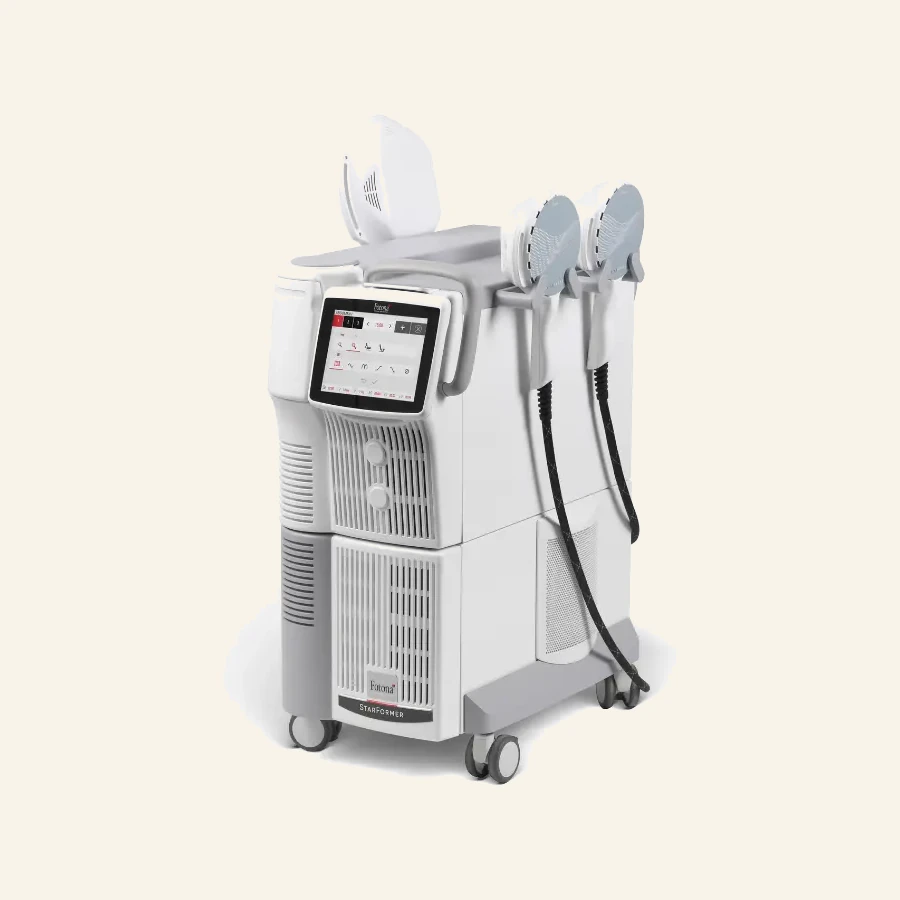
Every case is different. Discuss yours in a personal consultation.
Book a consultation on WhatsAppEvery figure published on this site is approximate and is not a quote. Any procedure or treatment first requires a private assessment consultation with Dr. Arístides Arellano —$800 MXN, charged separately— and it is at that consultation that the definitive cost of your case is determined.
Educational content; it does not replace a medical consultation. Results may vary from person to person.