
What is a facelift (rhytidectomy)?
Rhytidectomy addresses laxity of the mid and lower face: cheeks that have descended, deep nasolabial folds, loss of the jawline, jowls that break the facial oval, and laxity of the neck.
And it is worth understanding what actually ages a face, because everything else follows from it: a face does not merely fall — it also empties. Over the years the deep fat compartments of the face lose volume and descend, bone resorbs, and skin loses elasticity. These are three problems, not one.
That is why a facelift limited to pulling the skin produces the result everyone recognises and nobody wants: a tight, flat face, with the corners of the mouth dragged backward and no volume — an operated face, not a young one. Skin stretched over an empty face does not rejuvenate it: it gives it away.
The deep plane (SMAS) and restoring volume
The technical solution has two parts, and both are needed:
1. The deep plane is worked, not the skin. The SMAS (superficial musculoaponeurotic system) is the layer that supports the fat and muscles of the face. By repositioning and fixing it —upward and backward, along the correct vector— the skin is redraped over a structure already in place, and closed without tension. That is the difference between a firm facelift and a tight one: where the tension is placed. In the SMAS, it holds; in the skin, it shows.
2. The lost volume is restored, with fat grafting into the areas that emptied: cheekbone, temple, tear trough, jawline. Repositioning without refilling leaves a firmer but still gaunt face.
This approach is not new in this practice. In 1988 Dr. Arístides Arellano published the paper “Fat grafting and rhytidectomy” in Cirugía Plástica Ibero-Latinoamericana (Vol. XIV, No. 4, 1988) — that is, he wrote about combining fat grafting with the facelift more than three decades ago, when the prevailing approach still confined itself to tightening. Today that combination is the standard and is called the volumetric facelift. The document is in his credential archive, alongside his paper “Fat Injection” in Aesthetic Plastic Surgery (Springer-Verlag, 1990).
What is a deep plane facelift?
The deep plane facelift is the variant of rhytidectomy that works beneath the SMAS. Instead of tightening that layer from its surface (plication), the surgeon enters under it, releases the retaining ligaments that anchor the midface — the ones that keep a descended cheek pinned in place — and repositions skin and SMAS as a single composite block. The tension sits in the deep layer; the skin is never pulled on its own.
The practical difference is in the midface: when cheek descent is marked and the nasolabial fold is heavy, plication tightens the layer but the ligaments keep anchoring the tissue where it was; the deep plane releases them, which is why it reaches where plication falls short. In exchange, it is a deeper dissection, in the neighbourhood of the facial nerve branches, demanding more anatomy — not a “premium” menu option, but an indication decided by examining the face.
The deep plane facelift is offered as a surgical package from $80,000 MXN approx., all-inclusive — the same reference figure as the rhytidectomy, because the tariff quotes the operation, not the technique’s name. The indication (deep plane, plication or cervicofacial) is defined at the assessment.
Are there non-surgical alternatives to a facelift?
Yes, and the honest answer starts with something this page already explained: with age the face does not only descend, it also empties, and the skin loses elasticity as well. Those are three distinct problems, and non-surgical treatments work well on two of them.
On volume and skin quality there are genuine options: hyaluronic acid fillers restore volume, collagen biostimulators aim at firmness by gradually stimulating your own collagen, bioremodelators work on skin hydration and quality, and botulinum toxin acts on expression lines.
What none of them does is reposition the deep plane. Once there is real tissue descent —fallen cheeks, jowls breaking the jawline, neck laxity— and skin is genuinely in excess, the problem is one of position, not of volume or texture. No injection lifts the SMAS: it can soften and it can buy time, but it does not replace surgery once the indication is surgical.
And the opposite deserves saying just as plainly: sometimes surgery is too much. If there is no significant laxity and what bothers you is volume loss or skin quality, operating is over-treatment, and skin stretched over an empty face is precisely the result this page calls done. In that case the right answer is not to operate.
In practice the two paths coexist: many patients are managed non-surgically for years and move to surgery when the threshold is crossed, and after a facelift the work on skin and volume remains useful to sustain the result. Which one fits your case is not decided from a catalogue: it is decided by examining the face and measuring how much is descent, how much is emptiness and how much is skin. Results may vary from patient to patient.
Techniques used by Dr. Arístides Arellano
The plan is defined at the assessment, according to the degree of laxity, skin quality and —very particularly— how much volume has been lost:
- Facelift with SMAS plication / repositioning: the standard of modern rhytidectomy. Incisions are designed around the ear and within the sideburn, following natural creases, so they remain concealed.
- Deep plane facelift: dissection beneath the SMAS with release of the retaining ligaments, repositioning cheek and jawline as a composite block. Indicated when midface descent is marked; explained in detail in the section above.
- Face and neck lift (cervicofacial): for many patients the neck is what gives them away most — and a facelift that ignores the neck leaves an incongruent result: a young face above a neck that is not. When the case requires it, the platysmal bands and the cervicomental angle are addressed in the same operation.
- Facial fat grafting (volumetric facelift): grafting the patient’s own fat to restore lost volume in the cheekbone, temple and jawline. It is what restores the shape, not just the position.
- Associated submental liposuction: removal of submental fat to define the angle between chin and neck.
- Combination with blepharoplasty: the eyes age before the facial oval, and are frequently the first thing a patient notices. Operating both in the same session gives a more congruent result — a smooth face with drooping eyelids looks odd.
- Combination with laser resurfacing: a facelift repositions tissue, but it does not change skin quality — it does not erase the fine lines of the upper lip, nor pigmentation, nor sun damage. That is what the laser addresses: the practice’s fractional CO₂ AcuPulse, the same unit used for resurfacing. It is the most useful distinction a patient can take away from this page. Dr. Arístides lectured on “Facelift and skin resurfacing” in 1999.
How is it performed?
Surgery is performed under general anaesthesia or deep sedation in a hospital operating room, and lasts approximately 3 to 5 hours depending on the extent (face, neck or both) and any combined procedures. It usually requires one night of observation. A dressing or compression band is applied at the end, and rest is with the head elevated.
All surgery carries risk and requires a prior medical assessment. Results may vary according to each patient, their anatomy and their individual healing process.
Who is a good candidate?
Age is not the criterion — tissue quality is. There are 50-year-old patients who are better candidates than 65-year-old ones:
- Visible laxity of the cheeks, jawline or neck, with descent of the tissues.
- Skin with preserved elasticity: this is what allows it to redrape well over the new structure.
- Good general health, with no contraindications to surgery or anaesthesia.
- Not smoking, or stopping tobacco with the lead time indicated. Tobacco compromises the circulation of the facial skin flaps and is one of the most relevant risk factors in this surgery in particular. It is not a courtesy recommendation.
- Realistic expectations: a facelift repositions and restores volume; it does not stop ageing, does not change skin texture, and does not turn one face into another.
Recommended post-surgical treatments
Dr. Arístides may recommend facial manual lymphatic drainage and hyperbaric chamber sessions to reduce swelling and bruising —which are noticeable in the first weeks with this surgery— and, once matured, treatment of the periauricular scars. See the full guide: Post-surgical recovery and care.
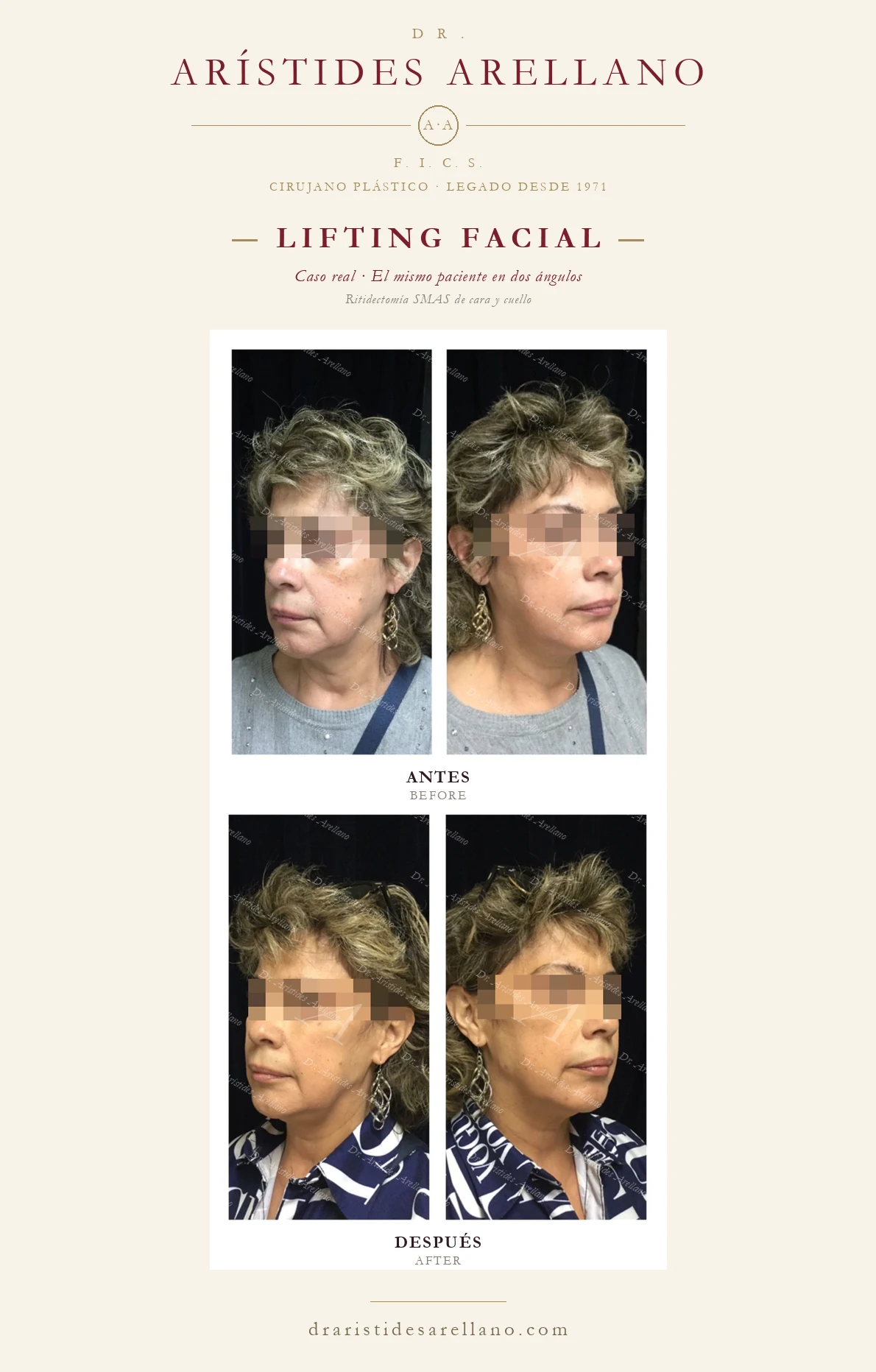
Before and after
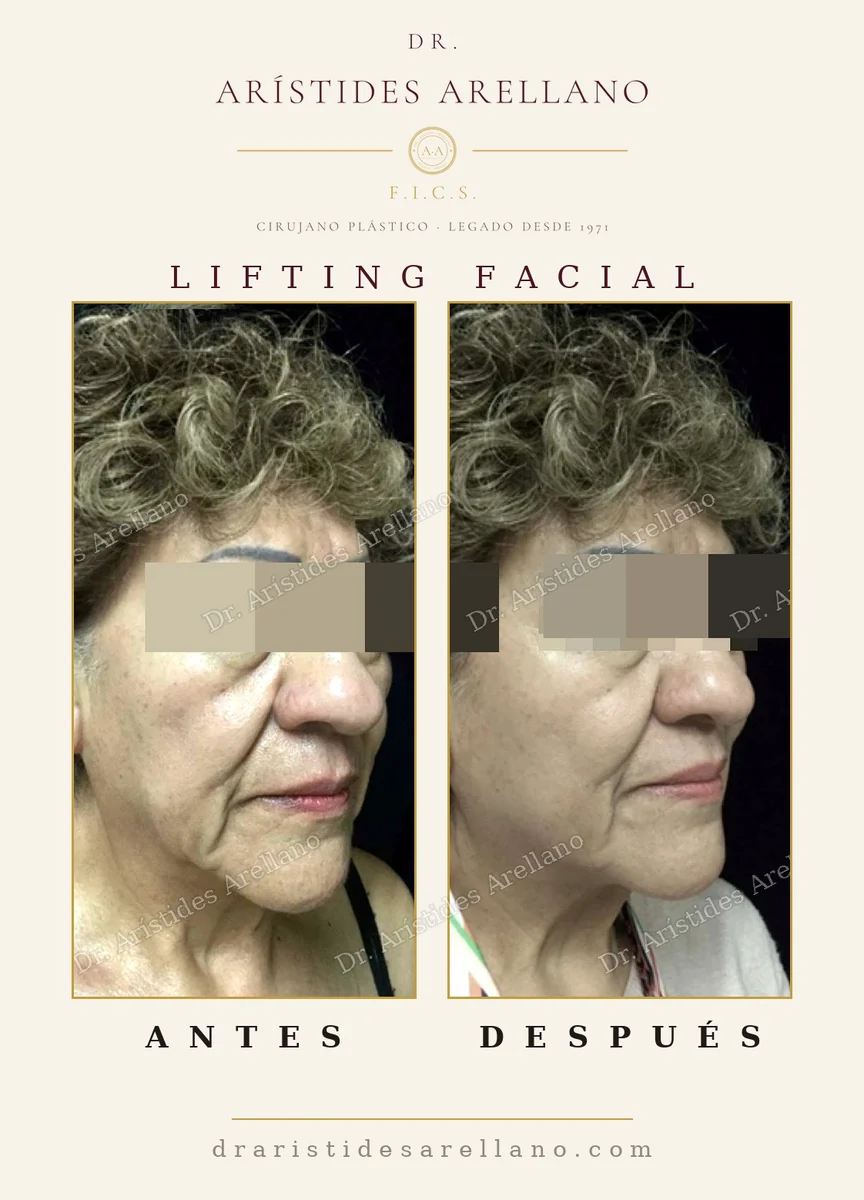
The cases below are real patients of Dr. Arístides Arellano, published with their written informed consent. Out of respect for each person’s privacy, only expressly authorised cases are published; at your in-person consultation Dr. Arístides can show you further cases with a starting point similar to yours. Results may vary from patient to patient.
Approximate price
A facelift (rhytidectomy) has a reference cost of $80,000 MXN. Approximate price — the definitive cost is set at your private consultation with Dr. Arístides Arellano. The final cost depends on the extent (face, neck or both), on whether it is combined with fat grafting, blepharoplasty or submental liposuction, and on hospital and anaesthetist fees. See all references in the price list. Full breakdown: how much a facelift costs in Mexico — the price table, what the figure includes and what it does not.
About Dr. Arístides Arellano
Dr. Arístides Arellano is a plastic surgeon holding a specialty licence: he practises under a Mexican medical licence (D.G.P. 1125959) and a specialty licence in Plastic & Reconstructive Surgery (0002008), both issued by the Directorate General of Professions (DGP), which reissued his certificate of professional standing in 2025. His career began before Mexico’s present-day specialty-board system existed: he belongs to the founding generation of plastic surgery in Puebla, the second generation of a surgical tradition started in 1971 by Dr. Francisco Arellano Ocampo. Trust is verified, not promised: both licences are public and anyone can look them up in the DGP’s National Registry of Professionals.
Related patient guide
If your assessment also includes the eyelids: Blepharoplasty: at what age, and how long results last — part of the informational guide series reviewed by Dr. Arístides Arellano.
Recovery · step by step
- Week 1Dressing or band; swelling and bruising. Rest with head elevated.
- Week 2Suture removal; most feel presentable.
- Weeks 3–4Gradual return to activity and light exercise.
- Months 2–6Scars mature and the result settles.
Risks and contraindications
A facelift is one of the most far-reaching facial operations, and its risks deserve to be understood as clearly as its benefits:
- Hematoma: the most frequent early complication of facelift surgery. Sudden swelling, pain or tightness in the first 24 to 48 hours requires immediate review, which is why that period includes close monitoring.
- Injury to facial nerve branches: may cause weakness of one movement (the brow, the corner of the mouth). Weakness usually recovers over weeks to months; permanent injury is infrequent, but possible.
- Skin necrosis: loss of circulation at the flap edges, especially behind the ear. Smoking multiplies this risk, which is why it is a strict contraindication.
- Sensory changes: numbness of the cheeks and ears (great auricular nerve territory), usually resolving gradually over months.
- Visible scarring or hairline loss: scar widening, or hair loss next to the incisions in the temple or behind the ear.
- Asymmetry: the two sides of the face do not heal or settle identically; a marked difference may require a touch-up.
- Seroma and infection: fluid build-up or wound infection; both are caught and treated at post-operative follow-up.
- Anesthetic risks: inherent to general anesthesia or prolonged sedation; assessed through your history and pre-operative tests.
A facelift is postponed or reconsidered in these situations:
- Active smoking: the single most important contraindication, because of flap necrosis risk. It must be stopped for weeks before and after surgery.
- Uncontrolled hypertension: it directly raises the risk of hematoma.
- Anticoagulants or antiplatelet drugs that cannot be paused with the prescribing doctor’s authorisation, and clotting disorders.
- Uncontrolled diabetes or other unmanaged chronic disease.
- Permanent fillers or recent thread lifts in the planes to be worked on: assessed case by case at the consultation.
- Expectations surgery cannot meet: a facelift repositions descended tissue; it does not change skin quality or stop aging.
Frequently asked questions
Are there non-surgical alternatives to a facelift?
Yes, and the honest answer starts with something this page already explained: with age the face does not only descend, it also empties, and the skin loses elasticity as well. Those are three distinct problems, and non-surgical treatments work well on two of them.
How much does a facelift cost in Puebla?
The reference price is approximately $80,000 MXN. The exact amount depends on the extent (face, neck or both), on whether it is combined with fat grafting, blepharoplasty or submental liposuction, and on hospital and anaesthetist fees. It is confirmed at your in-person consultation.
What is a deep plane facelift?
It is the variant of rhytidectomy that works beneath the SMAS: instead of tightening that layer from its surface, the retaining ligaments that anchor the midface are released and the skin and SMAS are repositioned as a single composite block. The tension sits in the deep layer, never in the skin, which is why it reaches the cheek and nasolabial fold where plication falls short. The indication is decided by examining the face at the assessment.
How much does a deep plane facelift cost in Mexico?
With Dr. Arístides Arellano in Puebla, the deep plane facelift is offered as a surgical package from approximately $80,000 MXN, all-inclusive: operating theatre, pre-operative laboratory work and post-surgical recovery treatments. It is the same reference figure as the rhytidectomy, because the operation is what is quoted, not the technique’s name; the definitive cost is set at the assessment.
Deep plane or SMAS: which is better?
That is the wrong question: both work the deep layer and both are serious rhytidectomies. Plication tightens the SMAS from its surface and handles jawline and neck laxity well; the deep plane releases the ligaments from beneath and reaches the midface better when cheek descent is marked. The choice is an indication decision — degree of descent, tissue quality, anatomy — made at the assessment, not from a menu.
Does a facelift leave the face tight or "done"?
That is exactly the result the technique aims to avoid, and it happens when the surgeon confines himself to pulling the skin. A well-executed facelift works the deep plane (SMAS) —the layer that supports the fat and muscles of the face— and repositions it; the skin is redraped over the top without tension. Lost volume is also restored with fat grafting. A tight face appears when the tension is placed in the skin; when it is placed in the SMAS, it holds and does not show.
What is the SMAS?
It is the superficial musculoaponeurotic system: the deep layer beneath the skin that supports the fat and muscles of the face. Repositioning and fixing it along the correct vector is what allows a firm, durable result without tightening the skin. It is the central technical difference between a modern facelift and a simple skin stretch.
Why is a facelift combined with fat grafting?
Because a face does not only fall with the years: it also empties. The deep fat compartments lose volume and descend. Repositioning without refilling leaves a firmer but still gaunt face, so volume is restored with fat grafting in the cheekbone, temple and jawline. Today it is called a volumetric facelift. Dr. Arístides Arellano published on this combination —“Fat grafting and rhytidectomy”— in Cirugía Plástica Ibero-Latinoamericana in 1988.
Does a facelift remove wrinkles?
Not all of them, and this is the most important distinction a patient can understand: a facelift repositions tissue and corrects laxity, but it does not change skin quality. It does not erase the fine lines of the upper lip, nor pigmentation, nor sun damage. For that, the surface of the skin is treated with fractional CO₂ resurfacing (AcuPulse), which can be combined with the surgery or done afterwards. Several of the cases on this page are exactly that: a lift plus the laser.
Is the CO₂ laser done during the same surgery or afterwards?
Both are possible and it is decided at your consultation. Blood supply to the skin is what governs the choice: over an area that has just been undermined in the lift, aggressive resurfacing adds healing risk. So the usual approach is to treat in the same operation the central zones that were NOT undermined — around the mouth and the eyes, which is where the fine lines live — and leave the rest for a later session, once the skin has settled.
Does a facelift include the neck?
It depends on the extent the case requires. For many patients the neck is precisely what gives them away most, and a facelift that ignores it leaves an incongruent result: a young face above a neck that is not. When indicated, the platysmal bands and the cervicomental angle are addressed in the same operation (a cervicofacial lift).
At what age should I have a facelift?
There is no single age, and age is not the criterion: what is assessed is tissue quality. There are 50-year-old patients who are better candidates than 65-year-old ones, because they retain better skin elasticity. It is assessed individually at consultation.
How long does a facelift last?
It usually lasts several years. A facelift turns the clock back, but it does not stop it: ageing continues its course from a better starting point. Maintaining a stable weight, not smoking and protecting the skin from the sun help preserve it. Results may vary between people and over time.
Can I have a facelift if I smoke?
Tobacco compromises the circulation of the facial skin flaps and is one of the most relevant risk factors in this surgery in particular, so stopping it with the lead time determined at consultation is required. It is not a courtesy recommendation: it directly affects healing and the safety of the procedure.
Where are the facelift scars?
The incisions are designed around the ear and within the sideburn, following natural creases, so they remain concealed. When the neck is addressed, a small incision under the chin may be added. Scars mature and fade over time.
Before and after
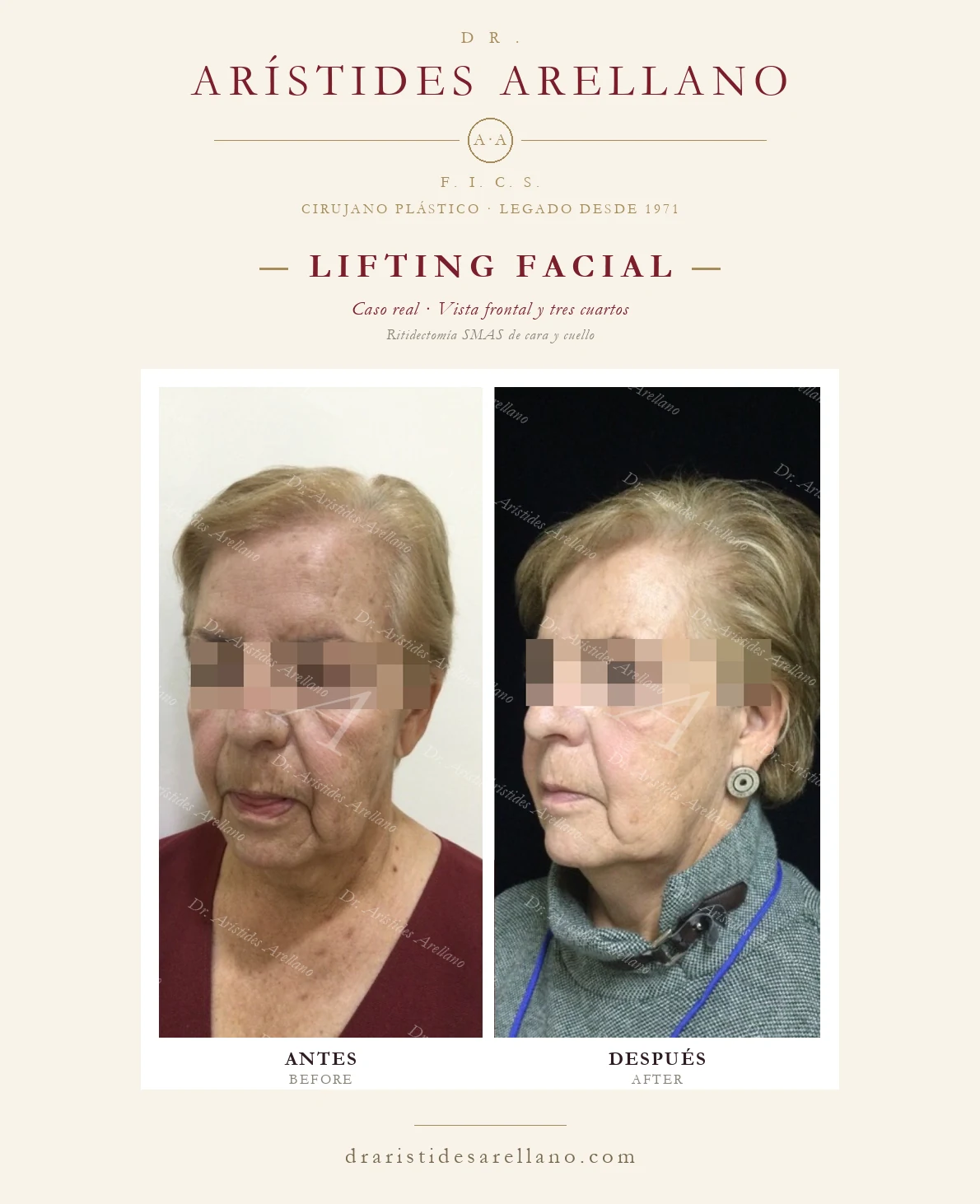
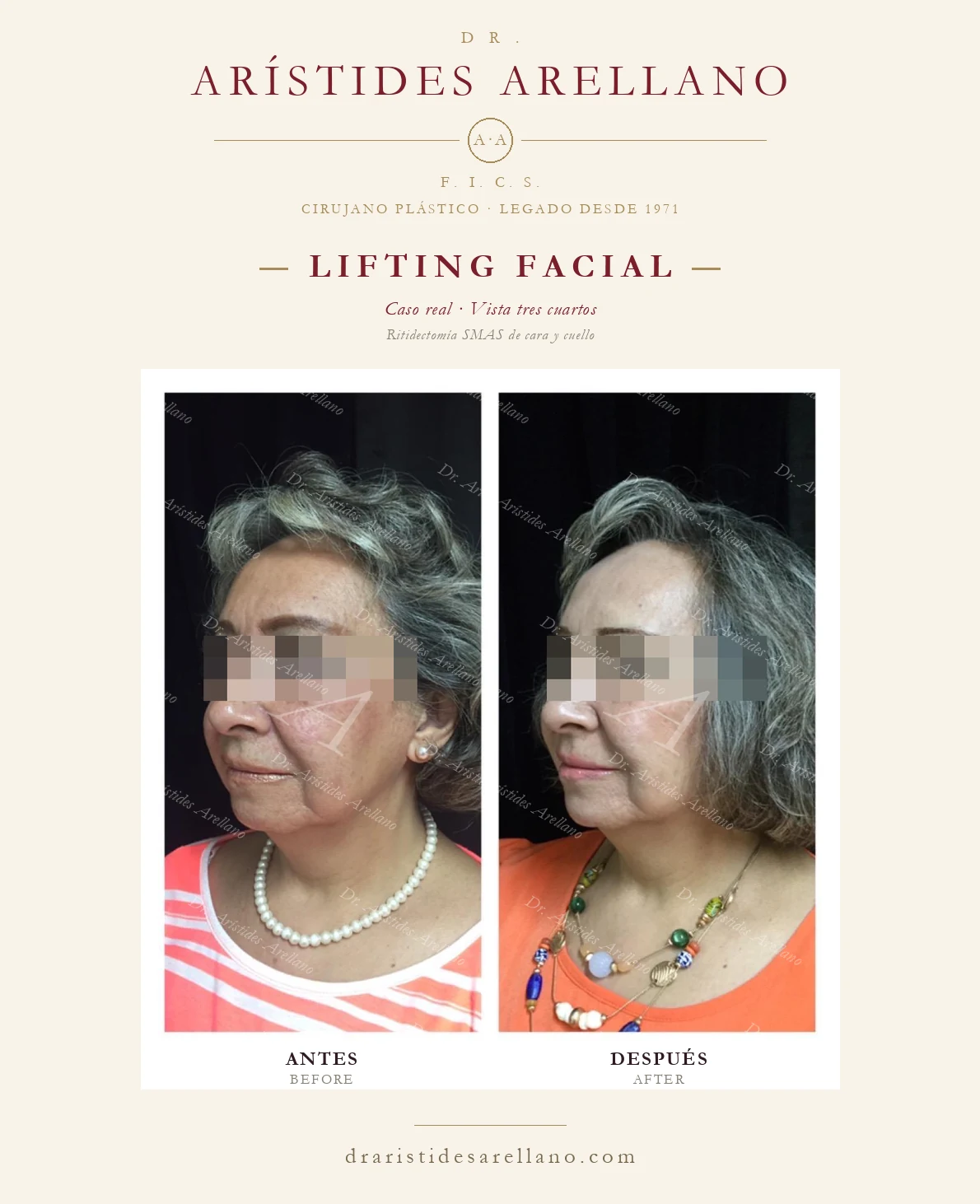
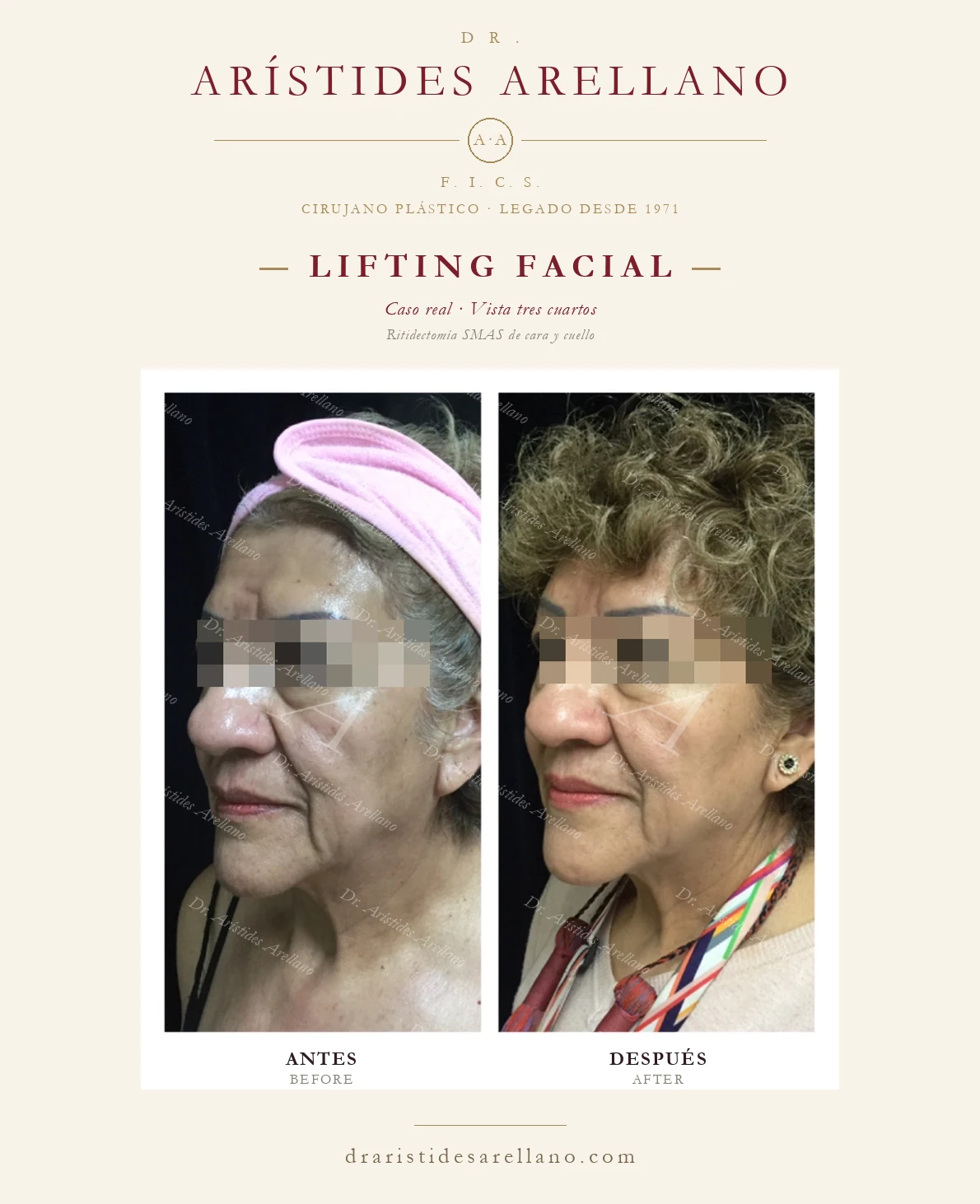
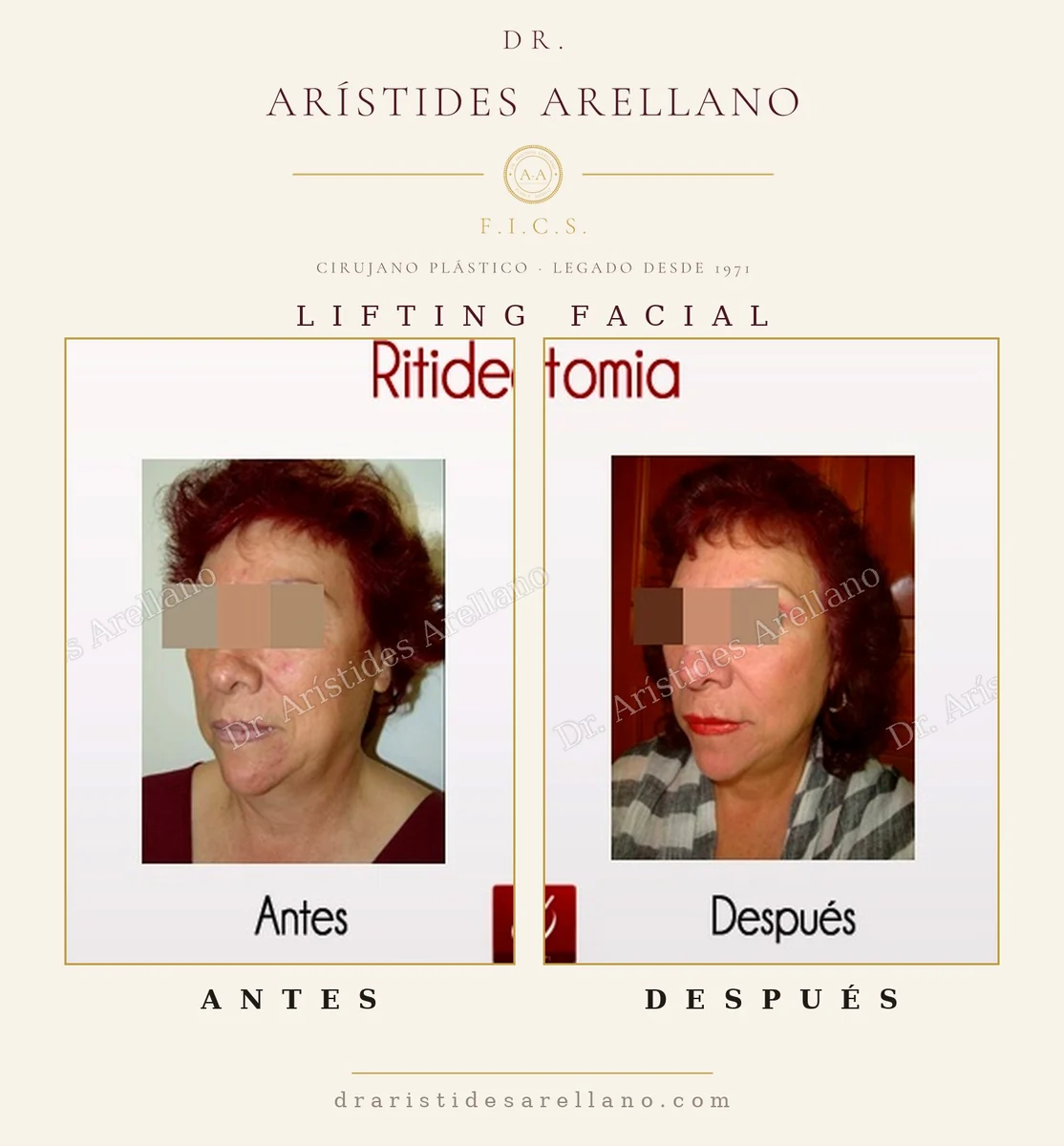
What is a facelift? It is putting descended tissue back where it belongs, not stretching skin. A lift that only pulls skin looks tight and lasts little; one that works the layer beneath — the SMAS, the muscular sheet of the face — raises the cheek and the jawline and holds for years. That difference is the whole operation. All surgery carries risks and requires a prior medical assessment; results vary from person to person.
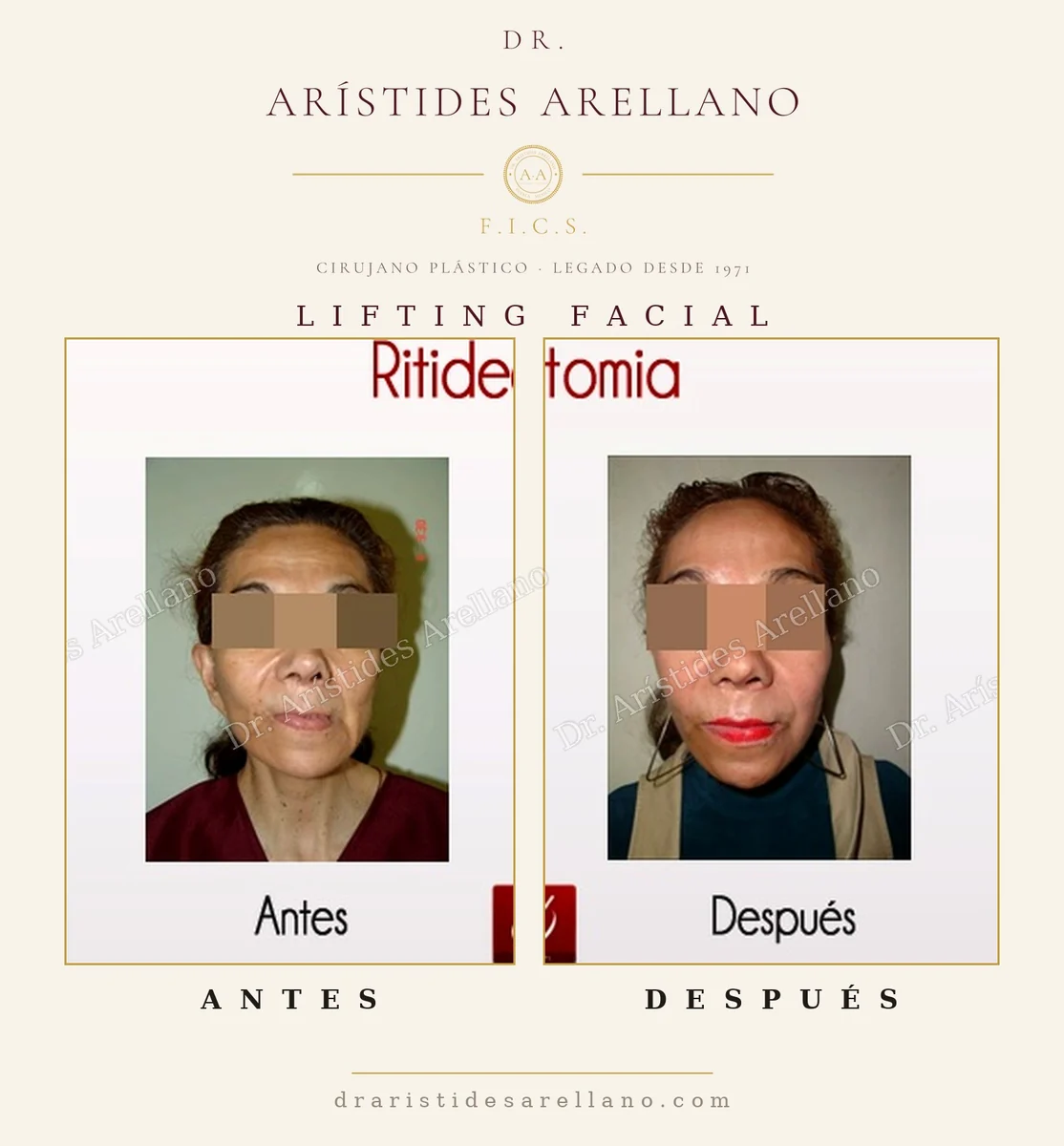
How much does a facelift cost? Here it starts at approximately MX$80,000 as an all-inclusive figure: theatre, pre-operative studies and recovery treatments are inside the price. It is the surgery where the gap between quoting the fee alone and quoting everything shows most, because theatre time is long. The definitive cost of each case is set at the private assessment consultation. All surgery carries risks and requires a prior medical assessment; results vary from person to person.
Threads or a facelift? They do not compete; they solve different stages. Threads reposition a little tissue and last twelve to eighteen months; they work when descent is just beginning. Once there is excess skin and the jawline has lost its edge, no thread brings it back — it only shifts things. Spending the price of a facelift on threads is the expensive mistake. All surgery carries risks and requires a prior medical assessment; results vary from person to person.
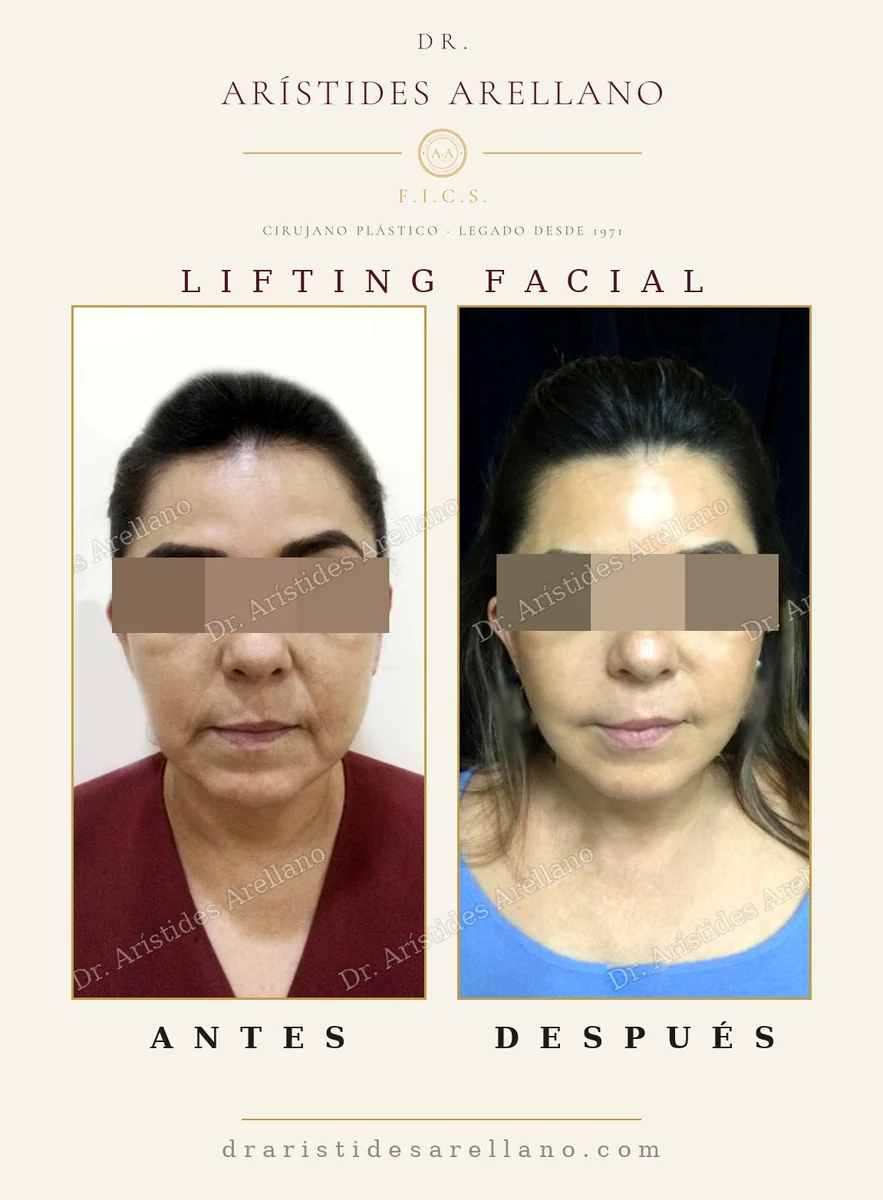
At what age? There is no age, there is a moment: when the skin of the neck and jaw no longer springs back on its own when you stretch it with your fingers. That usually falls between 45 and 60, but it arrives earlier with large weight loss or heavy sun exposure. Operating too early means operating again; too late demands more surgery for the same result. All surgery carries risks and requires a prior medical assessment; results vary from person to person.
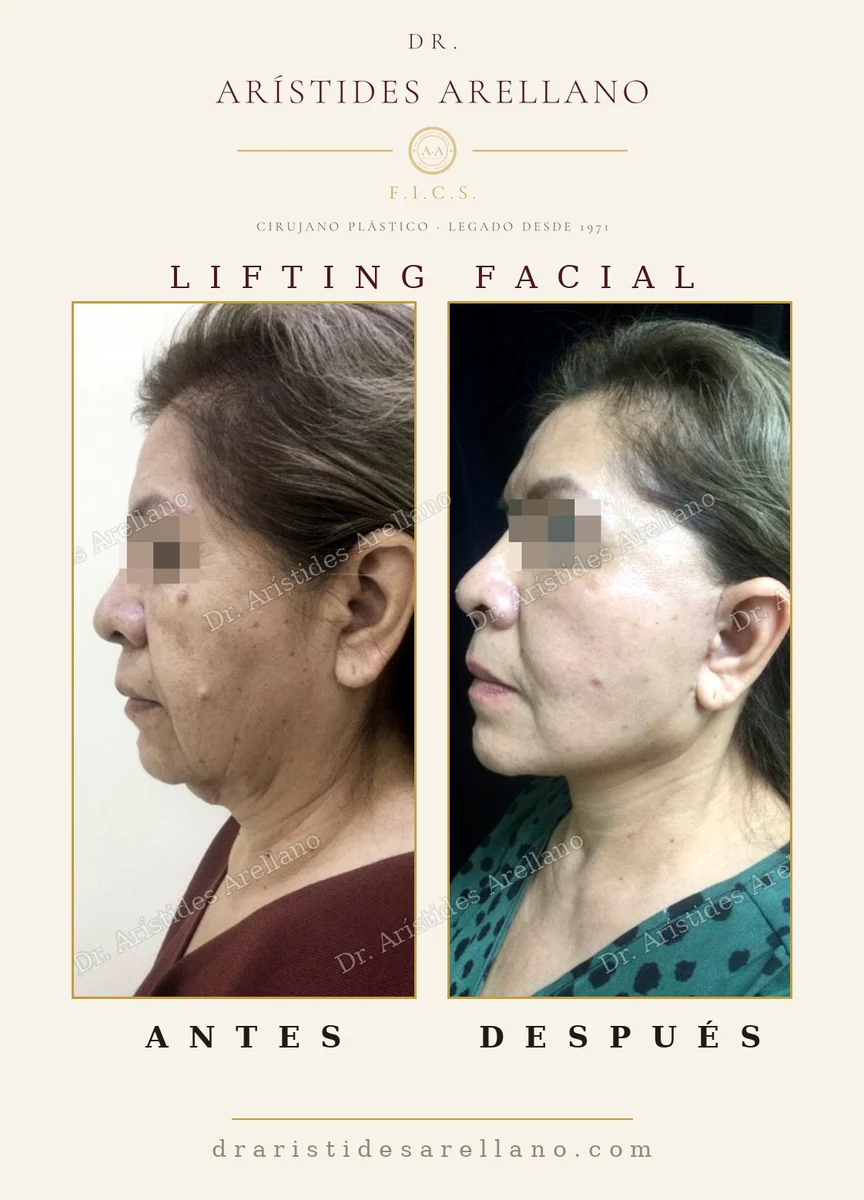
Where do the scars go? They follow the contour of the ear: up the front tucked into the crease, around the lobe, and down behind toward the hairline. That is why hair covers them from day one, and why the profile is the angle a facelift is judged from: if the scars show, they show here. All surgery carries risks and requires a prior medical assessment; results vary from person to person.
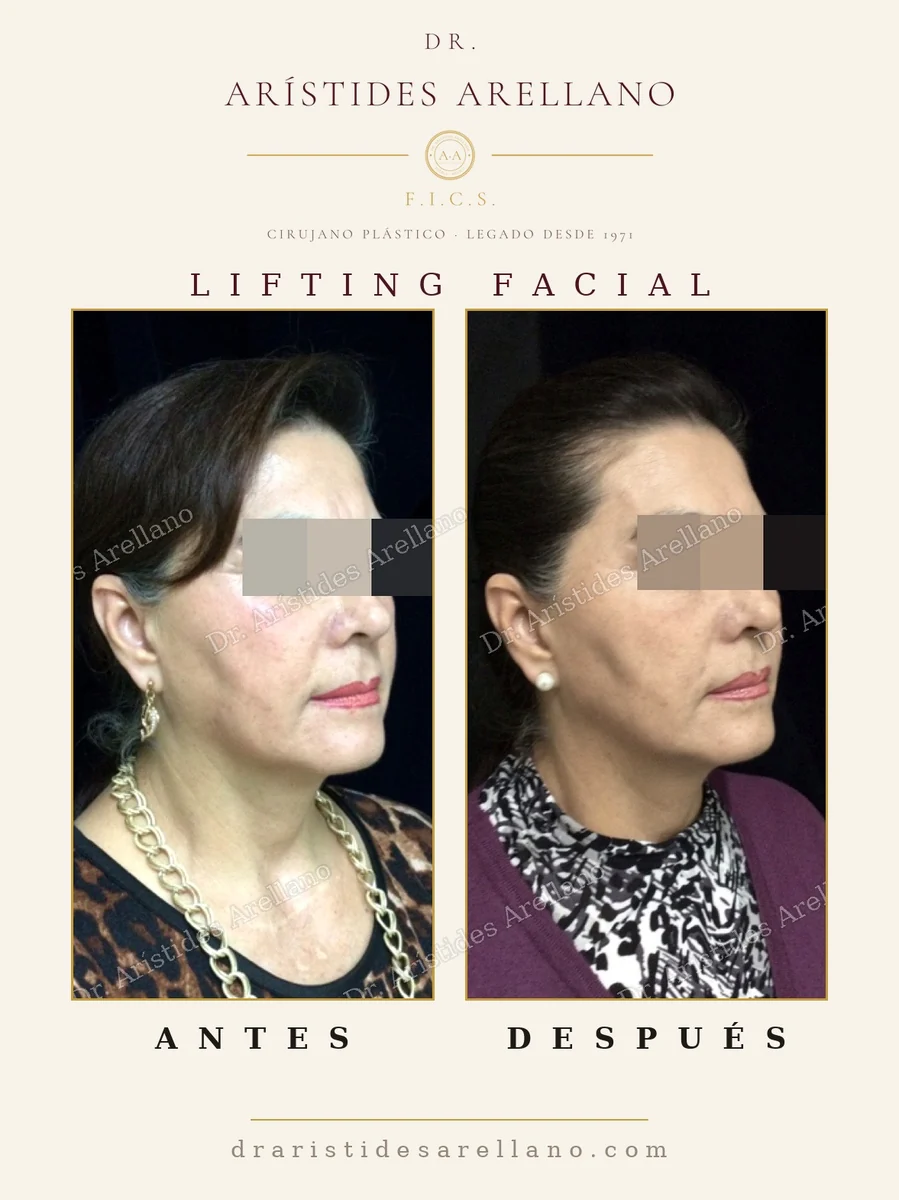
How long does it last? A facelift that works the SMAS buys eight to twelve years. It does not stop the clock: at ten years the face is still ageing, but from a better starting point than if nothing had been done. What shortens that most is smoking and sun, not the technique. All surgery carries risks and requires a prior medical assessment; results vary from person to person.
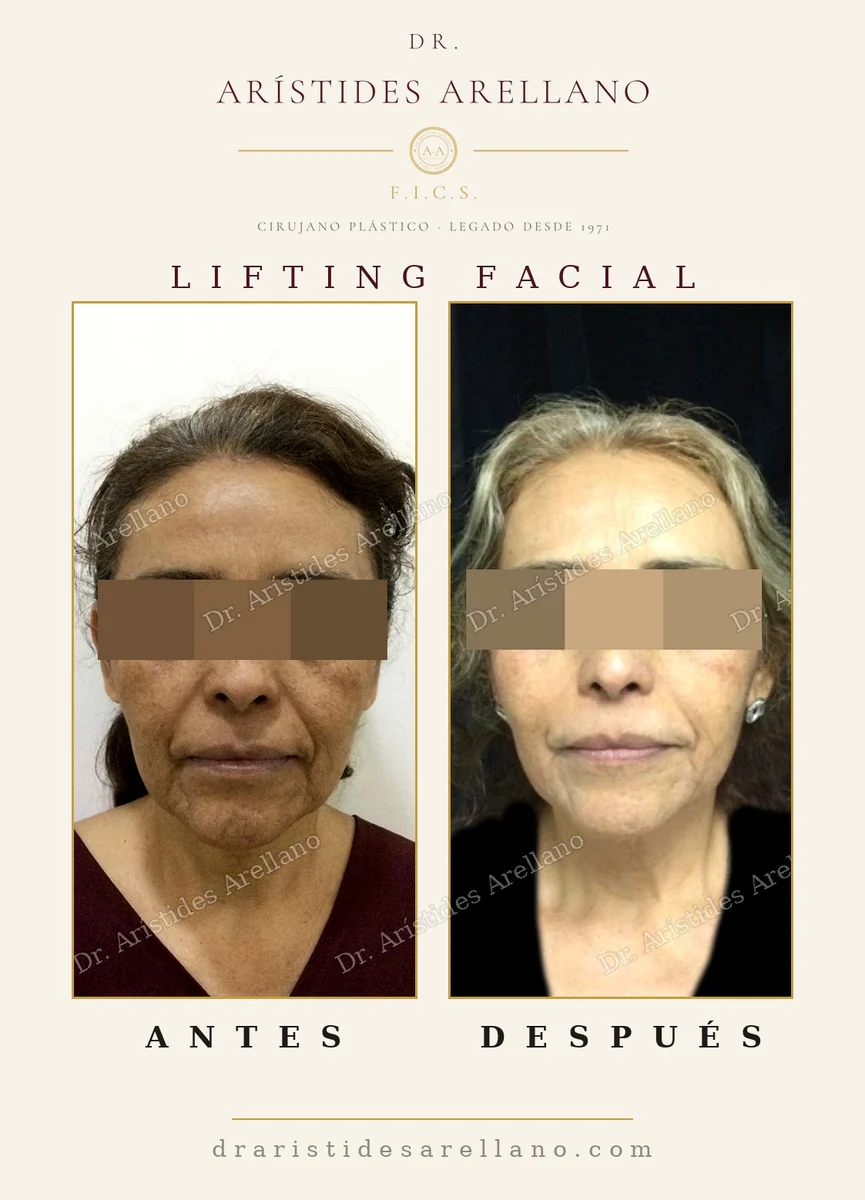
Does a facelift fix the neck too? Nearly always they have to be done together. Lifting the face and leaving the neck hanging is immediately obvious, and it is the result people recognise as «operated». The neck has its own work: treating the platysma bands and the angle beneath the chin. That is what gives the jawline back. All surgery carries risks and requires a prior medical assessment; results vary from person to person.
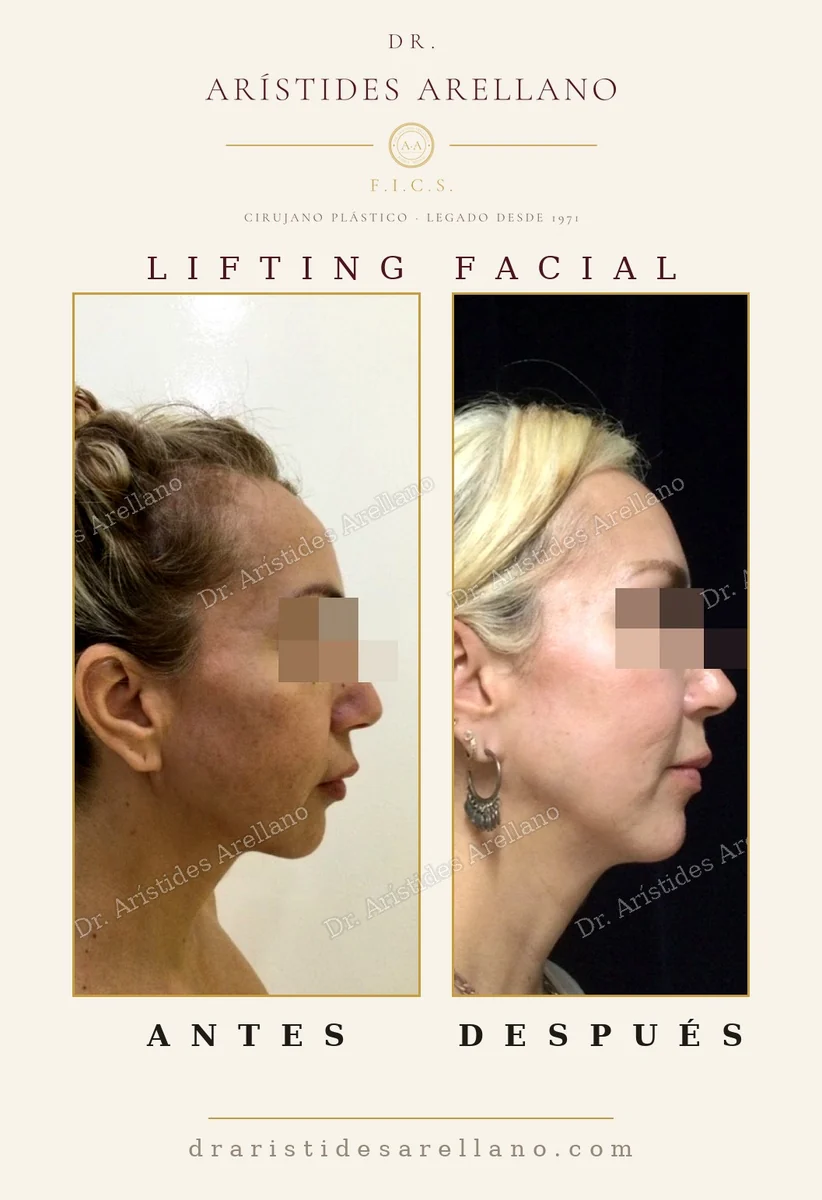
Will I end up looking pulled? That look has a specific cause: tightening skin instead of repositioning the deep layer. When the SMAS carries the tension, the skin settles over it without strain and the corner of the mouth does not shift. If the mouths in a surgeon's photos look dragged toward the ears, that is the technique you would be buying. All surgery carries risks and requires a prior medical assessment; results vary from person to person.
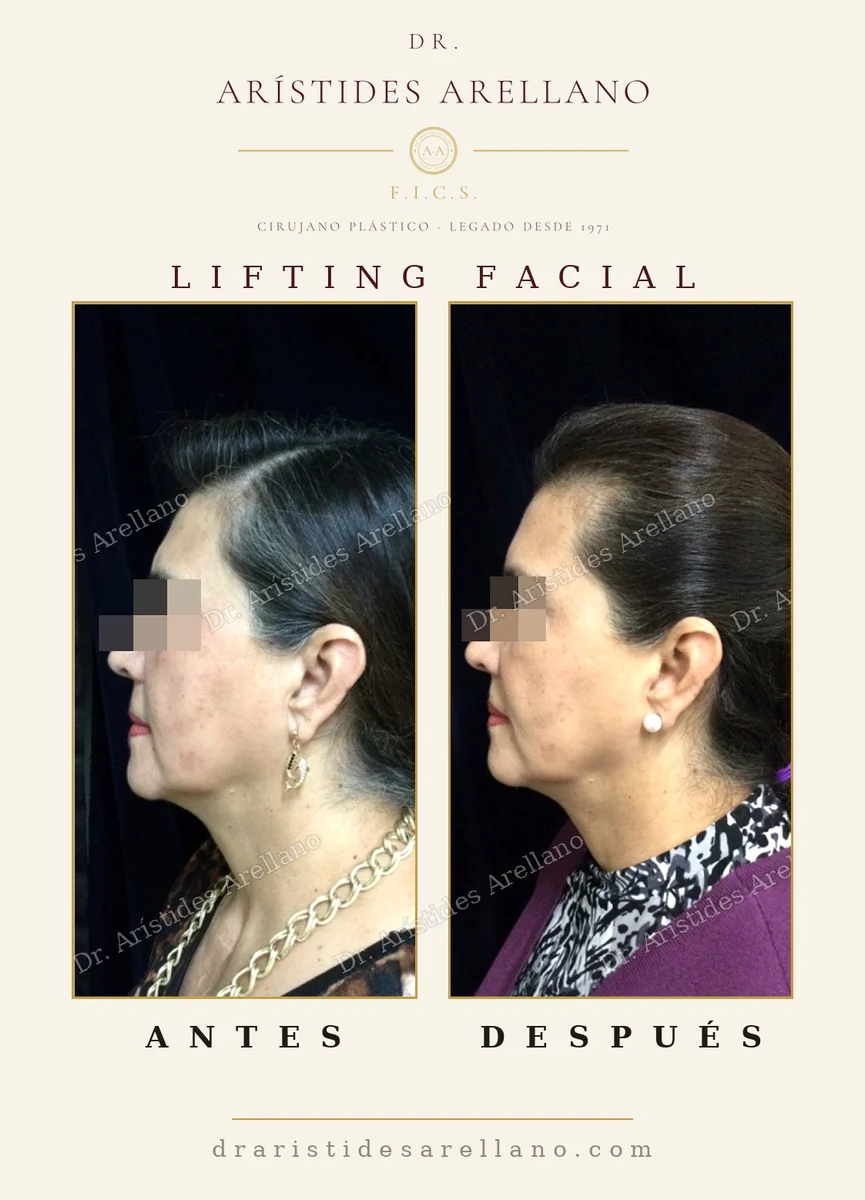
How long is recovery? Ten to fourteen days to look presentable with make-up and hair down; three weeks to return to normal social life. Fine swelling and a stiff, cardboard feeling take three to six months to fully resolve, and numb patches near the ear during that period are normal. The result is judged at six months. All surgery carries risks and requires a prior medical assessment; results vary from person to person.
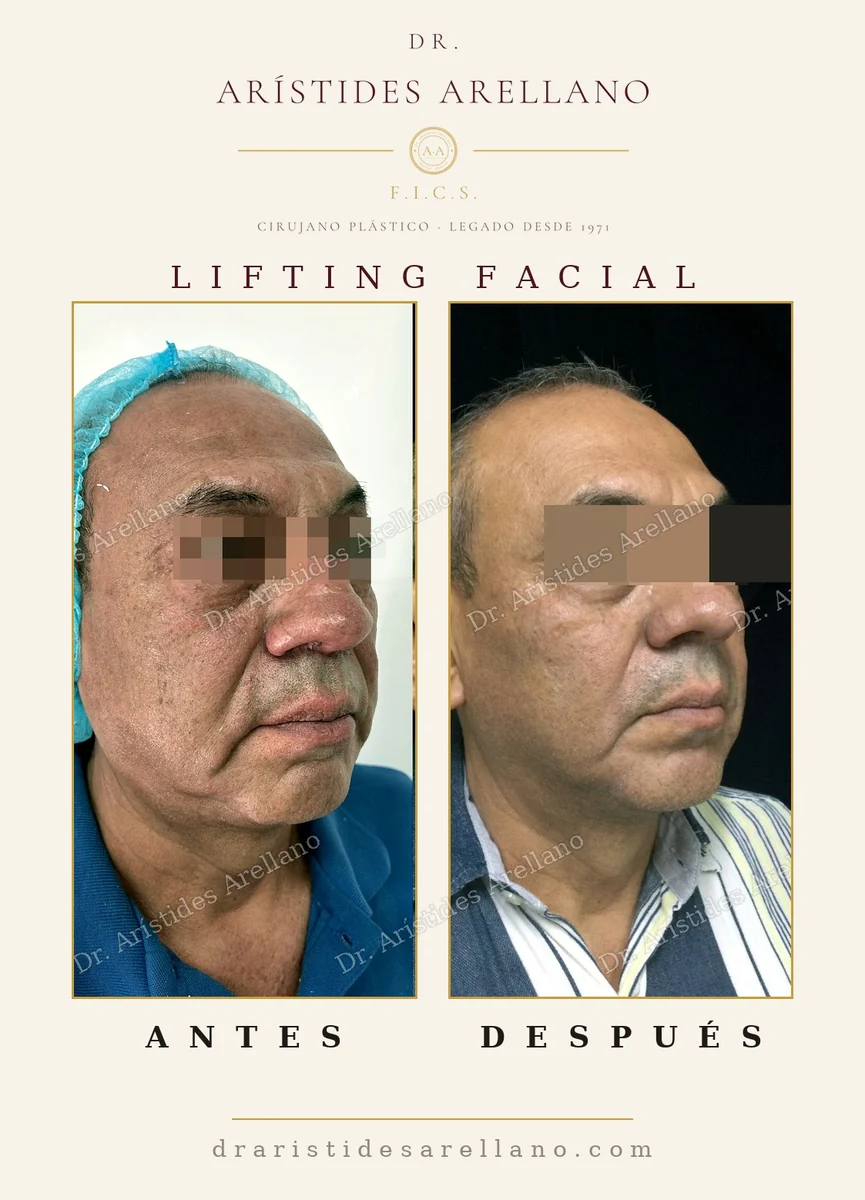
Do men have facelifts? Yes, with three real differences. Male skin is thicker and better vascularised, so it bleeds more and demands extra care against haematoma. The scars cannot be hidden with hair, so they are placed tight against the ear crease. And the bearded zone must be respected: shift it too far and hair ends up growing behind the ear. All surgery carries risks and requires a prior medical assessment; results vary from person to person.
Photographs of real patients, published with their written informed consent. Results may vary from person to person; these images are not a promise of outcome.
Every case is different. Discuss yours in a personal consultation.
Book a consultation on WhatsAppEvery figure published on this site is approximate and is not a quote. Any procedure or treatment first requires a private assessment consultation with Dr. Arístides Arellano —$800 MXN, charged separately— and it is at that consultation that the definitive cost of your case is determined.
Educational content; it does not replace a medical consultation. Results may vary from person to person.