
What is a BBL (fat-transfer buttock augmentation)?
The BBL —Brazilian Butt Lift— augments and shapes the buttocks using the patient’s own fat. It is really two surgeries in one: first a liposuction that sculpts the waist, lower back, flanks and hips; then the grafting of that same fat, purified, into the buttocks to add volume and projection.
That double effect is the real reason for its popularity: it does not merely enlarge the buttock, it creates the curve — because narrowing the waist changes the silhouette as much as filling the buttock does. And because it uses the patient’s own tissue, in most cases it needs no implants or foreign material.
Safety: the only conversation that matters in a BBL
This has to be said plainly, because the patient will read it elsewhere and deserves to read it here first: the BBL has historically carried the highest reported mortality rate of any aesthetic surgery. The cause is identified and it is a single one — fat embolism, which occurs when fat is injected inside the gluteal muscle, where the gluteal veins run, and one of them draws it into the circulation.
The response of plastic surgery worldwide to that problem is technical and specific: the fat does not go into the muscle. It is placed exclusively in the subcutaneous plane —above the fascia—, with a large-bore blunt cannula, in continuous motion, with the tip always under the surgeon’s visual and tactile control. That is the technique performed in this practice.
- Grafting exclusively subcutaneous, above the gluteal fascia. Never intramuscular. This is not a matter of style: it is the point at which the risk is decided.
- Large-bore blunt cannula, kept moving — never a fine needle or a static injection, which are the conditions that favour fat entering a vein.
- Volume is dictated by safety, not by a catalogue. When the volume a patient requests could only be achieved by compromising the plane, the answer is a smaller volume — or a second stage.
- Hospital operating room with an anaesthetist and full monitoring.
Dr. Arístides Arellano’s experience in fat grafting
The BBL is a relatively recent surgery as a commercial category. Fat grafting —the technique it is built on— is not, and that is where Dr. Arístides Arellano’s verifiable track record lies. Every document cited here can be consulted in his credential archive:
- Published author on fat grafting. His paper “Fat Injection” appeared in Aesthetic Plastic Surgery 14:127–136 (Springer-Verlag, 1990) — an international peer-reviewed journal, on the exact technique the BBL is built on, more than three decades before the procedure became popular.
- Coordinator of the International Fat Graft Symposium (Buenos Aires, June 1989; chairman: Dr. Abel Chajchir), and participant in the International Symposium on Fat Graft Surgery and Liposuction the same year.
- Member of the World Association of Gluteal Surgeons (WAGS) since 2019 — a membership that, as stated on the certificate itself, is granted on the basis of ethical and safety standards. In the surgery whose reputation is precisely a safety problem, that is the endorsement that counts.
- WAGS 2025 · Annual Conference & Body Contouring Workshop (12.5 AMA credits, Saint Louis University School of Medicine) — the technique is kept current; it is not a memory from the nineties.
- Member of the International Federation for Adipose Therapeutics and Science (IFATS) since 2016 — the scientific society devoted to adipose tissue.
How is it performed?
Surgery is performed under general anaesthesia in a hospital operating room and lasts approximately 2 to 4 hours, depending on the number of liposuction areas. It has three stages: harvest of the fat by liposuction of the donor areas (abdomen, flanks, back), purification of that fat to separate viable tissue from blood and fluids, and re-injection into the subcutaneous plane of the buttock, through multiple fine tunnels to maximise contact between the graft and vascularised tissue — which is what determines how much fat survives.
All surgery carries risk and requires a prior medical assessment. Results may vary according to each patient, their anatomy and their individual healing process.
Who is a good candidate?
- Enough donor fat. This is the requirement that rules out the most candidates: with no fat to move, there is no BBL. A very slim patient may not have sufficient material, and in that case we say so at the consultation instead of operating.
- Stable weight. The graft behaves like any other fat in the body: if weight rises or falls significantly, the result changes.
- Good general health, with no contraindications to surgery or general anaesthesia.
- Genuine willingness to follow the post-operative instructions — above all, no sitting directly on the buttocks for 2 to 3 weeks. It is the instruction most often broken and the one that ruins the most results: pressure on freshly grafted fat kills it before it revascularises.
- Realistic expectations: part of the grafted fat is always reabsorbed. Anyone promising 100% retention is not describing the biology of a graft.
Recommended post-surgical treatments
The BBL is the surgery in which post-operative care weighs most heavily on the result, because grafted fat must revascularise to survive. Dr. Arístides may recommend manual lymphatic drainage —for the swelling of the liposuction areas— and hyperbaric chamber sessions, aimed at supporting tissue oxygenation during the phase in which the graft is integrating. See the full guide: Post-surgical recovery and care.
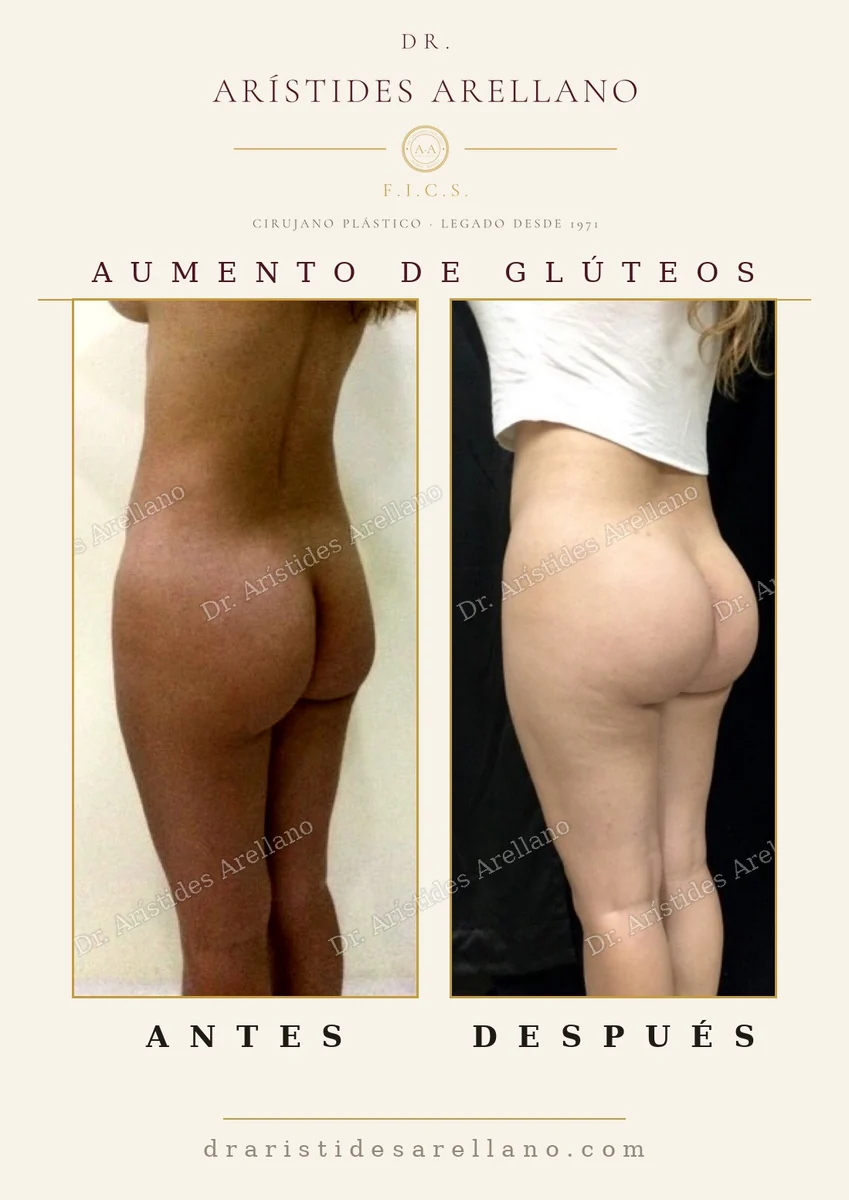
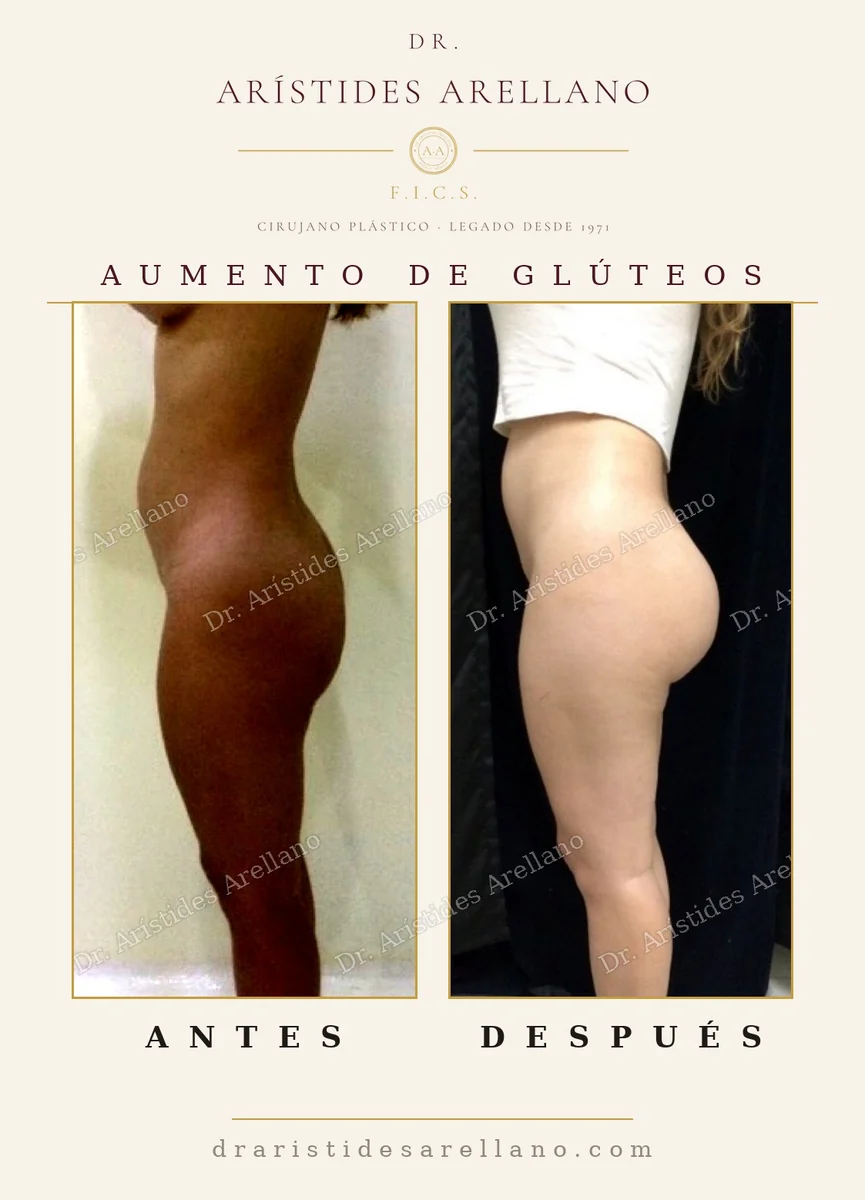
Before and after
The cases below are real patients of Dr. Arístides Arellano, published with their written informed consent. Out of respect for each person’s privacy, only expressly authorised cases are published; at your in-person consultation Dr. Arístides can show you further cases with a starting point similar to yours. Results may vary from patient to patient.
Approximate price
Buttock augmentation with the patient’s own fat has a reference cost of $70,000 MXN. Approximate price — the definitive cost is set at your private consultation with Dr. Arístides Arellano. The final cost depends on the number of liposuction areas worked to harvest the fat, and on hospital and anaesthetist fees. See all references in the price list. How much does liposuction cost in Mexico? — the body-contouring price table.
About Dr. Arístides Arellano
Dr. Arístides Arellano is a plastic surgeon holding a specialty licence: he practises under a Mexican medical licence (D.G.P. 1125959) and a specialty licence in Plastic & Reconstructive Surgery (0002008), both issued by the Directorate General of Professions (DGP), which reissued his certificate of professional standing in 2025. His career began before Mexico’s present-day specialty-board system existed: he belongs to the founding generation of plastic surgery in Puebla, the second generation of a surgical tradition started in 1971 by Dr. Francisco Arellano Ocampo. Trust is verified, not promised: both licences are public and anyone can look them up in the DGP’s National Registry of Professionals.
Related patient guide
A BBL includes a liposuction, and its recovery closely resembles it: Liposuction recovery, week by week — part of the informational guide series reviewed by Dr. Arístides Arellano.
Dr. Arístides explains it
Informational video by Dr. Arístides Arellano. Every case is different: the details of your procedure are defined at your consultation.
Recovery · step by step
- Weeks 1–3No sitting directly on the buttocks; a special cushion is used. Compression garment.
- Week 2Light activity; sitting and sleeping precautions continue.
- Weeks 4–6Progressive return; part of the grafted fat is naturally reabsorbed.
- Months 3–6Volume stabilizes and the definitive contour appears.
Risks and contraindications
Buttock fat transfer is the aesthetic procedure that has received the most safety scrutiny in the past decade, and for good reason: injecting fat into the wrong plane can cause a lethal fat embolism. The honest conversation starts there:
- Fat embolism: the serious, signature risk of this procedure. It happens when fat is injected into the muscle and enters the large gluteal veins. The international technical answer — injection exclusively in the subcutaneous plane, above the fascia, with a large blunt cannula kept in motion — exists precisely to prevent it, and it is the technique described on this page.
- Deep vein thrombosis and pulmonary embolism: clots in the legs that can travel to the lungs; prevented with compression, early walking and medication when indicated.
- Partial fat resorption: part of the transferred volume is reabsorbed in the first months; the stable result is assessed around month three or four, and the volume plan accounts for it from the start.
- Donor-site liposuction risks: contour irregularities, seroma and sensory changes in the areas the fat is taken from.
- Oil cysts and fat necrosis: collections of fat that did not survive the graft; they can form palpable nodules or require drainage.
- Infection: uncommon; monitored at follow-up.
- Asymmetry: volume or projection differences between the two sides, which may require a touch-up.
Buttock fat transfer is postponed or reconsidered in these situations:
- Insufficient donor fat: in very thin patients there is no material to transfer safely; the alternative is discussed at the consultation.
- Clotting disorders or an uninvestigated thromboembolic history.
- Active smoking, because of its effect on graft survival and healing.
- Social-media volume expectations: when the desired volume could only be reached by compromising the safe injection plane, the answer is a smaller volume or a second stage. Safety sets the limit.
Frequently asked questions
Is a BBL dangerous?
The BBL has historically carried the highest reported mortality rate of any aesthetic surgery, and the cause is identified: fat embolism, which occurs when fat is injected inside the gluteal muscle, where the gluteal veins run. The technical answer is specific and it is the one applied in this practice: fat is placed exclusively in the subcutaneous plane, above the fascia, with a large-bore blunt cannula kept in motion. Never intramuscular. That is the decision where the risk is determined, which is why it is worth asking any surgeon, in any city, which plane they place the fat in.
Which plane is the fat placed in during a BBL?
Exclusively in the subcutaneous plane, above the gluteal fascia. It is not injected inside the muscle. This is the central safety measure of the procedure, because the gluteal veins —the route by which fat can reach the circulation and cause an embolism— run within the muscle.
How much does a BBL cost in Puebla?
The reference price for buttock augmentation with the patient’s own fat is approximately $70,000 MXN. The exact amount depends on the number of liposuction areas worked to harvest the fat, and on hospital and anaesthetist fees. It is confirmed at your in-person consultation.
How much fat is reabsorbed after a BBL?
Part of the grafted fat is always reabsorbed during the first months: this is the normal biology of a graft, which must revascularise to survive. The fat that remains after that period is stable long term if weight is maintained. No surgeon can guarantee 100% retention. Results may vary.
When can I sit normally after a BBL?
Avoiding direct pressure on the buttocks for about 2 to 3 weeks is advised, using a special cushion that supports the thighs and offloads the grafted area. It is the instruction most often broken and the one that ruins the most results: pressure on freshly grafted fat kills it before it can revascularise.
Can I have a BBL if I am very slim?
Possibly not. A BBL requires enough donor fat, and that is the requirement that rules out the most candidates: with no fat to move, there is no procedure. The assessment reviews the fat available in the abdomen, flanks and back; if there is not enough, we say so plainly and discuss other options rather than operating.
Does a BBL use implants?
In most cases no: it uses the patient’s own fat, with no foreign material. Gluteal implants exist as a separate technique, with their own indications, risks and considerations; they are discussed at the assessment when the case warrants it.
What is Dr. Arístides Arellano’s experience with fat grafting?
He published the paper “Fat Injection” in Aesthetic Plastic Surgery 14:127–136 (Springer-Verlag, 1990), an international peer-reviewed journal, on the technique the BBL is built on. He was coordinator of the International Fat Graft Symposium in Buenos Aires in 1989. He has been a member of the World Association of Gluteal Surgeons (WAGS) since 2019 —a membership granted on the basis of ethical and safety standards, as stated on the certificate— and of the International Federation for Adipose Therapeutics and Science (IFATS) since 2016. The documents are in the credentials section of this site.
Does a BBL also slim the waist?
Yes, and it is a central part of the result. A BBL includes liposuction of the donor areas —waist, flanks, lower back— so the silhouette changes in two ways: the waist narrows and the buttock fills. The narrowing of the waist frequently contributes as much to the final curve as the buttock augmentation does.
Before and after
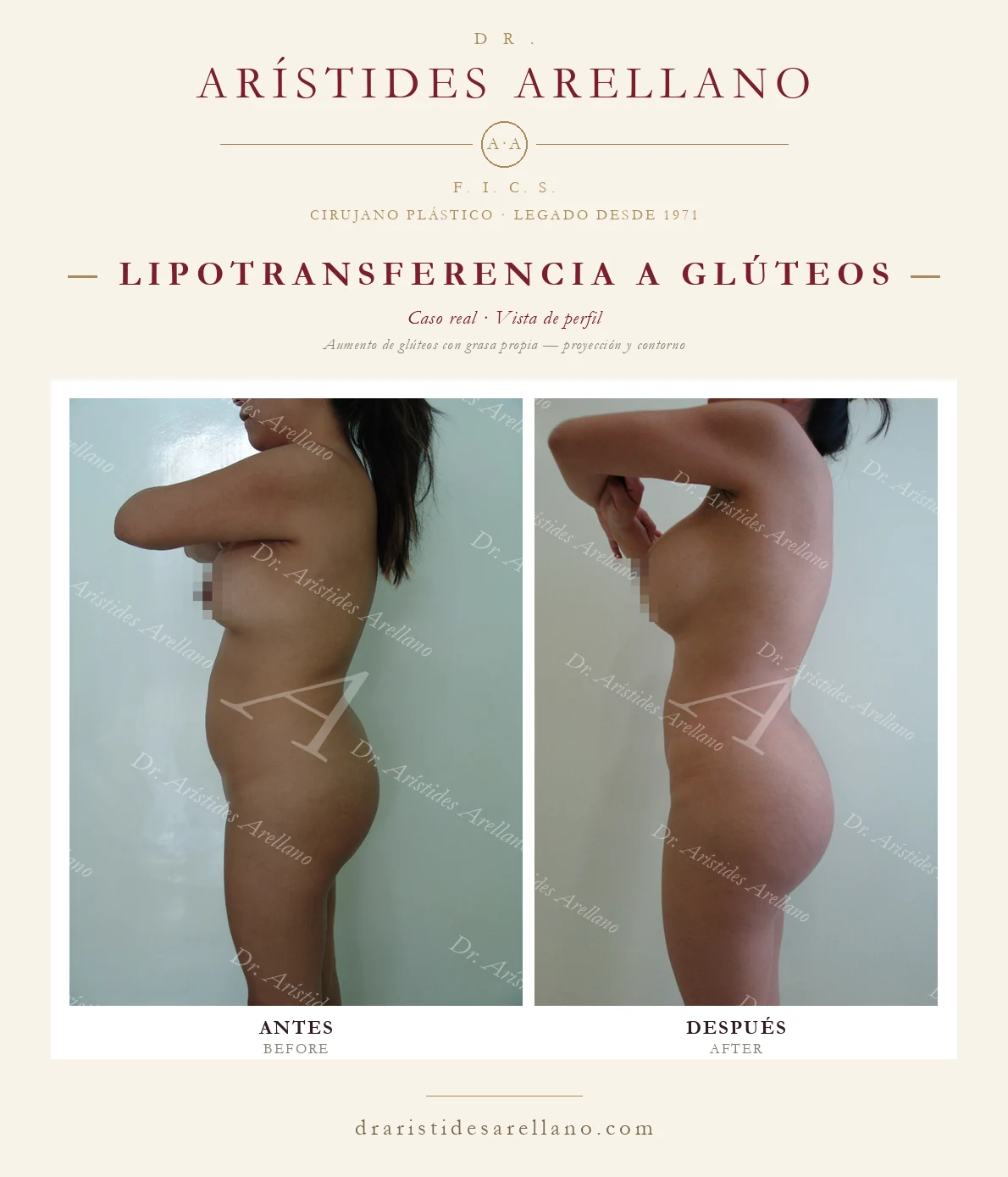
Real case of buttock augmentation (BBL) in Puebla, profile view. Gluteal fat transfer uses the patient's own fat —harvested by liposuction of the abdomen, waist or back— and reinjects it into the buttock; no implants are used. Part of the grafted fat is reabsorbed over the first months, which is why the definitive result is assessed between 3 and 6 months. All surgery carries risks and requires a prior medical assessment; results may vary from person to person.
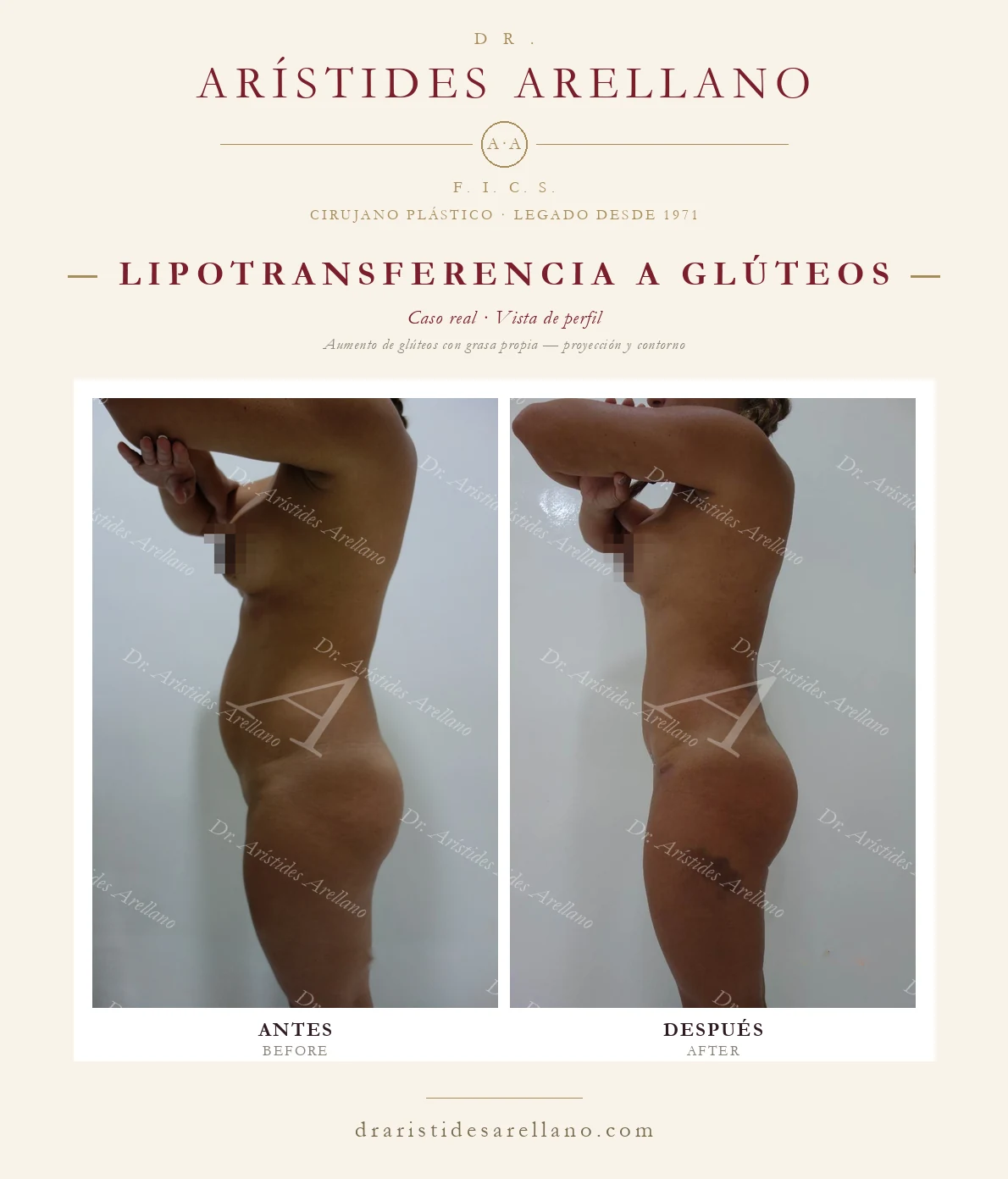
Real case of buttock augmentation with own fat in Puebla, profile view. A BBL works two areas at once: fat is removed from the waist and back —which narrows the waistline— and that same fat gives projection to the buttock. All surgery carries risks and requires a prior medical assessment; results may vary from person to person.
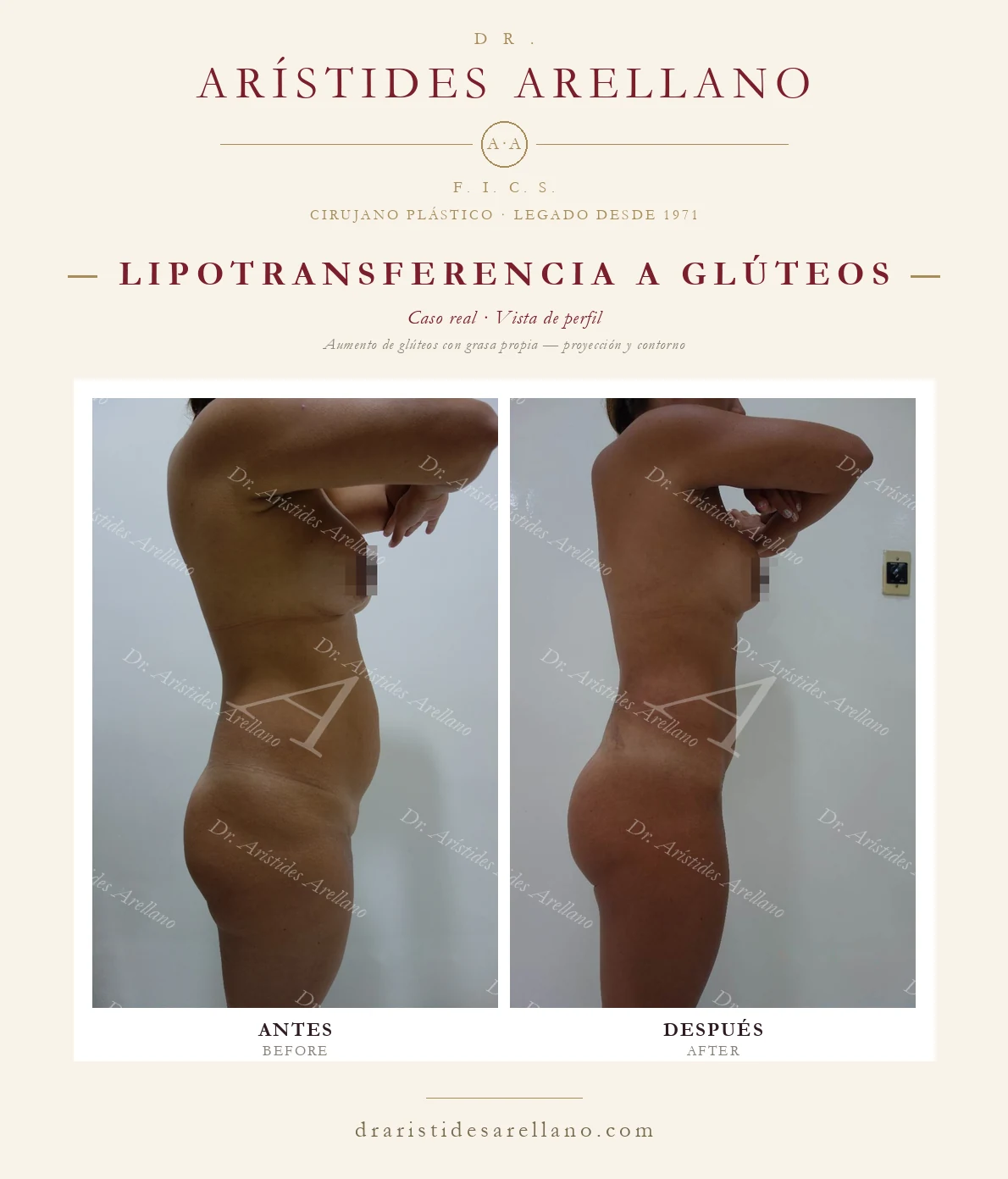
Real case of buttock augmentation (BBL) in Puebla, profile view. After surgery the patient avoids sitting directly on the buttocks for the first weeks and wears a compression garment continuously: much of the fat that survives depends on that care. All surgery carries risks and requires a prior medical assessment; results may vary from person to person.
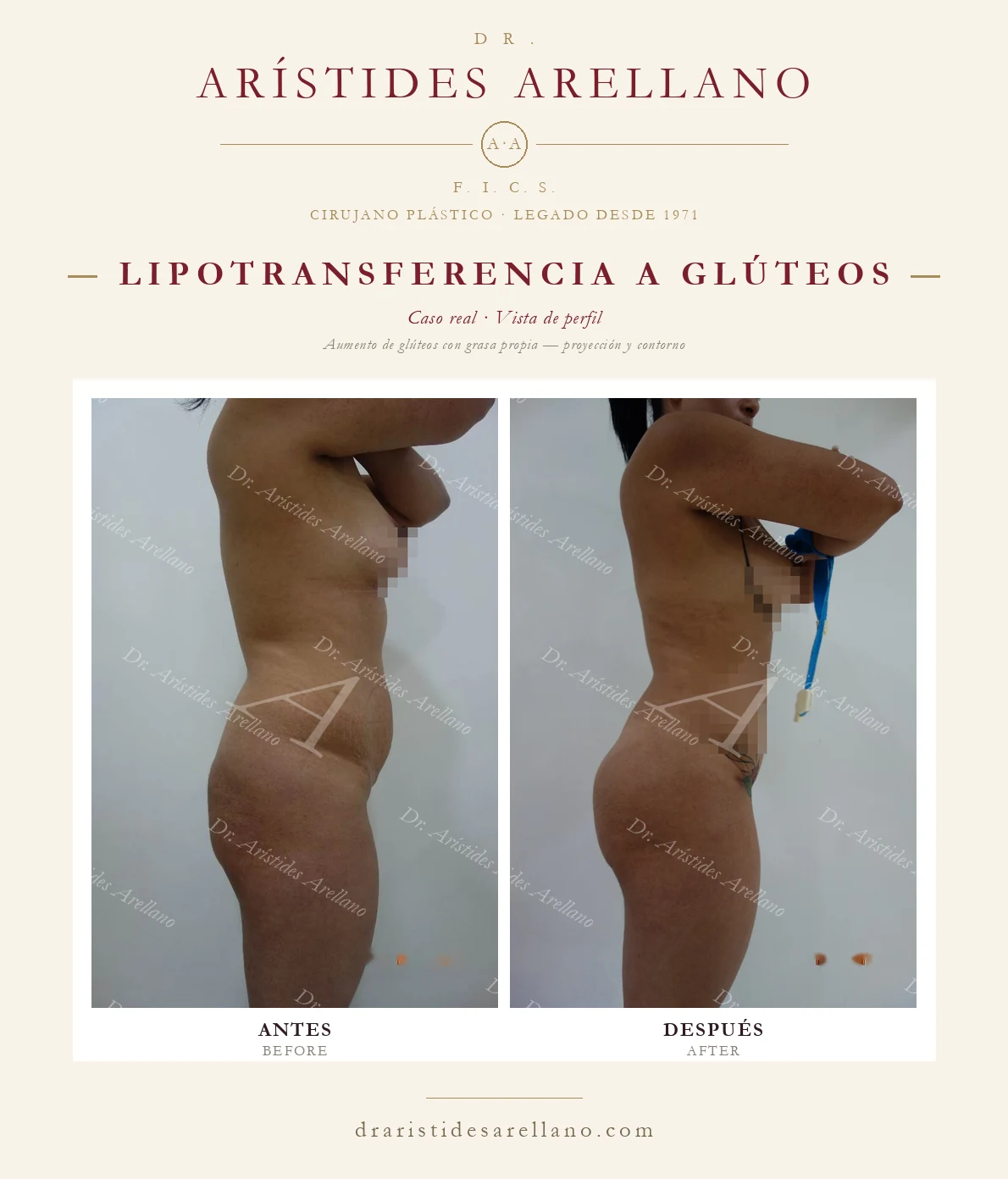
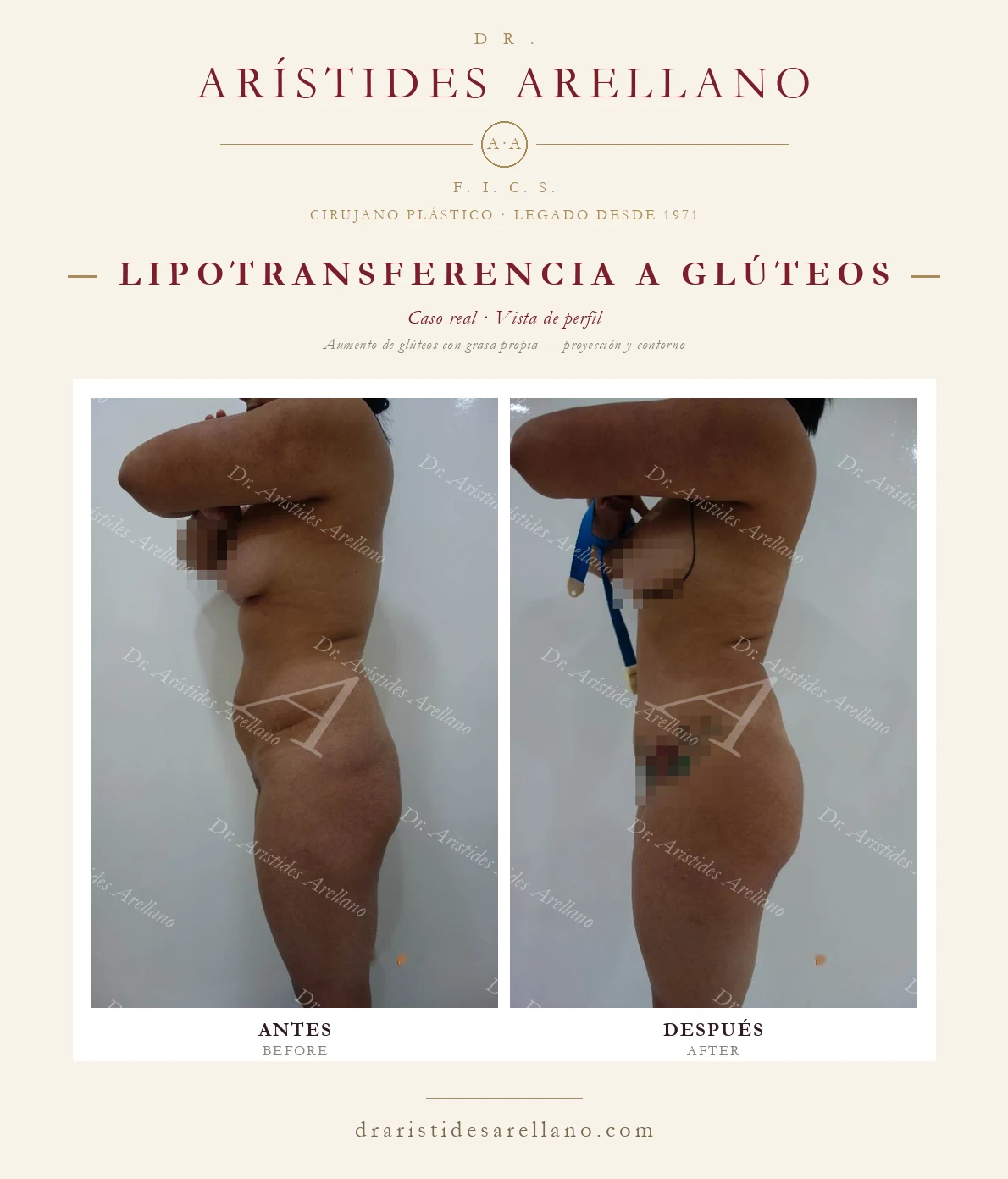
Real case of buttock augmentation (BBL) in Puebla, profile view. The goal is not the largest possible volume but the proportion between waist, hip and buttock; how much fat can be grafted depends on the fat available in each patient. All surgery carries risks and requires a prior medical assessment; results may vary from person to person.
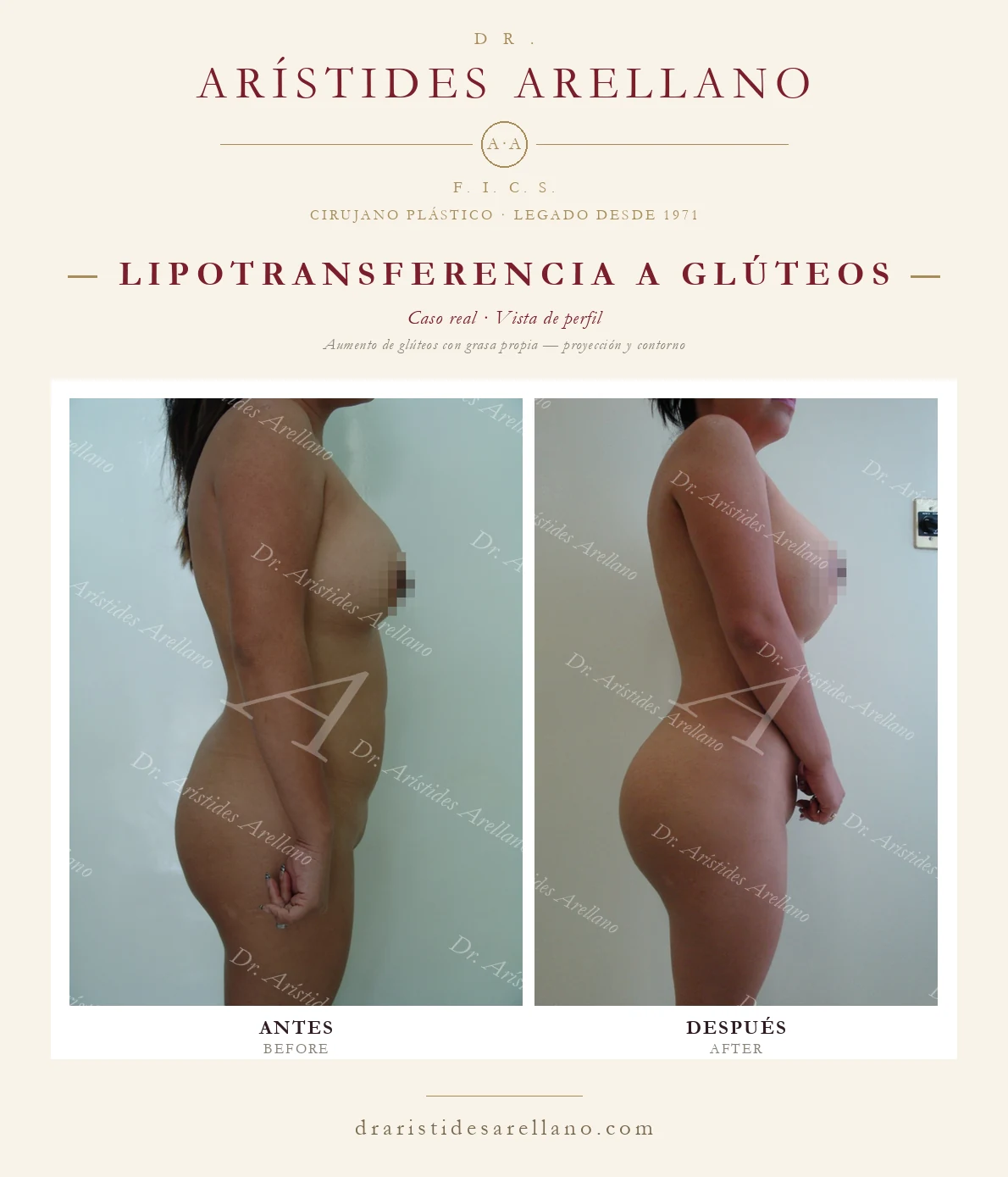
Real case of buttock augmentation (BBL) in Puebla, profile view. The lateral view shows a BBL result best, because gluteal projection can only be appreciated from the side. All surgery carries risks and requires a prior medical assessment; results may vary from person to person.
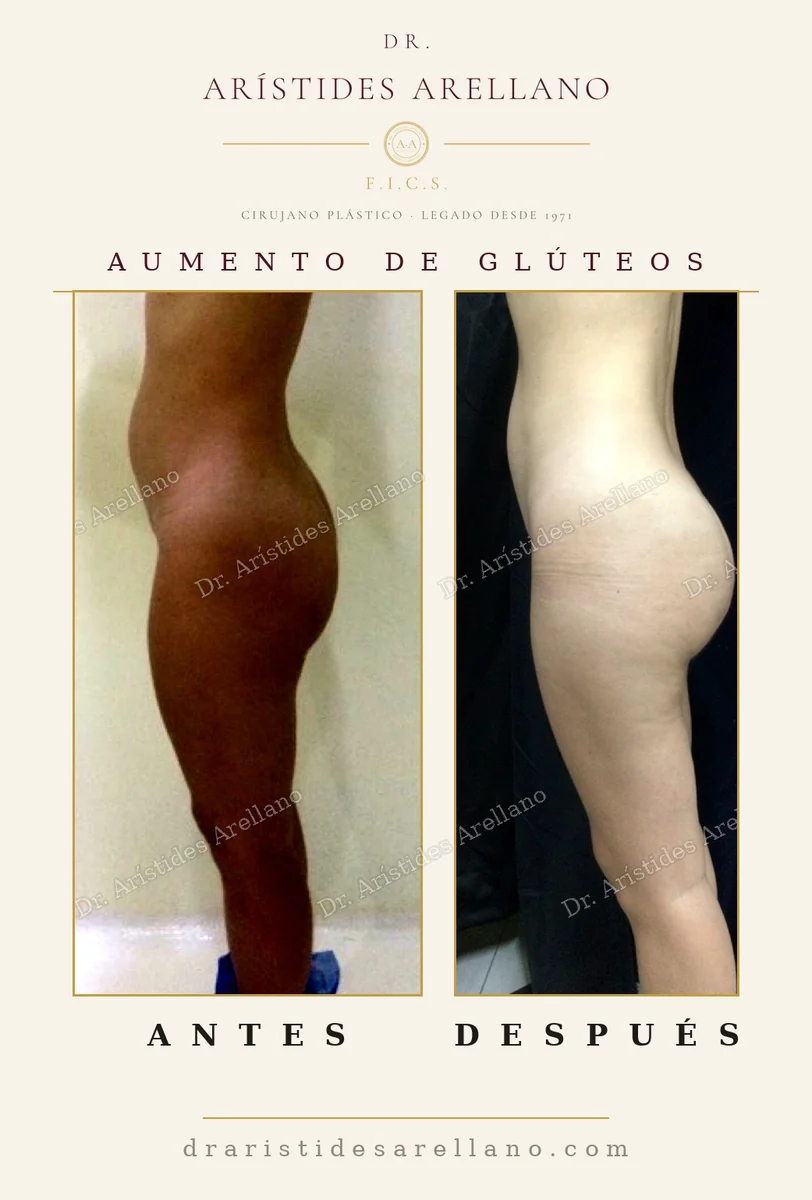
What is a BBL? It is buttock augmentation with your own fat: fat is suctioned from the waist, back or abdomen, processed, and grafted into the buttock. Two changes in one operation — the waist narrows and the buttock projects — which is why the profile changes so much: it is not only what goes in, it is what comes off around it. All surgery carries risks and requires a prior medical assessment; results vary from person to person.
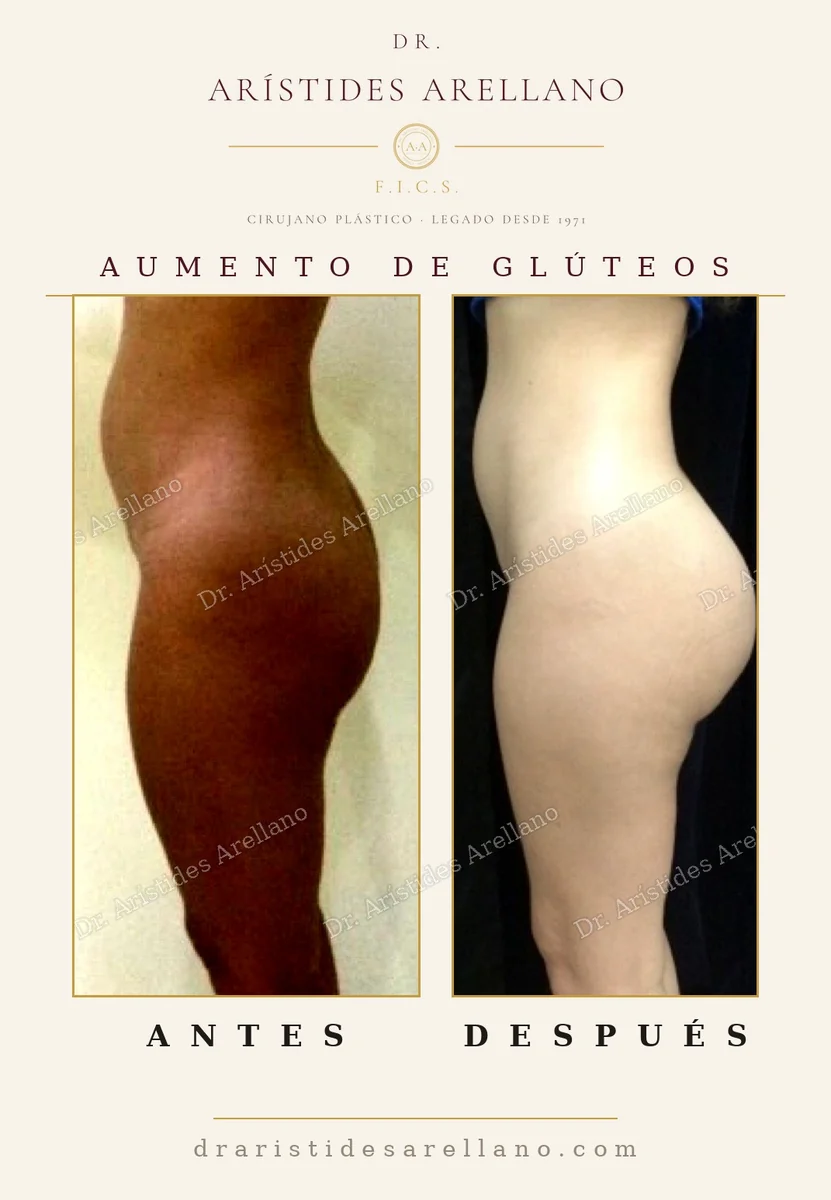
How much does buttock augmentation cost? Here gluteal fat grafting starts at approximately MX$70,000, with theatre, labs and recovery included. The price depends on how many areas are suctioned, because the donor fat is the raw material: without enough fat to remove, there is no graft to place. The definitive cost of each case is set at the private assessment consultation. All surgery carries risks and requires a prior medical assessment; results vary from person to person.
Own fat or an implant? Fat gives a more natural shape and puts the waist liposuction to use, but it needs available donor fat and part of it reabsorbs. An implant gives guaranteed volume to a very slim patient with nowhere to harvest from, at the cost of a foreign body and a rougher recovery. How slim the patient is usually settles it. All surgery carries risks and requires a prior medical assessment; results vary from person to person.
How long does it last, and does it reabsorb? Between 30 and 50 % of the grafted fat reabsorbs in the first six months: only the fat that establishes a blood supply survives. What remains after that is permanent and behaves like the rest of the body — it rises and falls with your weight. That is why the result is measured at six months, and why week-one photos deserve suspicion. All surgery carries risks and requires a prior medical assessment; results vary from person to person.
Photographs of real patients, published with their written informed consent. Results may vary from person to person; these images are not a promise of outcome.
Every case is different. Discuss yours in a personal consultation.
Book a consultation on WhatsAppEvery figure published on this site is approximate and is not a quote. Any procedure or treatment first requires a private assessment consultation with Dr. Arístides Arellano —$800 MXN, charged separately— and it is at that consultation that the definitive cost of your case is determined.
Educational content; it does not replace a medical consultation. Results may vary from person to person.