
What a hyperbaric chamber is: pressure plus oxygen
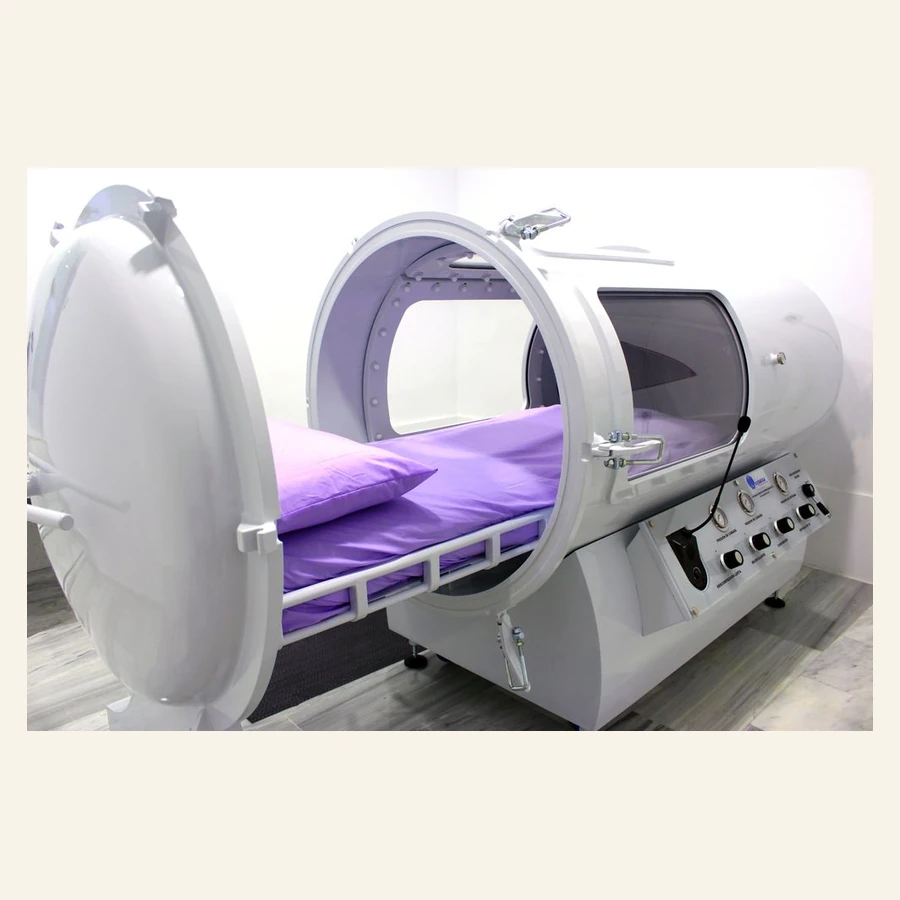
A hyperbaric chamber is a sealed enclosure in which air pressure is raised above normal atmospheric pressure while the patient breathes oxygen. That combination —pressure plus oxygen— is what defines the treatment. The accepted medical definition also puts numbers on it: at least 1.4 atmospheres absolute and near-100% oxygen. Take either condition away and it is not hyperbaric oxygen therapy, and further down you will see why that precision matters so much.
The names in circulation are almost all synonyms: hyperbaric therapy, hyperbaric oxygen therapy and hyperbaric oxygenation all mean the same thing. The chamber is the equipment; the therapy is what happens inside it.
There are two broad families of equipment, and the difference between them carries far more weight than it appears to: rigid medical-grade chambers, and soft fabric chambers that operate at much lower pressures. We give that a section of its own below, because everything you can honestly claim about any chamber follows from it.
One clarification up front: this is not a spa treatment or a relaxation pod, however it is marketed in some places. It is a medical device, it is prescribed after an assessment, and it has real contraindications.
What it is genuinely used for, and what that rules out
The short answer fits in one sentence: it delivers more oxygen to tissue whose oxygenation is the problem. That thread runs through every genuine indication it has, and it is also the most useful test for spotting the false ones. When a patient's problem is not a lack of oxygen in a tissue, the chamber has nothing to contribute.
Hyperbaric medicine has a short list of situations recognized by the UHMS (Undersea and Hyperbaric Medical Society, the US professional society for the specialty), with devices cleared by the FDA in that country, where the evidence supports its use. Most are medical emergencies or serious disease treated in hospitals, not in an aesthetic surgery practice. We list them in full in the next section, precisely because that list is the correct answer to this question.
In this clinic the use is far narrower, and it is better said plainly: support for recovery after plastic surgery. Mostly in patients Dr. Arístides operates on, and also in patients operated elsewhere who are referred here because their healing is going badly. It is a complementary treatment inside a post-operative plan, prescribed case by case. The recognized emergencies of hyperbaric medicine are not treated here — they are referred out.
It is also worth answering what it does not do, because in Mexico it is sold for a great many things with no support behind them. That list is on this page too, in full and unsoftened.
- What it does: reach tissue with compromised oxygenation — failing grafts and flaps, delayed radiation injury, selected chronic problem wounds — plus several hospital emergencies.
- What it does here: support tissue at identified risk, or with an established healing complication, after plastic surgery — prescribed and supervised case by case by the surgeon. It is not general healing support for every operated patient.
- What it does not do: slim you down, rejuvenate, detoxify, improve athletic performance, cure chronic disease, or replace medical or surgical treatment.
How it works: pressure, oxygen and plasma
Almost all the oxygen circulating in your body travels bound to the hemoglobin in red cells, and in a healthy person that hemoglobin is already close to fully saturated. Which is why breathing more oxygen at normal pressure changes very little: there is nowhere to put it.
Pressure does something different. At the pressures of the medical protocols — 2.0 to 2.4 ATA breathing near-100% oxygen — a far greater quantity of oxygen dissolves directly into the plasma, the liquid part of the blood. That dissolved oxygen does not need red cells to get anywhere, which is why it can reach tissue whose circulation is compromised — exactly the setting in which it was shown to work.
From that follow the effects attributed to it, all of them described at those same pressures: keeping tissue at the edge of survival alive while it revascularizes, supporting fibroblast function and the formation of new vessels, supporting the ability of white cells to kill bacteria, and a vasoconstriction that reduces swelling without reducing the oxygen arriving. These are well-described mechanisms.
And here is what almost no page writes down: every one of those effects is proportional to the partial pressure of the oxygen breathed. At a lower pressure, or with less oxygen, the delivered dose is smaller, and you cannot assume the same effect follows. The section on rigid versus soft chambers develops this, because it is what decides what can be claimed about any particular unit.
But first, the distinction that organizes this entire page: a plausible mechanism is not clinical proof. Something making physiological sense does not mean it has been demonstrated in patients — and a great deal of what is sold as hyperbaric oxygenation lives in precisely that gap.
The recognized indications of hyperbaric medicine — and why almost none are treated here
This section exists to answer the general question honestly, not to offer services. None of the emergencies below are treated at this clinic. They appear because they are the correct answer to "what is a hyperbaric chamber for?", and because anyone arriving here looking for them needs to know where to go instead.
The categories recognized by the UHMS include the following:
Four things need saying about this list, and all four are usually left out. First: recognized is not the same as approved in Mexico. These categories come from the UHMS and from devices cleared by the FDA in the United States. Citing them as Mexican regulatory approval would be wrong, and we are not going to do it.
Second: most of them are emergencies against a clock. Carbon monoxide poisoning, gas embolism, a necrotizing infection, a central retinal artery occlusion or sudden hearing loss are treated in a hospital and immediately. If you or someone near you is in that situation, go to an emergency room. Do not book an appointment, do not call around for prices, do not wait.
Third: in virtually all of them the chamber is an adjunct. It does not replace surgery, antibiotics, debridement or drainage. And it bears repeating here: Dr. Arístides is a plastic surgeon, not a hyperbaric medicine specialist and not a diving physician. These indications belong to other specialists at other centers, and here they are referred out.
Fourth, and this is the one that weighs most: all the evidence for these categories was generated at 2.0–2.4 ATA with near-100% oxygen. A chamber operating below those conditions does not inherit this list. This page makes no claim that any of these indications is something treated here.
Of the whole list, only two genuinely touch a plastic surgeon's territory: compromised grafts and flaps — tissue that is already failing, dusky or poorly perfused — and delayed radiation injury, relevant in breast reconstruction over irradiated tissue, always coordinated with the treating oncology team. Even there it is support within surgical management, never instead of it.
- Decompression sickness, and air or gas embolism.
- Carbon monoxide poisoning, including cases complicated by cyanide.
- Gas gangrene (clostridial myonecrosis) and necrotizing soft tissue infections.
- Crush injury, compartment syndrome and other acute traumatic ischemias.
- Compromised skin grafts and flaps — meaning tissue already showing compromise, not as prevention.
- Refractory chronic osteomyelitis unresponsive to standard surgical and antibiotic management.
- Delayed radiation injury of soft tissue and bone, including osteoradionecrosis.
- Selected problem wounds, with objective criteria: advanced-grade diabetic foot ulcers that failed standard care, inside a multidisciplinary wound program.
- Severe acute thermal burns, within a burn center. This does not stretch to laser burns, peels or post-procedure skin irritation.
- Intracranial abscess, exceptional blood loss anemia, central retinal artery occlusion and idiopathic sudden sensorineural hearing loss.
What we use it for here: support for recovery after plastic surgery
The actual use in this clinic is narrow, and stating it precisely is more useful than dressing it up: support sessions during the recovery of patients Dr. Arístides has operated on, and of patients operated elsewhere who are referred here because their healing is going badly. The physiological logic is the same one behind the recognized indication — more oxygen available to freshly operated tissue — but the two should not be confused.
Here is the line other pages erase on purpose. The recognized indication is for compromised grafts and flaps: tissue that is already in trouble. Applying it to a recovery that is going well is an extrapolation, not an established indication, and there are no large trials showing the chamber improves the final aesthetic result in patients healing normally. The chamber does not make a good surgical result better. It is a tool for tissue that is in trouble, or at identified risk. Which is why sessions are not prescribed routinely here after a surgery that is going well.
The argument is strongest in patients with identified risk — smokers, previously irradiated tissue, diabetes, revision surgery over scarred beds, closures under tension — and above all once a complication has actually appeared: struggling wound edges, dehiscence, marginal ischemia, early necrosis. That is the situation closest to the recognized indication and the most defensible of all. It is decided case by case, and we do not promise the tissue will survive.
In surgery where graft survival drives the result — fat transfer, BBL, facial fat grafting — the reasoning holds together: the graft depends on revascularizing in the first days. But the evidence is laboratory and animal work. No patient study shows sessions increase graft survival, and we are not going to promise it or attach a percentage to it.
After a liposuction or an abdominoplasty, many patients report feeling less swollen. The mechanism exists, described at the pressures of the medical protocols; the proof does not. And none of it replaces what does have evidence: the compression garment worn as instructed, the prescribed lymphatic drainage, movement, elevation, sensible salt and fluid intake, and time. Results may vary from patient to patient.
Real benefits, and where the evidence stops
Every benefit below comes with its limit in the same sentence. That is how the real evidence reads, and it is how a decision should be made.
You will find no percentage and no number of days on this page. "35% less swelling", "50% faster recovery", "back to normal in half the time" are advertising figures: no trial supports them, and the study most often cited in facial surgery is a case-control study of roughly twenty patients, not randomized, from which no causal conclusion can be drawn. Results may vary.
- More oxygen available to poorly perfused tissue — a well-described mechanism, demonstrated at the pressures of the medical protocols; it is the basis of the recognized indication in compromised grafts and flaps, not of routine recovery.
- Support for tissue at risk or already compromised — the most defensible use in plastic surgery; decided case by case, and it does not guarantee the tissue survives.
- Less swelling — there is a real mechanism (vasoconstriction without a drop in oxygen delivery), but the evidence in elective aesthetic surgery is sparse, low quality, and built on protocols that do not resemble one another.
- A sense of easier, more comfortable recovery — many patients report it; it is a subjective experience, not an outcome measured in a study.
- Support in established healing complications — a reasonable adjunct alongside surgical management; never instead of debridement, drainage, release of tension or reoperation.
- Bruising — here there is not even a convincing mechanism. Ecchymosis resolves on the timeline of hemoglobin breakdown, and we do not claim the chamber changes it.
What a hyperbaric chamber does NOT do
Before the list, one warning that is the most important thing on this page. If you suspect a vascular occlusion from a hyaluronic acid filler — skin turning white or mottled, disproportionate pain, a color change — it is an emergency: contact your doctor immediately. The treatment is hyaluronidase, not a hyperbaric chamber. If there is also sudden vision loss or severe pain in one eye, that is an ophthalmic emergency. Booking a session instead of seeking immediate care is the worst possible mistake in that scenario.
With that said, here is what this therapy does not do. This site already states that liposuction is not a weight-loss method and that a facelift does not change skin quality; the same honesty has to apply to the chamber.
- It does not slim you down, burn fat, reduce cellulite, or "finish off the fat left behind" after liposuction.
- It does not improve skin quality, erase wrinkles, or demonstrably build collagen.
- It does not compensate for smoking. Stopping several weeks before surgery does more for your healing than any number of sessions, and there is no number of sessions equivalent to continuing to smoke.
- It does not prevent necrosis after an abdominoplasty. That depends on technique, closure tension, not over-resecting, preserving blood supply, and patient selection.
- It does not cure a post-operative infection or save an infected implant. Infection around an implant is managed with antibiotics, drainage and frequently explantation. A biofilm on a foreign body is not an oxygen-delivery problem, and sitting in a chamber only delays the decision that resolves the case. If a wound is becoming infected, the place to go is the clinic or the operating room, not the chamber.
- It does not substitute for hyaluronidase in a filler vascular occlusion, and it is never a reason to delay it.
- It does not revive dead tissue. Established necrosis is debrided; no number of sessions resurrects it.
- It does not replace the operating room. A flap failing from a hematoma, a kinked pedicle, a closure under tension or a constricting dressing needs that fixed, and it needs it today.
The claims circulating in Mexico that we will not make
Search "cámara hiperbárica" in Spanish and you will find centers offering it for arthritis, chronic fatigue, stress, insomnia, athletic performance, varicose veins and "infection prevention". None of that is supported by evidence, and no business that lives on selling sessions has any incentive to say so. We do: here, sessions are not the product.
The anti-aging case deserves naming in detail because it is the one cited most. There is a study in 35 healthy older adults, with no control group, that measured telomere length and senescent-cell markers in cells isolated from blood. It is the paper sitting behind almost all "anti-aging" marketing of this therapy. A change in a laboratory marker, in blood cells, is not a demonstration of rejuvenation — and the FDA has explicitly warned about promoting hyperbaric chambers as an anti-aging treatment.
The full list of what is not proven, so you have it in one place:
None of this is an attack on anyone, and that includes older promotional material from this same family of clinics: if you find a flyer or a post promising any of it, the version on this page is the correct one. These items are here because they are exactly the searches that bring people to this page, and because someone with a surgical practice to sustain does not need to sell sessions to people who do not need them.
- Anti-aging, "lengthening telomeres", clearing senescent cells, longevity programs.
- Skin rejuvenation, collagen production, wrinkles, skin quality.
- Cancer. The FDA names it explicitly among unproven uses, and it is especially dangerous because it can delay real oncological treatment.
- Autism, Alzheimer's disease and dementia, and Lyme disease — named expressly by the FDA as neither cleared nor proven.
- Long COVID, fibromyalgia, chronic pain and chronic fatigue.
- Multiple sclerosis, and chronic sequelae of stroke, traumatic brain injury or post-concussion syndrome. In brain injury, rigorous controlled trials showed no benefit over sham treatment.
- Cerebral palsy. A controlled trial found the same improvement in the sham arm as in the treated arm — a textbook demonstration that low-pressure chamber "results" can be placebo.
- "Eliminating infections". An infection is treated with antibiotics, drainage and surgery where needed; the chamber is at most an adjunct in severe necrotizing infections managed in a hospital.
- "Detox", oxygenating the body, cellular cleansing and immune boosting — which, as stated, are not measurable medical concepts to begin with.
- Athletic performance, sports recovery, energy and jet lag.
- Hair growth, erectile dysfunction, fertility and "wellness packages".
Rigid chambers and soft chambers: why pressure is not a detail
This is the point almost nobody explains, and it is the one that should weigh most on your decision — here or anywhere else.
The accepted definition of hyperbaric oxygen therapy requires two conditions at once: being wholly enclosed in a chamber at a pressure of at least 1.4 atmospheres absolute, and breathing near-100% oxygen. That is the UHMS definition. Miss either one and it is not hyperbaric oxygen therapy, however the equipment is labeled.
The reason is physics, not bureaucracy. The therapeutic effect depends on oxygen dissolved in plasma, and that fraction is proportional to the partial pressure of the oxygen breathed. Doubling the pressure roughly doubles the dissolved oxygen delivered. A low-pressure chamber running on ambient air delivers a small fraction of what a medical chamber on oxygen delivers. It is a different dose, not a gentler version of the same one.
And here is the consequence no commercial page publishes: all the evidence behind the recognized indications was generated in rigid chambers, at 2.0–2.4 ATA, with near-100% oxygen, in long sessions. None of it was generated in low-pressure soft chambers. Those indications therefore do not transfer by extrapolation to any chamber operating below those conditions — the studies simply were not done at that dose. In the United States, the only soft-sided chamber type cleared by the FDA is cleared for acute mountain sickness, is not certified for use with supplemental oxygen, and does not meet the pressure-vessel and fire-safety standards applied to clinical chambers.
From which follows a list of questions worth asking anywhere you are offered sessions, this clinic included: what pressure the chamber runs at, how the oxygen is delivered, whether the unit is rigid or fabric, who is present throughout the session and with what training, what the protocol is if something goes wrong, and whether the device holds a sanitary registration. If you do not get concrete answers, you already have your answer.
And since this page cannot demand what it does not supply, here is the answer for this equipment: .
With a warning that goes with it, and that holds whatever the figure turns out to be: this page makes no claim that the equipment here delivers the therapy studied in the protocols behind the recognized indications. Those indications were demonstrated at 2.0–2.4 ATA with near-100% oxygen. What is offered here is support for recovery after plastic surgery, on the limited evidence this same page has already described, and nothing beyond that.
What a hyperbaric chamber costs in Puebla
The reference price is $700 MXN per session, and the 10-session package is $6,000 MXN. To that you have to add the first figure you actually pay, and the one almost no page publishes: the assessment appointment is charged separately and is not included in the session price. These are approximate prices, confirmed when you book, and you should be wary of any quote given over the phone without an assessment.
Those figures apply to sessions quoted separately: patients operated elsewhere who are referred here, and sessions beyond the ones your surgeon has already prescribed. In both cases the assessment comes first, and it may perfectly well conclude that you do not need sessions at all.
If you have your surgery here, the relationship to your surgical price is this: sessions are not automatically part of any surgical package and are not prescribed routinely after a surgery that is going well. When the surgeon does prescribe them — for an identified risk or an established healing complication — they are covered by your surgical price, which is all-inclusive and covers the operating room, facilities, pre-operative laboratory work and the recovery treatments you are prescribed. When he does not prescribe them, nothing is charged: they were never charged up front, so there is nothing to refund or discount.
How many is decided at your assessment and during follow-up, according to your procedure and your progress, not from a catalog. Exactly what your surgical package includes is confirmed in writing before your surgery; the general list is on prices.
One note of commercial honesty: a ten-session package is not something to buy before you know whether you are a candidate and whether you have contraindications. The assessment comes first, always.
Buying the equipment is a different question — and a different decision
Many people searching "how much does a hyperbaric chamber cost" are not looking for a session at all: they are looking to buy the equipment. It is worth separating, because those search results are mostly retailers, distributors and marketplaces rather than clinics, which confuses anyone who only wanted the price of treatment.
We do not sell or distribute equipment, so you will find no purchase prices here. If what you want is the cost of being treated, the reference is in the previous section: $700 MXN per session, $6,000 MXN for ten, and the assessment separately.
And if you are seriously considering buying a chamber for home use, the section on rigid versus soft chambers is what you should read before spending anything. A home unit rarely reaches the conditions under which any benefit was demonstrated, and a chamber operated without trained staff turns a low-risk therapy into a high-risk one. The question is not the price. It is what exactly you would be buying.
What a session is like, and what cannot go in with you
The session is not usually painful. You go in, the chamber pressurizes gradually, you breathe normally, and at the end it depressurizes gradually too. The discomfort to expect is in the ears — and, less often, in the sinuses or in a decayed or filled tooth — from air trapped as the pressure changes.
Which is why during pressurization you need to equalize the pressure in your ears, just as on an aircraft descending: swallowing, yawning, or blowing gently against a pinched nose. We teach you the technique and you practice it with us before the first session, because it is the key to avoiding the commonest complication there is. If you cannot equalize, the descent stops and reverses. It is never forced.
The space is enclosed, and for some people that matters. If you are claustrophobic, say so beforehand: see the chamber before committing to a package, and accept that for some patients it is simply not the right treatment. That is not a failure — it is useful information.
And now the most serious risk of all: inside an oxygen-enriched chamber, materials ignite far more readily and burn far faster. Fires inside hyperbaric chambers have been recorded, some of them fatal. Which is why nothing flammable goes in: no make-up, creams, oils, perfume, hair products, lip balm or petrolatum-based ointments — including the ones sometimes prescribed to keep a wound moist — and no synthetic fabrics, lighters, batteries, e-cigarettes, phones or electronic devices of any kind.
In an aesthetic surgery practice this is not a theoretical risk: patients arrive with cream on their skin and ointment over their incisions, because that is what they were told to do. Which is why the pre-session protocol is physically checked, not asked about in passing, and cotton garments are used. If anywhere lets you into a chamber without checking any of this, that clinic has a safety problem regardless of what it promises.
Your sessions are scheduled around your drains, dressings and compression garments, as your surgeon directs. And one rule is not negotiable: attending the chamber never replaces your follow-up appointment.
Who cannot go in: contraindications and risks
This section exists because almost nobody in this market publishes it. A page describing hyperbaric therapy as "safe, quick, with no risk or side effects" is not defensible by anyone, and you deserve to read the opposite before deciding.
The absolute contraindication is an untreated pneumothorax. On decompression, trapped gas expands, and a simple pneumothorax can become a tension pneumothorax, which is life-threatening. It must be drained before any hyperbaric exposure.
And it is worth saying how it is excluded, not merely that it is, because a verbal checklist does not detect a silent pneumothorax: it is assessed clinically and chest imaging is obtained where indicated — always before a first session in anyone who has had chest, breast or upper-torso surgery, a central line or a block — which is precisely the population operated on here, and precisely the early post-operative window. The remaining contraindications are relative and require assessment:
As for side effects, the commonest by a wide margin is middle-ear barotrauma: pain or a blocked sensation and, in some cases, a ruptured eardrum. Next come sinus and dental barotrauma, from air trapped under a filling or in a decayed tooth. With a well-taught equalization technique and slow pressurization, most of it is avoided.
Less frequent, but real: pulmonary barotrauma — whose feared consequence is a pneumothorax; a seizure from central nervous system oxygen toxicity — uncommon at standard protocols and, in centers with trained staff, self-limiting and without lasting sequelae; pulmonary oxygen toxicity in very prolonged exposures; anxiety or claustrophobia that prevents finishing a session; and hypoglycemia in patients on insulin.
One effect to anticipate in long courses is a temporary myopic shift: distance vision can blur over an extended course of treatment, usually reversing over weeks to months once it ends. So wait until treatment is over before changing your eyeglass prescription. In very prolonged exposures, cataract maturation has also been reported — and unlike the myopic shift, it does not reverse.
The honest summary: in a properly run facility, with a correct indication and trained staff present, serious complications are rare, and what you usually meet is the ear problem, which is managed. That is true — but it is a statement about a well-run chamber, not a guarantee about any chamber. None of this is decided without a medical assessment before the first session.
- Air-trapping lung disease: COPD with CO₂ retention, emphysematous bullae — risk of pulmonary barotrauma.
- Active respiratory infection, chronic sinusitis or nasal congestion, which prevent equalization and sharply raise the risk of ear and sinus barotrauma. Postponed until resolved.
- Inability to equalize the middle ear, recent ear surgery, or tympanic membrane pathology.
- A history of seizures or a lowered seizure threshold, and uncontrolled fever, which raises that risk.
- Pregnancy: avoided for elective indications. Post-surgical aesthetic use does not justify it.
- Certain drugs and chemotherapies — bleomycin, doxorubicin, cisplatin, disulfiram, topical mafenide acetate — requiring consultation with the prescribing physician. Some centers treat bleomycin as an absolute contraindication.
- Heart failure with reduced ejection fraction and other significant cardiac disease; also uncontrolled hypertension.
- Insulin-treated diabetes: sessions can lower blood glucose, so it is measured before and after with a plan for hypoglycemia.
- Implanted devices not rated for pressure: pacemakers, defibrillators, insulin pumps and some valved tissue expanders. The rating must be verified before exposure.
- Recent or currently treated eye conditions, recent ocular surgery, known optic neuritis, and significant claustrophobia or anxiety.
Who prescribes and supervises the sessions
Dr. Arístides Arellano Huacuja is a plastic surgeon: professional license 1125959 and specialty license 0002008. He is the second generation of a clinic founded in Puebla in 1971.
And now the part worth saying out loud: he is not a hyperbaric medicine specialist and not a diving physician, and nowhere on this site is he presented as one. He is a plastic surgeon who prescribes support sessions inside the post-operative plan of his own patients, and of patients referred here with healing that is going badly. That is the only scope claim this page makes, and it is the one he can defend. Who operates the equipment, and with what hyperbaric training, is stated in this page's equipment specification — and if that is not clear to you, ask before you book, here or anywhere else.
Which is why the emergencies in the recognized-indications section — carbon monoxide poisoning, decompression sickness, necrotizing infections, retinal artery occlusion — are not treated here and are referred out. And why no sessions are offered for neurological or metabolic disease, or for "wellness" programs. Saying no is part of the job.
Before a first session there is always a medical assessment, charged separately: contraindications are reviewed, pneumothorax is excluded with imaging where indicated, it is confirmed that the treatment makes sense in your particular case, and the protocol is explained, safety measures included. You can read his background on about Dr. Arístides, verify his credentials on accreditations and verifications, and book through contact.
About Dr. Arístides Arellano
Dr. Arístides Arellano is a plastic surgeon holding a specialty licence: he practises under a Mexican medical licence (D.G.P. 1125959) and a specialty licence in Plastic & Reconstructive Surgery (0002008), both issued by the Directorate General of Professions (DGP), which reissued his certificate of professional standing in 2025. His career began before Mexico’s present-day specialty-board system existed: he belongs to the founding generation of plastic surgery in Puebla, the second generation of a surgical tradition started in 1971 by Dr. Francisco Arellano Ocampo. Trust is verified, not promised: both licences are public and anyone can look them up in the DGP’s National Registry of Professionals.
See the full guide: Post-surgical recovery and care.
Trust is verified, not promised. All 210 scanned documents —degree, licences, diplomas, publications and certificates, from 1977 to 2025— are open in Dr. Arístides Arellano’s credential archive, alongside an explanation of the difference between a specialty licence and a board certification.
What the protocol looks like
- Before the first sessionA medical assessment, always, and it is charged separately. Contraindications are reviewed —pneumothorax, lung or ear disease, active respiratory infection, medications, pregnancy, implanted devices—, it is confirmed that the treatment makes sense in your case, and the schedule is set. If you have had chest, breast or upper-torso surgery, pneumothorax is excluded with imaging, not with questions alone. If a clinic sells you a package at reception without this step, the safety filter simply is not there.
- On the dayCome in cotton clothing and with no make-up, creams, oils, perfume, hair products or petrolatum-based ointments on your skin or your incisions. No phones, batteries, lighters, e-cigarettes or electronic devices go in. Staff check physically: it is the most important safety measure in the entire protocol.
- During pressurizationWe teach you to equalize your ears and you practice it with us before going in: swallowing, yawning, or blowing gently against a pinched nose. Pressurization is gradual and, if you cannot equalize, it stops and reverses. It is never forced — ear barotrauma is the commonest complication and is nearly always preventable.
- During the sessionYou breathe normally and it is not usually painful. There is always staff present with you throughout the session. If you get ear pain, anxiety, dizziness or any discomfort, say so immediately: the session is adjusted or ended. If you are on insulin, blood glucose is measured before and after, because sessions can lower it.
- Between sessionsYour sessions are scheduled around your drains, dressings and compression garments, as your surgeon directs. And one rule that is not negotiable: attending the chamber does not replace your follow-up appointment, your garment, your prescribed lymphatic drainage or the rest you were told to take. Results may vary from patient to patient.
- If something is not rightSpreading redness, fever, discharge, increasing pain or a wound edge changing color are reasons for an immediate consultation, not for one more session. The chamber is an adjunct within medical and surgical management; it never replaces it and is never a reason to delay it.
Frequently asked questions
What is a hyperbaric chamber?
It is a sealed enclosure in which air pressure is raised above normal atmospheric pressure while the patient breathes oxygen. That combination of pressure and oxygen is what defines the treatment, and the accepted medical definition puts two numbers on it: at least 1.4 atmospheres absolute and near-100% oxygen. Miss either condition and it is not hyperbaric oxygen therapy. Hyperbaric therapy, hyperbaric oxygen therapy and hyperbaric oxygenation all name the same thing. It is a medical device, not a spa capsule.
What is a hyperbaric chamber used for?
It is used to deliver more oxygen to tissue whose oxygenation is the problem. That thread runs through every genuine indication it has. Hyperbaric medicine has a short list of situations recognized by the UHMS, the US professional society for the specialty: decompression sickness, gas embolism, carbon monoxide poisoning, necrotizing infections, compromised skin grafts and flaps, delayed radiation injury and selected chronic problem wounds, among others. All of them were demonstrated at 2.0–2.4 atmospheres with near-100% oxygen, and most are hospital emergencies that are not treated here. In this clinic the use is narrower: support for recovery after plastic surgery, prescribed case by case.
How does a hyperbaric chamber work?
Almost all the oxygen in your body travels bound to hemoglobin, which in a healthy person is already close to fully saturated. At the pressures of the medical protocols, 2.0 to 2.4 atmospheres breathing near-100% oxygen, a far greater quantity of oxygen dissolves directly into the plasma, the liquid part of the blood. That dissolved oxygen does not depend on red cells to reach its destination, which is why it can reach tissue whose circulation is compromised. It also causes vasoconstriction, which reduces swelling without reducing the oxygen arriving. Every one of those effects is proportional to the partial pressure of the oxygen breathed: lower pressure means a smaller delivered dose.
How much does a hyperbaric session cost in Puebla?
The reference price is $700 MXN per session, and the 10-session package is $6,000 MXN. There is one more figure you do pay and that almost nobody publishes: the assessment appointment is charged separately,. These are approximate prices, confirmed when you book. And do not buy the ten-session package before you know whether you are a candidate. The assessment comes first.
Are the sessions included in the price of my surgery?
Not automatically, and that matters. Sessions are not a standard part of any surgical package and are not prescribed routinely after a surgery that is going well. When the surgeon does prescribe them, for an identified risk or an established healing complication, they are covered by your surgical price, which is all-inclusive and covers the operating room, facilities, pre-operative laboratory work and the recovery treatments you are prescribed. When he does not prescribe them, nothing is charged, because nothing was charged up front. How many there are is decided at your assessment and during follow-up, not from a catalog. The $700 MXN and $6,000 MXN figures are the reference for sessions quoted separately.
How much does it cost to buy a hyperbaric chamber?
We do not sell or distribute equipment, so we publish no purchase prices. If what you want is the cost of treatment, the reference is $700 MXN per session, $6,000 MXN for ten, and the assessment separately. And if you are genuinely considering buying a chamber for home use, read the section on rigid versus soft chambers first: home units rarely reach the conditions under which any benefit was demonstrated, and a chamber without trained staff turns a low-risk therapy into a high-risk one.
How many sessions are needed after surgery?
In practice short courses are used, which is why a ten-session package exists. But let us be clear: for recovery after elective aesthetic surgery there is no validated protocol. Nobody has established in studies what the correct number of sessions is, or the correct day to begin. It is clinical practice, not a proven schedule, and the surgeon adjusts it case by case during your post-operative follow-up. He may also conclude that you need none at all. Results may vary.
Does it hurt? What does it feel like inside, and what if I am claustrophobic?
It is not usually painful. You go in, the chamber pressurizes gradually, you breathe normally, and at the end it depressurizes gradually too. The discomfort to expect is in the ears, much like an aircraft descending, and less often in the sinuses or in a decayed or filled tooth; in some cases ear barotrauma can rupture the eardrum, which is why equalizing starts from the beginning: swallowing, yawning, or blowing gently against a pinched nose. We teach you the technique and you practice it before the first session. On claustrophobia: it is an enclosed space and for some people that matters a great deal. Say so beforehand, see the chamber before committing to a package, and accept that for some patients it is simply not the right treatment.
Can I go in with my phone, wearing make-up, or with ointment on the wound?
No, and this is the single most important safety point on the page. Inside an oxygen-enriched chamber, materials ignite far more readily and burn far faster; fires inside hyperbaric chambers have been recorded, some of them fatal. Nothing flammable goes in: no make-up, creams, oils, perfume, hair products, lip balm or petrolatum-based ointments, including the ones sometimes prescribed to keep a wound moist. No synthetic fabrics, lighters, batteries, e-cigarettes, phones or any electronic device either. Cotton garments are used and staff physically check, rather than asking in passing.
Who cannot go into a hyperbaric chamber?
The absolute contraindication is an untreated pneumothorax: on decompression, trapped gas expands and a simple pneumothorax can become a tension pneumothorax. It must be drained before any hyperbaric exposure. And it is worth saying how it is excluded, because a verbal checklist does not detect a silent pneumothorax: it is assessed clinically and chest imaging is obtained where indicated, always before a first session in anyone who has had chest, breast or upper-torso surgery, a central line or a block. Relative contraindications requiring assessment include air-trapping lung disease, active respiratory infection or nasal congestion, inability to equalize the ears or recent ear surgery, a history of seizures, uncontrolled fever or hypertension, pregnancy, certain drugs and chemotherapies such as bleomycin, heart failure with reduced ejection fraction, insulin-treated diabetes, implanted devices not rated for pressure, recent eye conditions or known optic neuritis, and significant claustrophobia. All of this is reviewed at a medical assessment before the first session.
What are the side effects of hyperbaric oxygen therapy?
The commonest by a wide margin is middle-ear barotrauma: ear pain or a blocked sensation and, in some cases, a ruptured eardrum. Next come sinus barotrauma and dental barotrauma, from air trapped under a filling or in a decayed tooth. Less frequent but real: pulmonary barotrauma, whose feared consequence is a pneumothorax; a seizure from central nervous system oxygen toxicity; anxiety or claustrophobia; and hypoglycemia in patients on insulin. Long courses can produce a temporary myopic shift, meaning distance vision blurs, which usually reverses over weeks to months, so wait until treatment is over before changing your eyeglass prescription. In very prolonged exposures, cataract maturation has also been reported, and that does not reverse. In a properly run facility with trained staff, serious complications are rare, but that is a statement about a well-run chamber, not a blanket guarantee. No honest page can claim hyperbaric therapy is risk-free.
Does it reduce swelling after liposuction?
The mechanism is real, described at the pressures of the medical protocols: hyperoxia causes vasoconstriction, which reduces swelling without reducing the oxygen reaching the tissue, and many patients report feeling less swollen. What does not exist is the proof. Evidence in elective aesthetic surgery is thin, with small studies, inconsistent protocols and no adequate comparison groups. We will not give you a percentage or a number of days, because those figures exist only in advertising. And none of it replaces what does have evidence: the compression garment worn as instructed, the lymphatic drainage prescribed, movement, elevation and time.
Does it improve fat graft survival?
The reasoning is coherent. Grafted fat survives its first days by imbibition and depends on revascularizing within roughly the first week, so raising dissolved oxygen during that window is a physiologically reasonable idea. But the evidence is essentially animal and laboratory work: there is no patient study demonstrating that sessions increase graft retention, and no defensible percentage exists. Any page promising you a survival figure is inventing it. What genuinely moves the result is harvest and processing technique, not overfilling the recipient site, avoiding pressure on the grafted area and keeping your weight stable.
Does a hyperbaric chamber rejuvenate skin, help you lose weight, or remove cellulite? And is it the same as a collagen chamber?
No to all of it, and no. There is no credible clinical evidence that hyperbaric oxygenation improves skin appearance, wrinkles or collagen quality in healthy skin, and none at all that it produces weight loss, fat burning or cellulite reduction. If this site says a liposuction is not a weight-loss method and a facelift does not change skin quality, the same honesty has to apply here. And no, it is not the same as a collagen chamber: two different devices, different principles, different prices.
Does it treat cancer, autism or long COVID?
No, and that deserves saying without hedging. The FDA explicitly names cancer, autism, Alzheimer's disease and Lyme disease among conditions for which hyperbaric oxygen devices are neither cleared nor proven. Long COVID has only small preliminary studies with subjective endpoints. With cancer the risk is twofold, because a patient may delay oncological treatment that does work. The same applies to fibromyalgia, multiple sclerosis, chronic traumatic brain injury sequelae, cerebral palsy, detox, immune boosting, athletic performance and hair growth: none are offered here and we will not claim them.
Does a hyperbaric chamber eliminate an infection?
No, and this is one of the most dangerous claims in circulation. An infection is treated with antibiotics, with drainage, and with surgery where needed. The chamber appears at most as an adjunct in severe necrotizing infections managed in a hospital, alongside debridement and antibiotics, never instead of them. If after surgery you have spreading redness, fever, discharge or increasing pain, the place to go is the clinic or the operating room that same day, not a chamber session.
If I suspect a vascular occlusion from filler, should I book a hyperbaric session?
No. It is an emergency measured in minutes to hours, not something to schedule. If after a hyaluronic acid filler you develop skin blanching, a mottled pattern, disproportionate pain or a color change, contact your doctor immediately: the treatment is hyaluronidase, given as early as possible and repeated as needed. If there is also sudden vision loss or severe pain in one eye, that is an ophthalmic emergency. Hyperbaric oxygen appears in this scenario at most as a secondary adjunct once ischemia is established, and never as a reason to delay hyaluronidase.
Can I smoke if I am having hyperbaric sessions?
No, and sessions do not compensate for smoking. Nicotine causes vasoconstriction and the carbon monoxide in smoke occupies hemoglobin: both reduce tissue oxygen exactly where a surgical wound or a flap is most vulnerable, which is why smokers have more dehiscence, more delayed healing and more flap necrosis. Stopping smoking several weeks before surgery does more for your healing than any number of sessions, and there is no number of sessions equivalent to continuing to smoke.
Is Dr. Arístides a hyperbaric medicine specialist?
No, and he does not present himself as one. He is a plastic surgeon, professional license 1125959 and specialty license 0002008, second generation of a clinic founded in Puebla in 1971. He is not a hyperbaric medicine specialist and not a diving physician. He prescribes support sessions inside the post-operative plan of his own patients and of patients referred here with healing that is going badly: that is the only scope claim this page makes. The hyperbaric training of whoever operates the equipment is stated in this page's equipment specification, and if it is not clear to you, ask before booking. The recognized emergencies of hyperbaric medicine, such as carbon monoxide poisoning or decompression sickness, are referred to other specialists and other centers.
The equipment used
Every case is different. Discuss yours in a personal consultation.
Book a consultation on WhatsAppEvery figure published on this site is approximate and is not a quote. Any procedure or treatment first requires a private assessment consultation with Dr. Arístides Arellano —$800 MXN, charged separately— and it is at that consultation that the definitive cost of your case is determined.
Educational content; it does not replace a medical consultation. Results may vary from person to person.