What is abdominoplasty?
Abdominoplasty is the surgery that removes excess abdominal skin and fat and repairs the separation of the abdominal muscles (rectus diastasis) through plication: a suture that brings the muscles back together at the midline.
Unlike liposuction —which only removes fat— abdominoplasty also treats lax excess skin and weakness of the muscular wall. The two procedures resolve different problems and are sometimes combined.
Techniques used by Dr. Arístides Arellano
Technique is defined at the assessment, based on where the excess skin and diastasis are concentrated:
- Full abdominoplasty: a low horizontal incision (hidden under underwear) allows removal of excess skin across the whole abdomen, repair of the diastasis along its full length and, where necessary, repositioning of the navel.
- Mini-abdominoplasty: indicated when excess skin and diastasis are concentrated below the navel; the incision is shorter and umbilical repositioning is not always required.
- Abdominoplasty with diastasis repair: emphasis on muscular plication when separation of the rectus muscles is the main component to correct — common in post-partum patients.
- Lipoabdominoplasty: combines abdominoplasty with liposuction of the flanks, waist and/or lower back in the same operation, achieving a complete torso contour in a single surgery and a single recovery.
How is it performed?
It is performed under general anaesthesia in a hospital operating room. It lasts approximately 2 to 4 hours depending on whether it is full, mini or lipoabdominoplasty. It requires a hospital stay of at least 24 hours for post-operative monitoring, and a compression garment is fitted afterwards and must be worn.
All surgery carries risk and requires prior medical assessment. Results may vary according to each patient, their skin elasticity and the degree of diastasis.
Mommy makeover: combined abdominoplasty
A mommy makeover is not a single procedure but the combination —in one or more surgeries— of abdominoplasty with other procedures commonly affected by pregnancy and breastfeeding, such as breast augmentation or mastopexy, and/or liposculpture of other areas.
The plan is designed individually according to what each patient wants to correct. As a reference, a mommy makeover has an approximate cost of $180,000 MXN, varying with the procedures included. Approximate price — the definitive cost is set at your private consultation with Dr. Arístides Arellano.
Who is a good candidate?
- Lax excess abdominal skin that does not improve with exercise (common after pregnancy or major weight loss).
- Diastasis of the rectus abdominis muscles.
- Stable weight. Patients planning a future pregnancy are usually advised to postpone surgery.
- Good general health, without active smoking — a factor that increases the risk of healing complications.
- Realistic expectations, reviewed in detail at the consultation.
Recommended post-surgical treatments
A compression garment must be worn for several weeks, and Dr. Arístides may prescribe manual lymphatic drainage and hyperbaric chamber sessions to speed the reduction of swelling. See the full guide: Post-surgical recovery and care.
Before and after
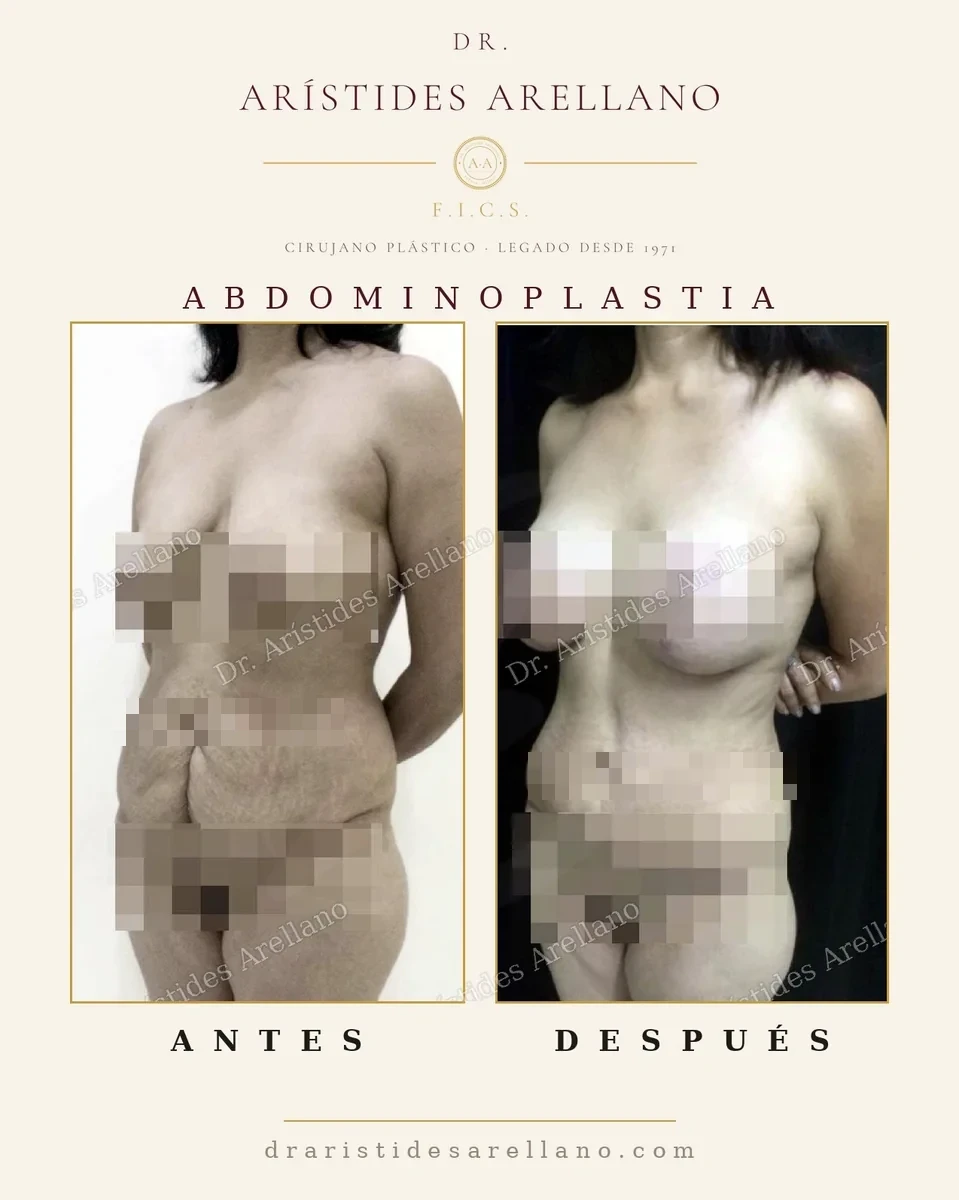
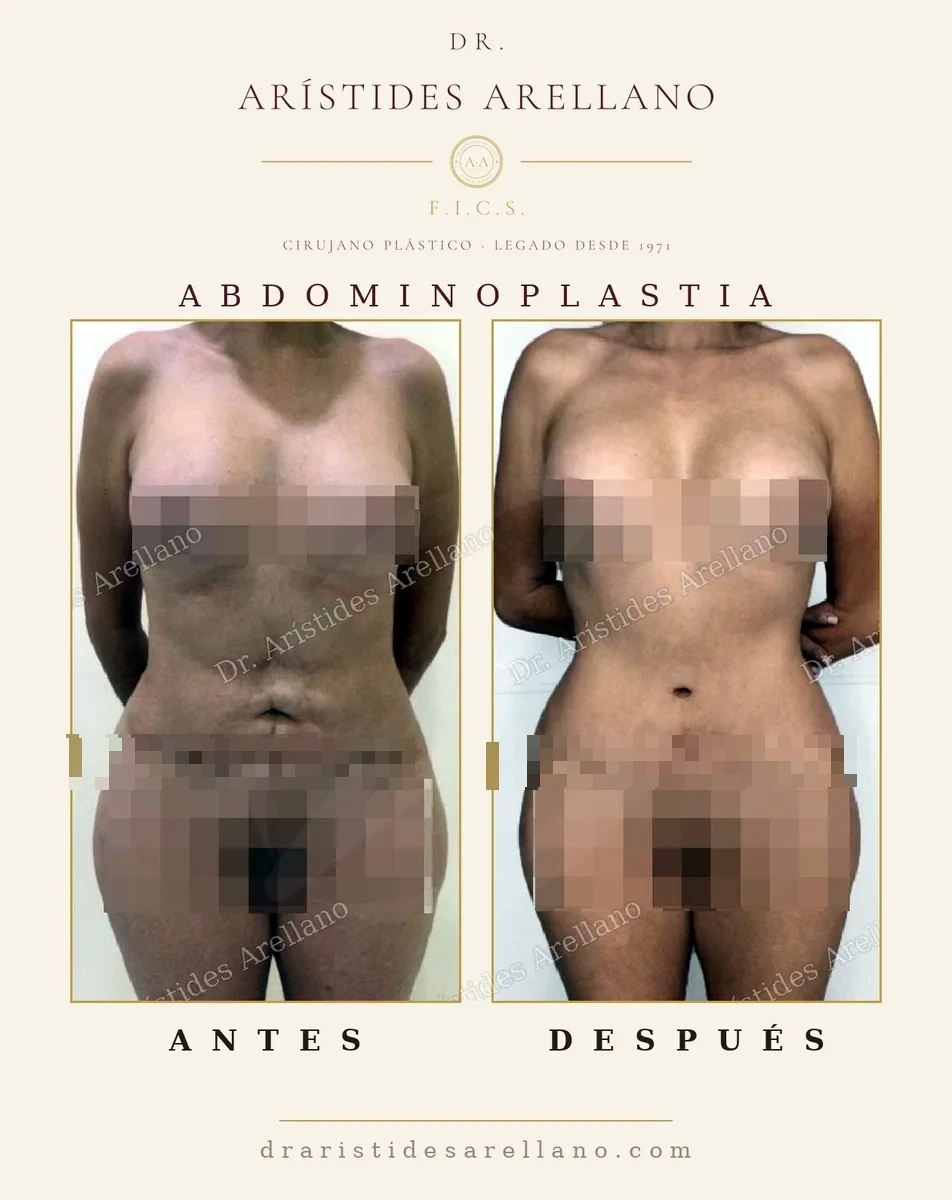
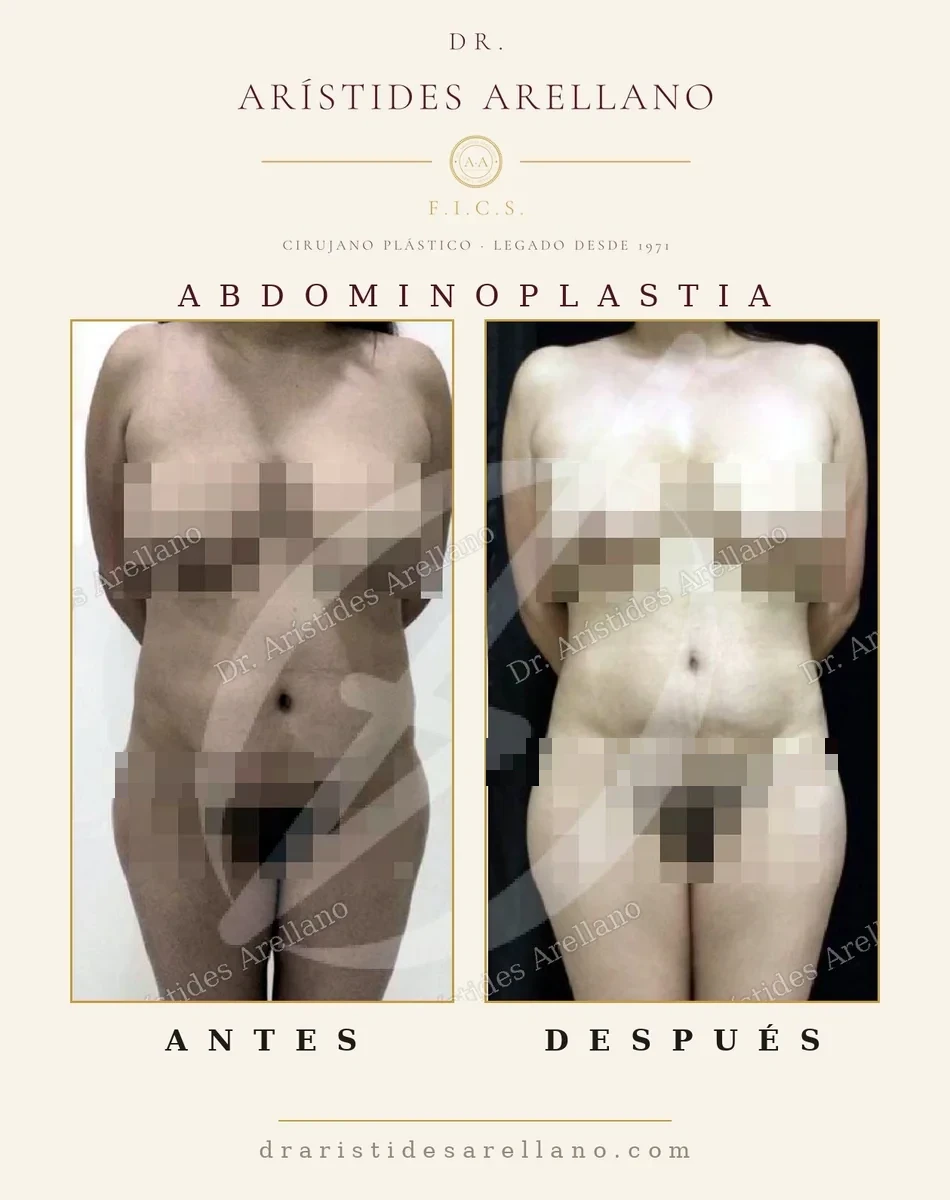
The cases below are real patients of Dr. Arístides Arellano, published with their written informed consent. Out of respect for each person’s privacy, only expressly authorised cases are published; at your in-person consultation Dr. Arístides can show you further cases with a starting point similar to yours. Results may vary from patient to patient.
Approximate price
Abdominoplasty has a reference cost of $80,000 MXN; lipoabdominoplasty (abdominoplasty + liposuction), $120,000 MXN. Approximate price — the definitive cost is set at your private consultation with Dr. Arístides Arellano. The final cost depends on the technique (full, mini or lipoabdominoplasty), the degree of diastasis and whether it is combined with other procedures (mommy makeover).
Want the full breakdown? See how much a tummy tuck costs in Mexico — the price table, what the figure includes, what it does not, and why it varies.
About Dr. Arístides Arellano
Dr. Arístides Arellano is a plastic surgeon holding a specialty licence: he practises under a Mexican medical licence (D.G.P. 1125959) and a specialty licence in Plastic & Reconstructive Surgery (0002008), both issued by the Directorate General of Professions (DGP), which reissued his certificate of professional standing in 2025. His career began before Mexico’s present-day specialty-board system existed: he belongs to the founding generation of plastic surgery in Puebla, the second generation of a surgical tradition started in 1971 by Dr. Francisco Arellano Ocampo. Trust is verified, not promised: both licences are public and anyone can look them up in the DGP’s National Registry of Professionals.
Related patient guide
To go deeper before or after your consultation: How to sleep and what to eat after a tummy tuck — part of the informational guide series reviewed by Dr. Arístides Arellano.
Documented training in body contouring
A properly performed tummy tuck is abdominal-wall surgery, not a skin trim. Dr. Arístides Arellano is a specialist in Plastic & Reconstructive Surgery authorised by the DGP since 1990, with body-contouring surgical training documented from his postgraduate years and updated through 2025:
- Annual theoretical-practical course in Plastic Surgery (80 h) — Sociedad de Cirugía Plástica de Buenos Aires
- Postgraduate diploma in Plastic Surgery (Argentina) — Hospital General de Agudos Dr. Abel Zubizarreta, Municipalidad de Buenos Aires · diciembre de 1989
- WAGS 2025 Annual Conference & Body Contouring Workshop (12.5 AMA credits) — Saint Louis University School of Medicine · Sunny Isles Beach, FL, 21–24 de mayo de 2025
- Liposuction and fat-grafting course — Hospital General de Agudos Dr. Abel Zubizarreta · Buenos Aires, 1988
- DGP specialty authorization — AE-002008 — Dirección General de Profesiones (DGP) · México D.F., 27 de marzo de 1990
Trust is verified, not promised. All 210 scanned documents —degree, licences, diplomas, publications and certificates, from 1977 to 2025— are open in Dr. Arístides Arellano’s credential archive, alongside an explanation of the difference between a specialty licence and a board certification.
Recovery · step by step
- Days 1–3Hospital stay or strict rest at home, surgical drains if placed, and pain managed with prescribed analgesia.
- Weeks 1–2Drains and sutures removed as applicable; walking in a slightly flexed posture is advised so as not to tension the muscular suture.
- Weeks 3–4Mobility improves progressively; exercise and abdominal strain are still restricted.
- Weeks 6–8Return to full physical activity, including abdominal exercise, is gradually authorised as medically advised.
- Months 3–6Residual swelling resolves, the scar matures and the definitive contour appears.
Risks and contraindications
A tummy tuck has one of the most demanding recoveries in body contouring, and within plastic surgery it is one of the operations with the highest documented thromboembolic risk. In this operation, the prevention protocol matters as much as the technique. Its specific risks:
- Seroma: the most frequent complication of abdominoplasty: fluid accumulating between the abdominal planes, which may require drains or office aspiration.
- Deep vein thrombosis and pulmonary embolism: clots forming in the legs that can travel to the lungs — the serious risk characteristic of this operation. Prevention is protocol, not preference: early walking, compression and, when indicated, prophylactic anticoagulant medication.
- Wound dehiscence: partial opening of the incision, most often centrally, where tension is highest.
- Flap or umbilical necrosis: loss of blood supply to the tissue; the risk multiplies with smoking and in combined procedures.
- Hypertrophic or widened scarring: the tummy-tuck scar is long by design; its final quality depends on each skin and on post-operative care.
- Sensory changes: numbness of the lower abdomen, common for months and occasionally partially permanent.
- Asymmetry or residual excess: contour differences or leftover skin at the scar ends (“dog ears”), which may require a touch-up.
- Infection: of the wound or of an untreated seroma; checked at every follow-up visit.
A tummy tuck is postponed or reconsidered in these situations:
- Active smoking: a direct flap-necrosis risk; it must be stopped for weeks before and after surgery.
- Future pregnancy plans: a later pregnancy can undo the muscle repair. The advisable time to operate is once childbearing is complete.
- Obesity or unstable weight: the best and safest result comes near each patient’s stable weight.
- Uncontrolled diabetes, malnutrition or uncorrected anemia.
- A personal or family history of thrombosis: not always a contraindication, but it changes the protocol and must always be disclosed at the consultation.
- Previous abdominal scars that compromise the flap’s circulation: assessed case by case.
Frequently asked questions
How much does a tummy tuck cost in Puebla?
The reference price is approximately $80,000 MXN for abdominoplasty, and $120,000 MXN for lipoabdominoplasty (abdominoplasty + liposuction). The exact amount is confirmed at your in-person consultation.
What is lipoabdominoplasty?
It is the combination of abdominoplasty with liposuction of the waist, flanks and/or lower back in the same surgery, achieving a complete torso contour in a single procedure and a single recovery.
Does abdominoplasty correct abdominal diastasis?
Yes. Repair of the diastasis —the separation of the rectus muscles— by plication is a central part of the abdominoplasty technique, not merely a side effect.
What is the difference between abdominoplasty and liposuction?
Liposuction only removes localized fat. Abdominoplasty removes excess skin, repairs muscular diastasis and, in many cases, also treats fat via the lipoabdominoplasty technique. One or the other —or their combination— is recommended depending on whether the main problem is skin, muscle or fat.
What does a mommy makeover involve and how much does it cost?
It is the personalised combination of abdominoplasty with other procedures —such as breast augmentation or mastopexy and/or liposculpture— designed to address changes associated with pregnancy and breastfeeding. It has a reference cost of approximately $180,000 MXN, varying with the procedures included. The plan and final price are confirmed at your in-person consultation.
Does a tummy tuck remove stretch marks?
It can remove stretch marks on the skin that is excised (usually below the navel); those elsewhere may remain. Results may vary.
How long is recovery after a tummy tuck?
Initial recovery —basic mobility, drain removal— takes 1 to 2 weeks; return to full physical activity is gradually authorised between weeks 6 and 8, and the definitive result is seen between the third and sixth month.
Before and after
How much does a tummy tuck cost? Here it starts at approximately MX$80,000, and that figure is all-inclusive: operating theatre and facilities, pre-operative laboratory work and post-surgical recovery treatments. It is not the surgeon's fee alone — which is how it is quoted elsewhere, and why a cheap-looking estimate grows later. The definitive cost of each case is set at the private assessment consultation. All surgery carries risks and requires a prior medical assessment; results vary from person to person.
Can the muscles separate again after an abdominoplasty? The plication — the suture that brings the rectus muscles together — is permanent, but not indestructible. What puts it at risk is lifting weight too soon, a later pregnancy, or major weight gain. The first two months define the result, which is why the compression garment and the no-lifting rule are pressed so hard. All surgery carries risks and requires a prior medical assessment; results vary from person to person.
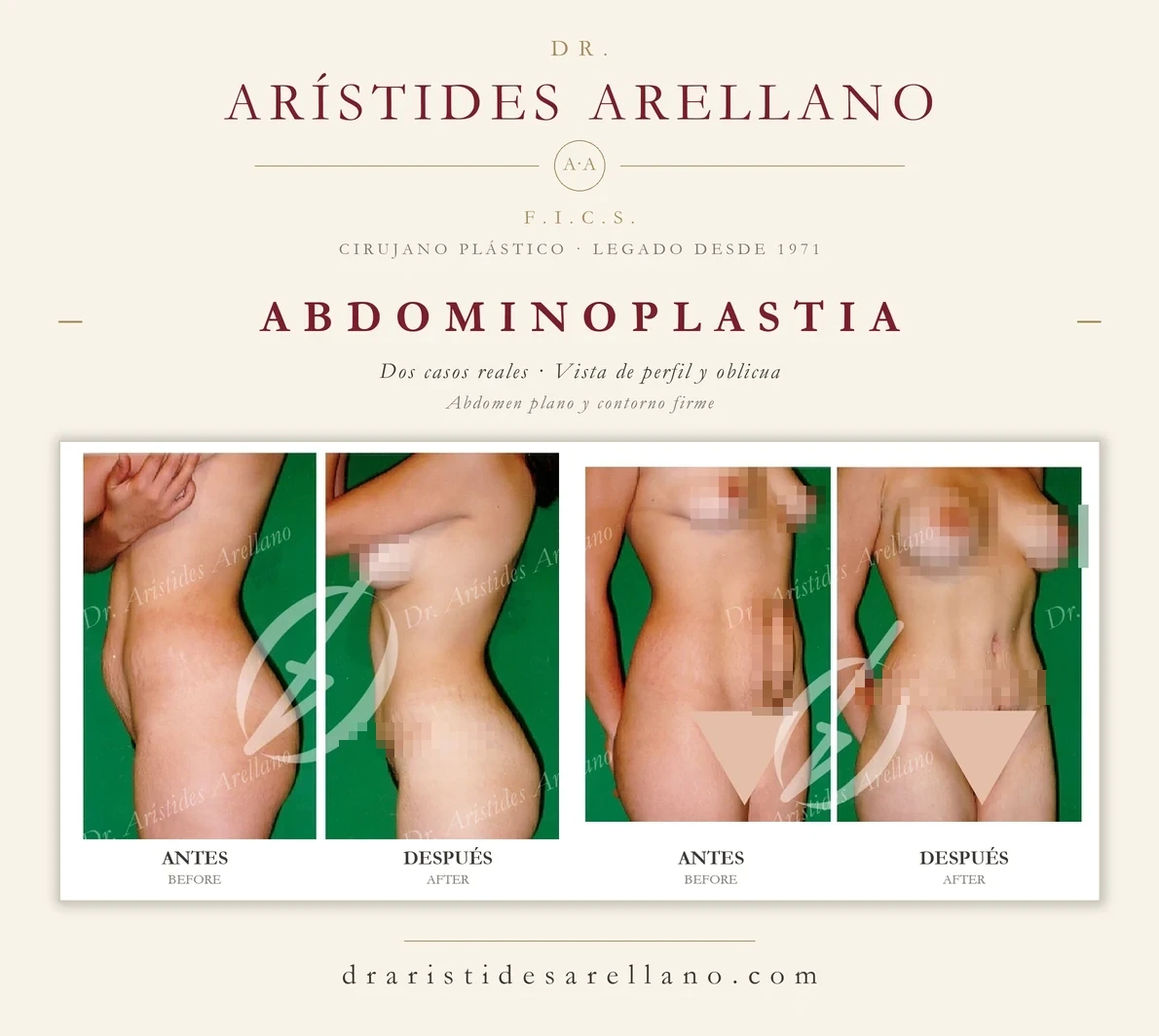
When do I get back to normal? Walking, the same day. Desk work, 10 to 15 days. Sweeping, mopping, carrying a child or strength training: not before 6 to 8 weeks, because those are exactly the movements that pull on the muscle repair. Swelling keeps going down until around the sixth month; the final photo is not the one-month photo. All surgery carries risks and requires a prior medical assessment; results vary from person to person.
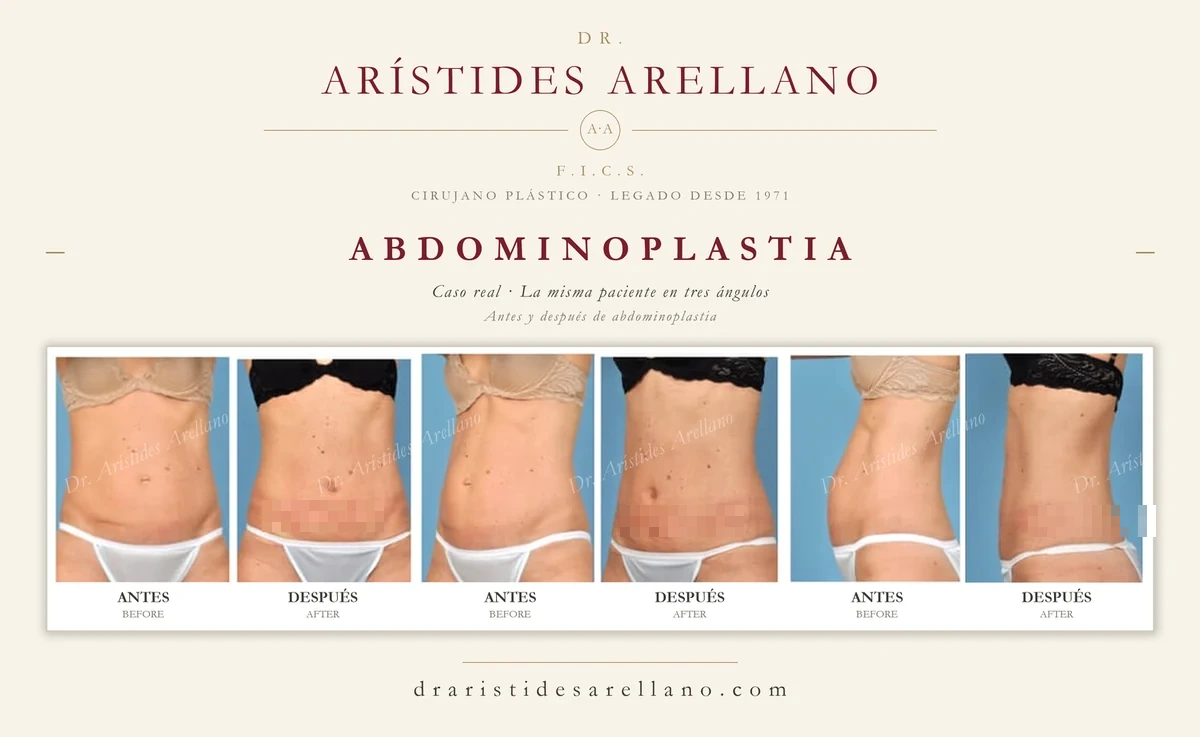
What is a mini tummy tuck and is it right for me? The mini treats only below the navel, leaves a shorter scar and does not reposition the belly button. It works when the problem is a small lower bulge and the abdominal wall is firm. If there is skin above the navel or the muscles are separated — this patient's case — the mini falls short and the result disappoints. All surgery carries risks and requires a prior medical assessment; results vary from person to person.
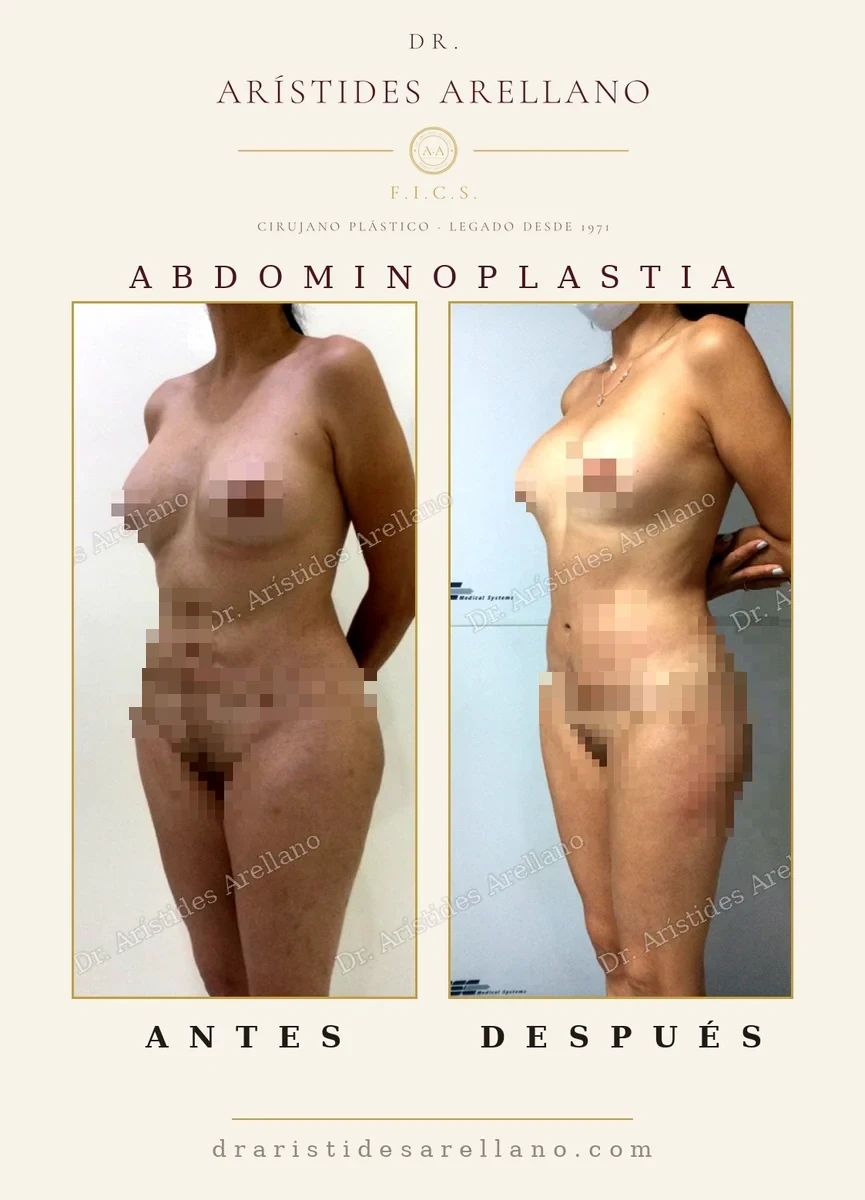
What does an abdominoplasty scar look like? It is a low horizontal line running hip to hip, deliberately placed below where underwear or a swimsuit sits. It matures over 12 to 18 months: first red and raised, later flat and pale. It never disappears — no tummy tuck is scar-free — and the surgeon's job is to hide it and keep it fine. In these photographs the area is covered for the patient's privacy. All surgery carries risks and requires a prior medical assessment; results vary from person to person.
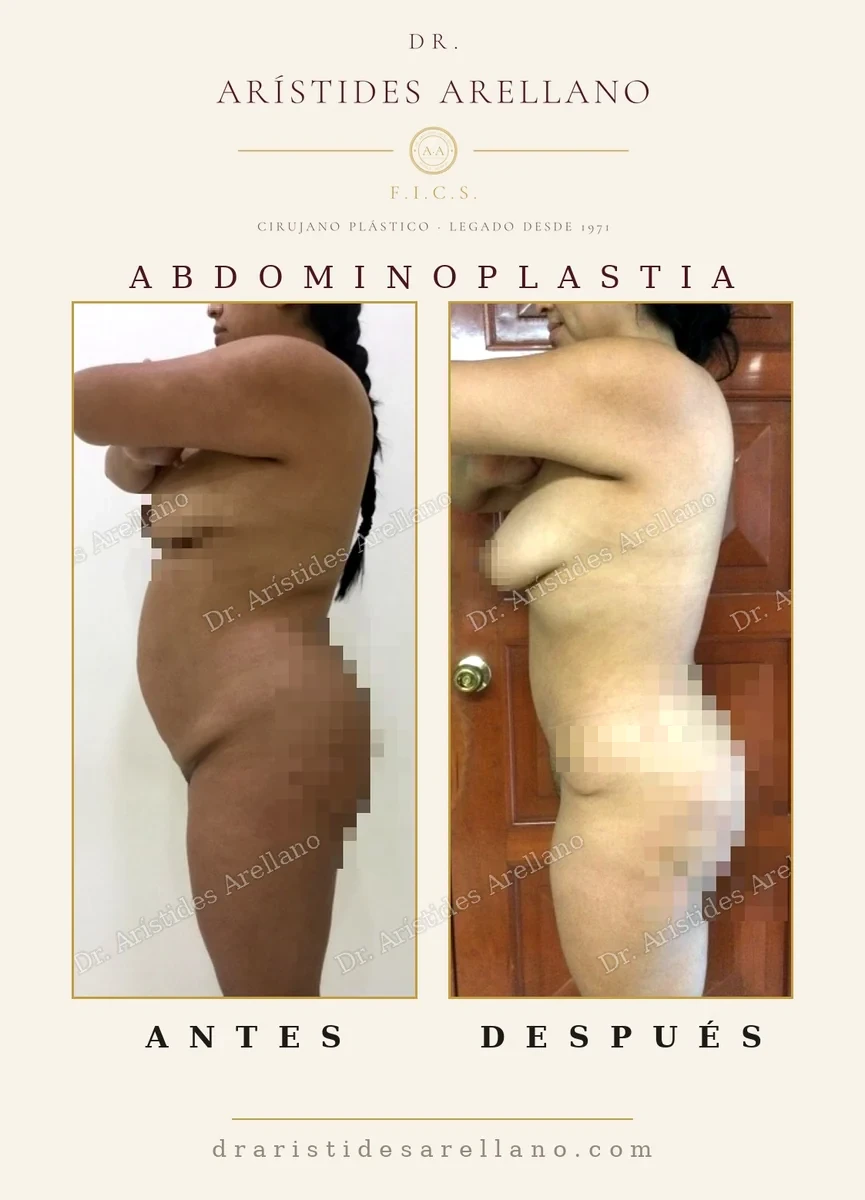
What exactly is an abdominoplasty? It is not liposuction. The excess skin hanging below the navel is removed and the rectus abdominis muscles are stitched back together after pregnancy or major weight change separates them. That is why the profile changes most: what is corrected is not just fat, it is stretched skin and a slack abdominal wall. All surgery carries risks and requires a prior medical assessment; results vary from person to person.
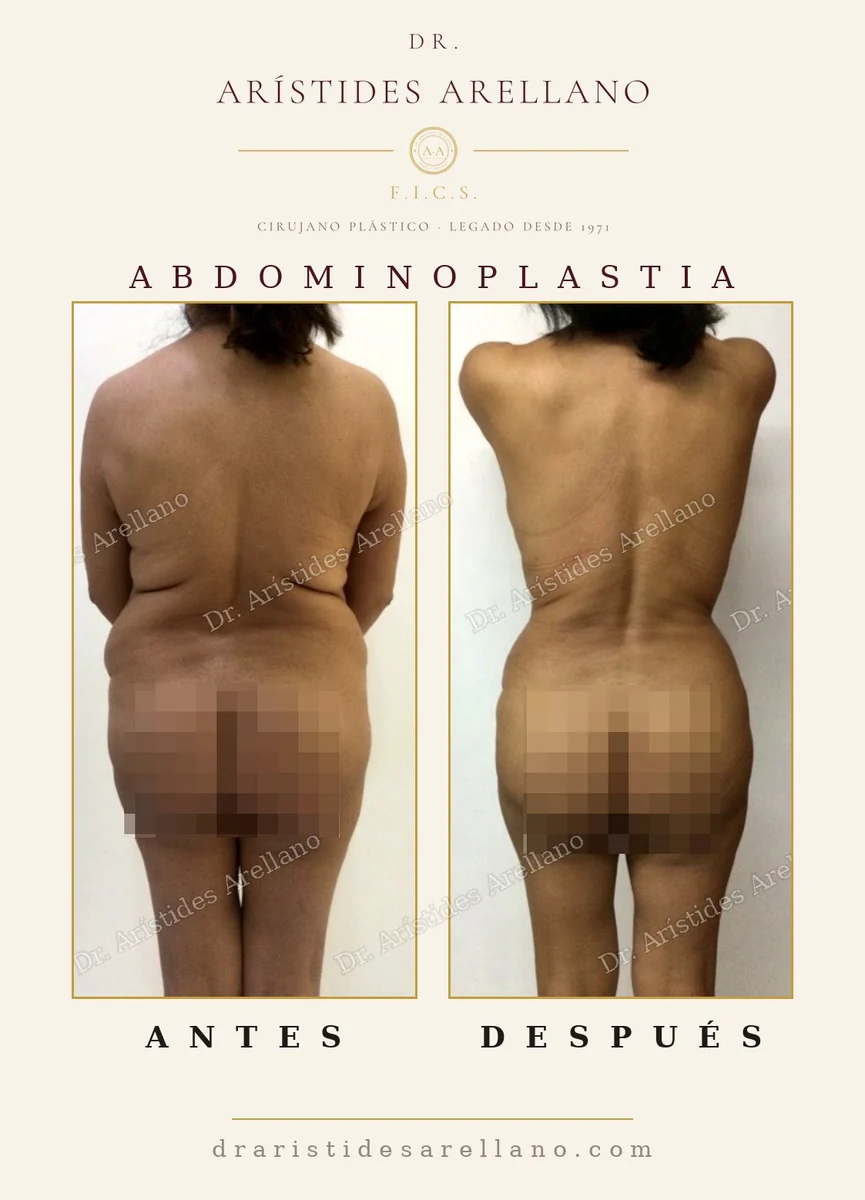
Does a tummy tuck also remove the love handles? Not on its own: abdominoplasty works on the front. The flanks and lower back are treated by adding flank liposuction in the same operation, which is what was done here. That is why the back view matters — it is the angle patients notice when getting dressed, and almost nobody shows it. All surgery carries risks and requires a prior medical assessment; results vary from person to person.
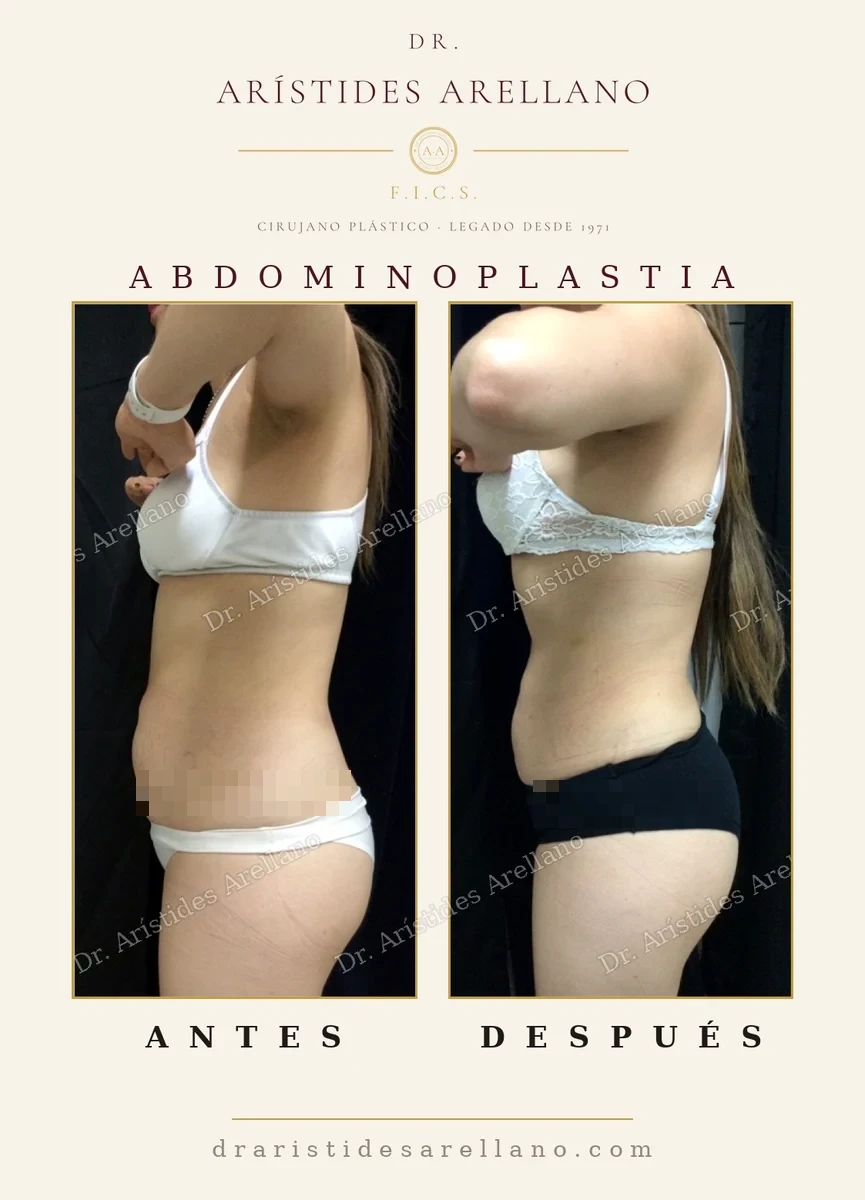
Does the result show through clothing? It is the most-asked question and almost never photographed. Here the before and after are taken in underwear, in profile — the way the patient sees herself in the mirror each morning. The scar sits below the underwear line, so what shows is the contour, not the surgery. All surgery carries risks and requires a prior medical assessment; results vary from person to person.
Photographs of real patients, published with their written informed consent. Results may vary from person to person; these images are not a promise of outcome.
Every case is different. Discuss yours in a personal consultation.
Book a consultation on WhatsAppEvery figure published on this site is approximate and is not a quote. Any procedure or treatment first requires a private assessment consultation with Dr. Arístides Arellano —$800 MXN, charged separately— and it is at that consultation that the definitive cost of your case is determined.
Educational content; it does not replace a medical consultation. Results may vary from person to person.