
What is gynecomastia?
Gynecomastia is the excess development of tissue in the male chest. For many men it is a silent source of discomfort for years: avoiding taking their shirt off, the pool, the beach, fitted clothing. It is more common than is admitted out loud, and it has a surgical solution.
The first thing to distinguish —and where most patients who arrive at consultation are mistaken— is what that chest is made of:
- True (glandular) gynecomastia: there is real breast gland beneath the areola. It feels like a firm disc, sometimes tender or painful to the touch.
- Pseudogynecomastia (fatty): it is fat, not gland. It usually accompanies excess weight and feels soft and diffuse.
- Mixed: the most common — both are present.
Why the gym does not fix it
This is the frustration that brings most patients to the consultation: they lost weight, got in shape, and the chest is still there. The explanation is simple and deserves to be said plainly: breast gland is not fat. It does not respond to diet, it does not respond to exercise, no non-surgical treatment dissolves it, and —this is the important part— liposuction alone does not remove it either.
From this comes the technical error that produces re-operations: treating a mixed gynecomastia with liposuction only. The fat goes, the glandular disc stays, and the patient ends up with a slimmer chest in which the lump under the areola is more noticeable than before. When there is gland, the gland is excised. Always.
Techniques used by Dr. Arístides Arellano
The plan is defined by the predominant component, and in most cases combines two manoeuvres in the same operation:
- Liposuction of the fatty component: removes chest fat and the transition toward the armpit and flank, which is what restores the male pectoral line. It is performed with the LipoVaser Power X (VASER) platform, whose ultrasound energy facilitates extraction and supports skin retraction — relevant here, where the quality of retraction decides whether skin excision is needed at all.
- Gland excision via a periareolar approach: through a discreet incision at the lower areolar border —where the change in colour conceals the scar— the glandular disc is removed directly. It is the part of the surgery that nothing can substitute for.
- Preserving a retroareolar cushion: not all the gland beneath the areola is removed. Leaving a thin layer prevents the "crater" deformity —a sunken areola tethered to the muscle— which is the typical aesthetic complication of over-resection and is difficult to correct afterwards.
- Skin-excess correction: only in advanced cases or after massive weight loss, when the skin will not retract on its own. It is assessed at consultation and raised plainly, because it means more scarring.
- Preservation of nipple sensation: the approach respects the innervation of the nipple-areola complex.
How is it performed?
Surgery is performed under general anaesthesia or sedation with local anaesthesia, depending on the case, in a hospital operating room. It lasts approximately 1 to 2 hours and is outpatient in many cases. A chest compression garment is fitted at the end and worn for the first weeks: it supports the contour while the skin retracts and reduces the risk of fluid accumulation.
All surgery carries risk and requires a prior medical assessment. Results may vary according to each patient, their anatomy and their individual healing process.
Who is a good candidate?
- Men with stable gynecomastia —unchanged for some time—, in good health and with realistic expectations.
- Weight close to their usual. In pure pseudogynecomastia (fat, no gland), losing weight can improve the chest significantly, and that is said honestly before proposing surgery.
- No active underlying cause. The assessment rules out an ongoing hormonal or medication-related cause, and this is not a formality: if the origin remains active, tissue can regrow after surgery. Known causes include certain medications, some endocrine conditions and the use of anabolic steroids — a frequent cause and frequently omitted at consultation. Disclosing it changes the surgical plan and the prognosis; concealing it harms the patient himself.
- Adolescents: pubertal gynecomastia is common and frequently resolves on its own within months to a couple of years. Except in very marked cases or those with significant psychological impact, waiting before operating is usually advised.
Recommended post-surgical treatments
Dr. Arístides may recommend manual lymphatic drainage and hyperbaric chamber sessions to reduce swelling and support skin retraction, and treatment of the periareolar scar in patients with a history of keloid scarring. See the full guide: Post-surgical recovery and care.
Before and after
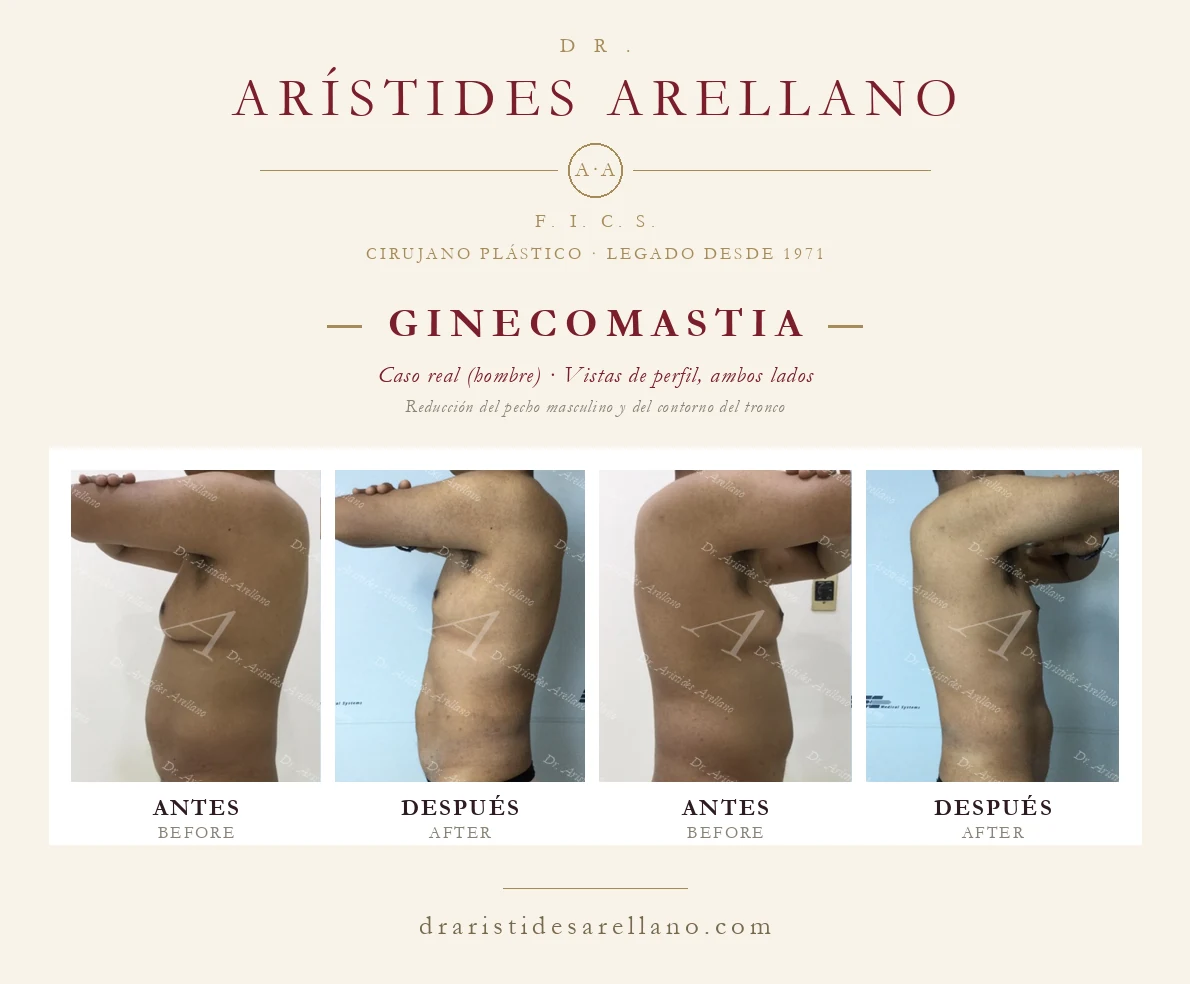
The cases below are real patients of Dr. Arístides Arellano, published with their written informed consent. Out of respect for each person’s privacy, only expressly authorised cases are published; at your in-person consultation Dr. Arístides can show you further cases with a starting point similar to yours. Results may vary from patient to patient.
Approximate price
Gynecomastia surgery has a reference cost of $45,000 MXN. Approximate price — the definitive cost is set at your private consultation with Dr. Arístides Arellano. The final cost depends on the grade, on whether liposuction alone or also gland excision and skin correction are required, and on hospital and anaesthetist fees. See all references in the price list.
About Dr. Arístides Arellano
Dr. Arístides Arellano is a plastic surgeon holding a specialty licence: he practises under a Mexican medical licence (D.G.P. 1125959) and a specialty licence in Plastic & Reconstructive Surgery (0002008), both issued by the Directorate General of Professions (DGP), which reissued his certificate of professional standing in 2025. His career began before Mexico’s present-day specialty-board system existed: he belongs to the founding generation of plastic surgery in Puebla, the second generation of a surgical tradition started in 1971 by Dr. Francisco Arellano Ocampo. Trust is verified, not promised: both licences are public and anyone can look them up in the DGP’s National Registry of Professionals.
Related patient guide
Gynecomastia surgery includes chest liposuction, and its recovery resembles it: Liposuction recovery, week by week — part of the informational guide series reviewed by Dr. Arístides Arellano.
Documented training in breast glandular surgery and liposuction
Gynecomastia is badly handled when treated as fat alone: there is almost always glandular tissue, and glandular tissue must be excised. Dr. Arístides Arellano is fully licensed — professional and specialty cédula — and both halves of the problem, liposuction and breast surgery, are documented in his archive:
- Liposuction course (56 h) — Clínica Libertador · Buenos Aires
- International symposium on reconstructive breast surgery — Pontificia Universidad Católica Argentina · Buenos Aires, 7 de mayo de 1988
- Member — American Society of Lipo-Suction Surgery — Estados Unidos
- Postgraduate diploma in Plastic Surgery (Argentina) — Hospital General de Agudos Dr. Abel Zubizarreta, Municipalidad de Buenos Aires · diciembre de 1989
Trust is verified, not promised. All 210 scanned documents —degree, licences, diplomas, publications and certificates, from 1977 to 2025— are open in Dr. Arístides Arellano’s credential archive, alongside an explanation of the difference between a specialty licence and a board certification.
Dr. Arístides explains it
Informational video by Dr. Arístides Arellano. Every case is different: the details of your procedure are defined at your consultation.
Recovery · step by step
- Days 1–7Compression garment and mild discomfort. Relative rest; chest strain is avoided.
- Week 2Office activity and social life resume; the compression garment continues.
- Weeks 3–6Progressive return to exercise as medically advised.
- Months 3–6Swelling fully subsides and the definitive contour settles.
Risks and contraindications
Before operating on gynecomastia you have to understand it: it can be glandular, fatty or mixed, and it can have a hormonal or medication-related cause that must be investigated first. Operating without that diagnosis is the first risk. The surgical ones are these:
- Nipple depression or crater deformity: removing too much gland leaves a contour defect that is hard to correct; resection aims for an even plane, not “zero” tissue.
- Contour irregularities: waves or steps between treated areas, which may require a touch-up.
- Hematoma and seroma: the most frequent early complications of this operation; they may need drainage.
- Nipple and areola sensitivity changes: usually temporary; in some cases persistent.
- Scars: periareolar scars are usually discreet; in advanced grades with excess skin, the incisions — and the scars — are longer.
- Residual asymmetry: a difference between the two sides can remain and warrant correction.
- Recurrence: if the cause persists — a medication, anabolic steroids, an untreated hormonal disorder — the tissue can grow back.
Gynecomastia surgery is postponed or reconsidered in these situations:
- An uninvestigated cause: hormonal disorders, medications or anabolic-steroid use are identified and corrected before surgery; otherwise the operation treats the effect and leaves the cause alive.
- Adolescents: a good share of pubertal gynecomastia resolves on its own with time, so in minors observation comes before surgery.
- Obesity or unstable weight: the fatty component responds best near each patient’s stable weight.
- Unmanaged chronic disease or clotting disorders.
Frequently asked questions
How much does gynecomastia surgery cost in Puebla?
The reference price is approximately $45,000 MXN. The exact amount depends on the grade, on whether liposuction alone or also gland excision and skin correction are required, and on hospital and anaesthetist fees. It is confirmed at your in-person consultation.
Why won’t diet and exercise get rid of my chest?
Because breast gland is not fat. If your gynecomastia has a glandular component —that firm disc felt beneath the areola— it does not respond to diet or exercise, and no non-surgical treatment dissolves it. Losing weight can improve the chest considerably when the problem is fat only (pseudogynecomastia), but when there is gland, the gland only comes out with surgery.
Does liposuction alone fix gynecomastia?
Only when the problem is fat exclusively. If gland is present and only liposuction is performed, the fat is removed but the glandular disc stays, and the lump under the areola is frequently more noticeable than before, on an already slimmer chest. It is the technical error that produces the most re-operations. When there is gland, it is excised.
Can gynecomastia come back after surgery?
If the gland is removed and there is no active underlying cause, the result is usually lasting: excised glandular tissue does not regenerate. It can recur if an active cause persists —certain medications, some hormonal conditions, or the use of anabolic steroids— or with significant weight gain, which changes the contour by way of fat.
What scar does gynecomastia surgery leave?
When only liposuction is needed, tiny puncture marks remain. When gland is excised, the scar sits at the lower areolar border, where the change in skin colour conceals it, and it usually becomes very discreet over time. Cases with significant skin excess require additional scars, which is stated plainly before surgery.
What is the crater deformity?
It is a sunken areola tethered to the muscle, which appears when too much gland is removed beneath the nipple. It is the typical aesthetic complication of over-resection and is difficult to correct afterwards. It is prevented by leaving a thin cushion of retroareolar tissue, which is part of the technique.
Should I have surgery if I am a teenager?
Generally not immediately. Pubertal gynecomastia is common and frequently resolves on its own within months to a couple of years. Except in very marked cases or those with significant psychological impact, waiting and reassessing is usually advised.
Is it outpatient surgery?
In many cases yes, under general anaesthesia or sedation with local anaesthesia. The assessment defines the safest anaesthetic plan for each person.
Before and after
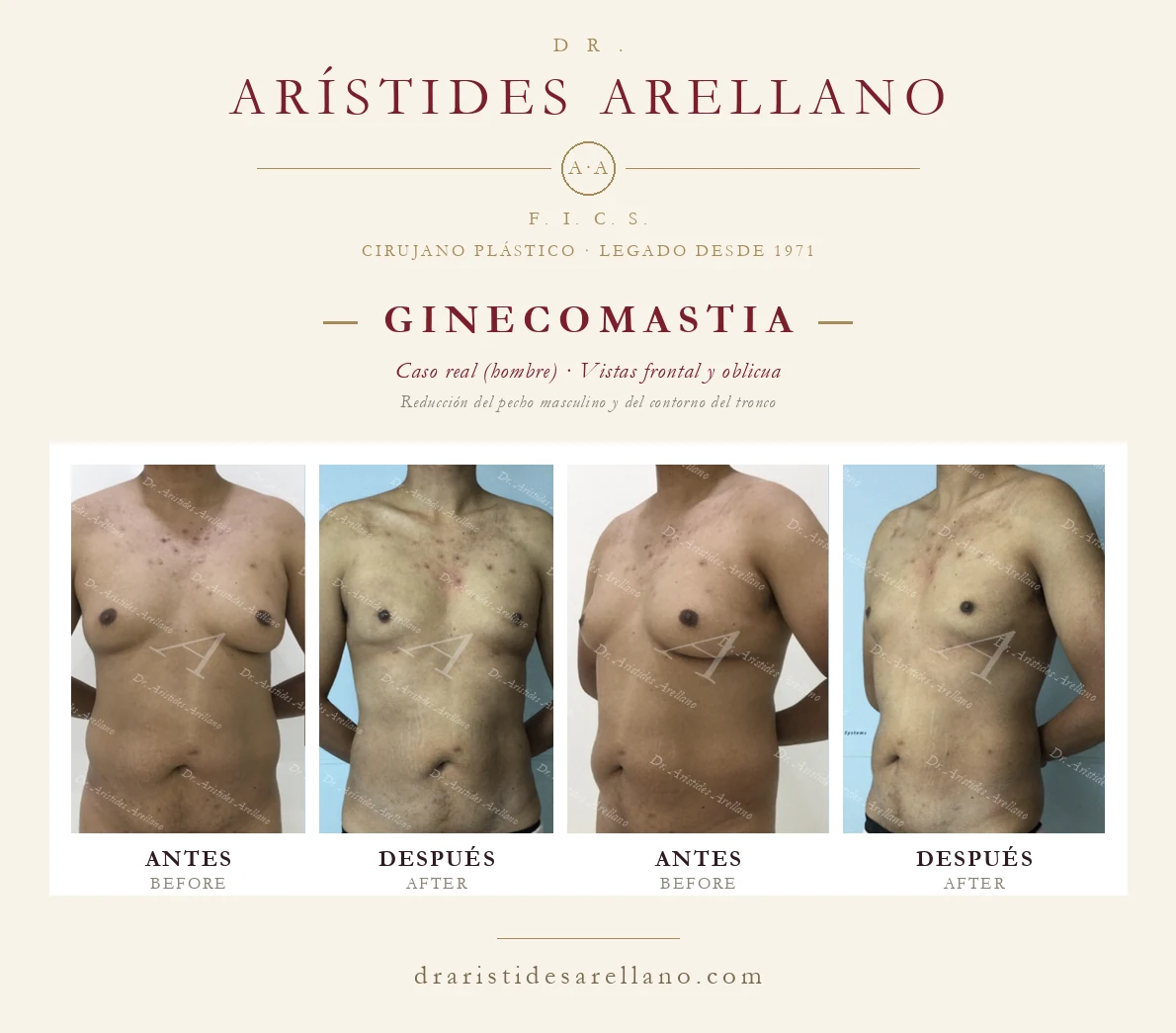
Real case of gynecomastia surgery in Puebla, in frontal and oblique views. Two angles are used because the male chest is judged both head-on and at three-quarters. Gynecomastia is the growth of breast tissue in men and the treatment depends on what it is made of: liposuction removes the fatty component, but true glandular tissue cannot be suctioned — it is removed through a periareolar incision. The result depends on that distinction, which is established at the consultation. All surgery carries risks and requires a prior medical assessment; results may vary from person to person.
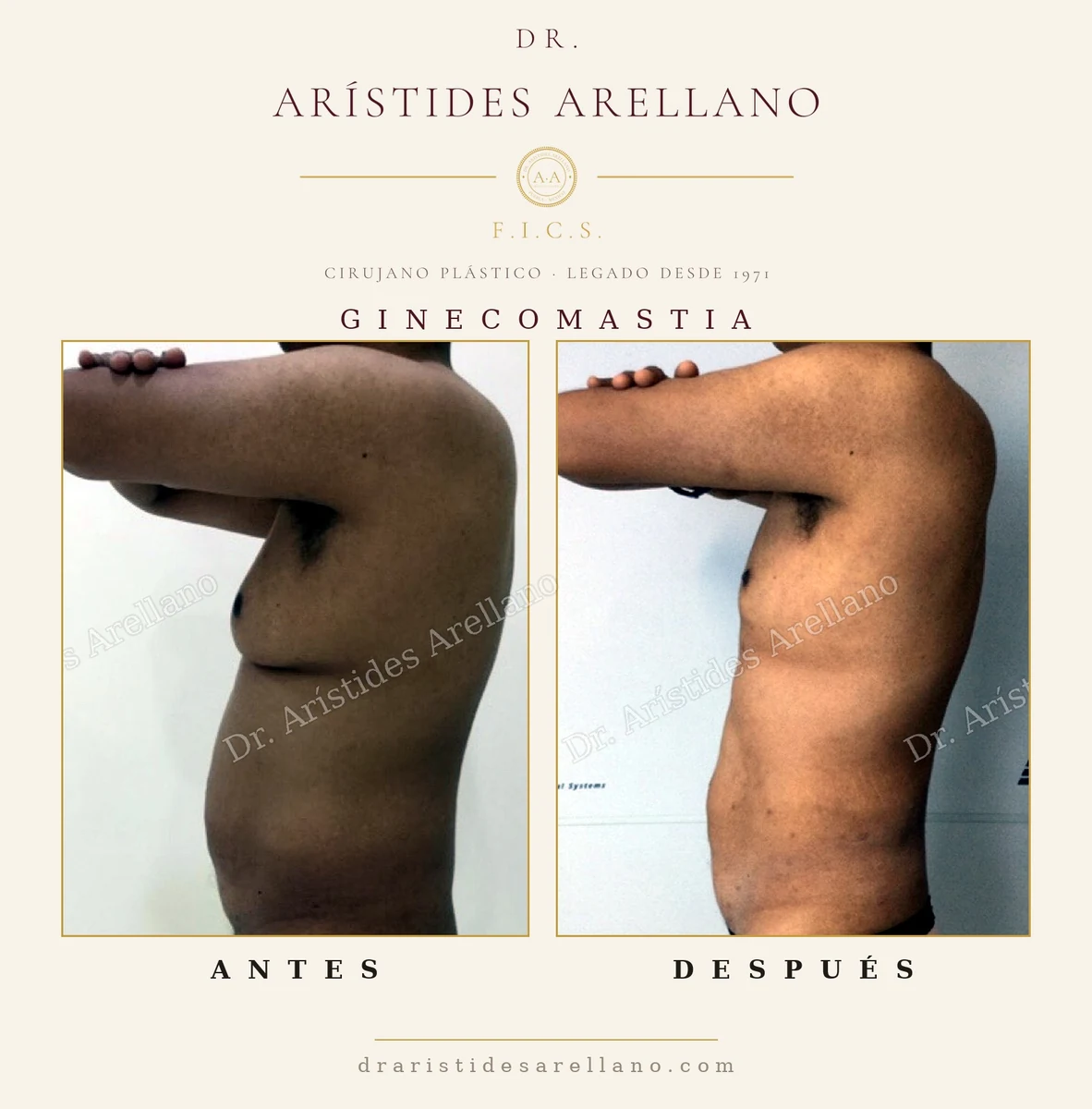
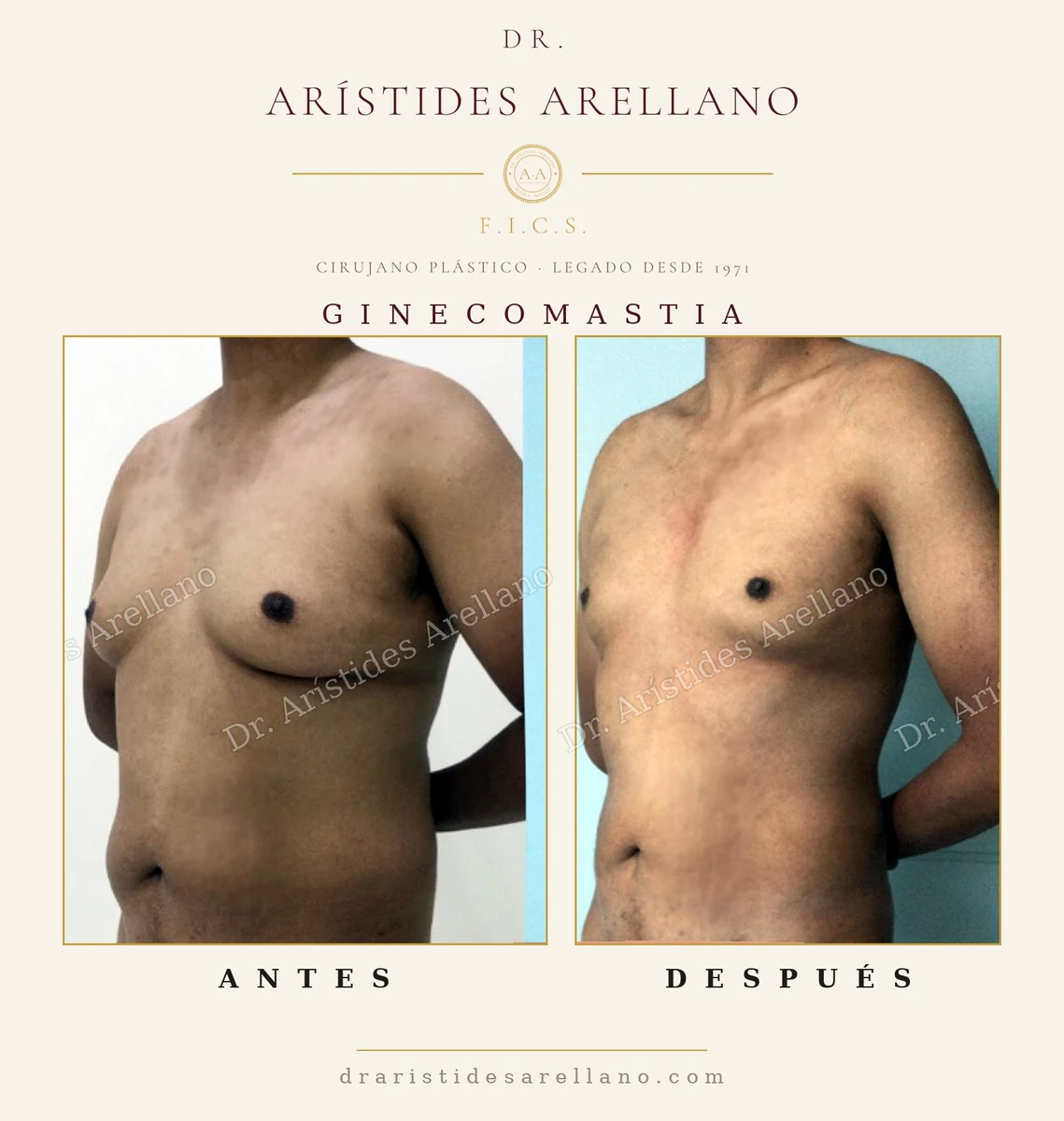
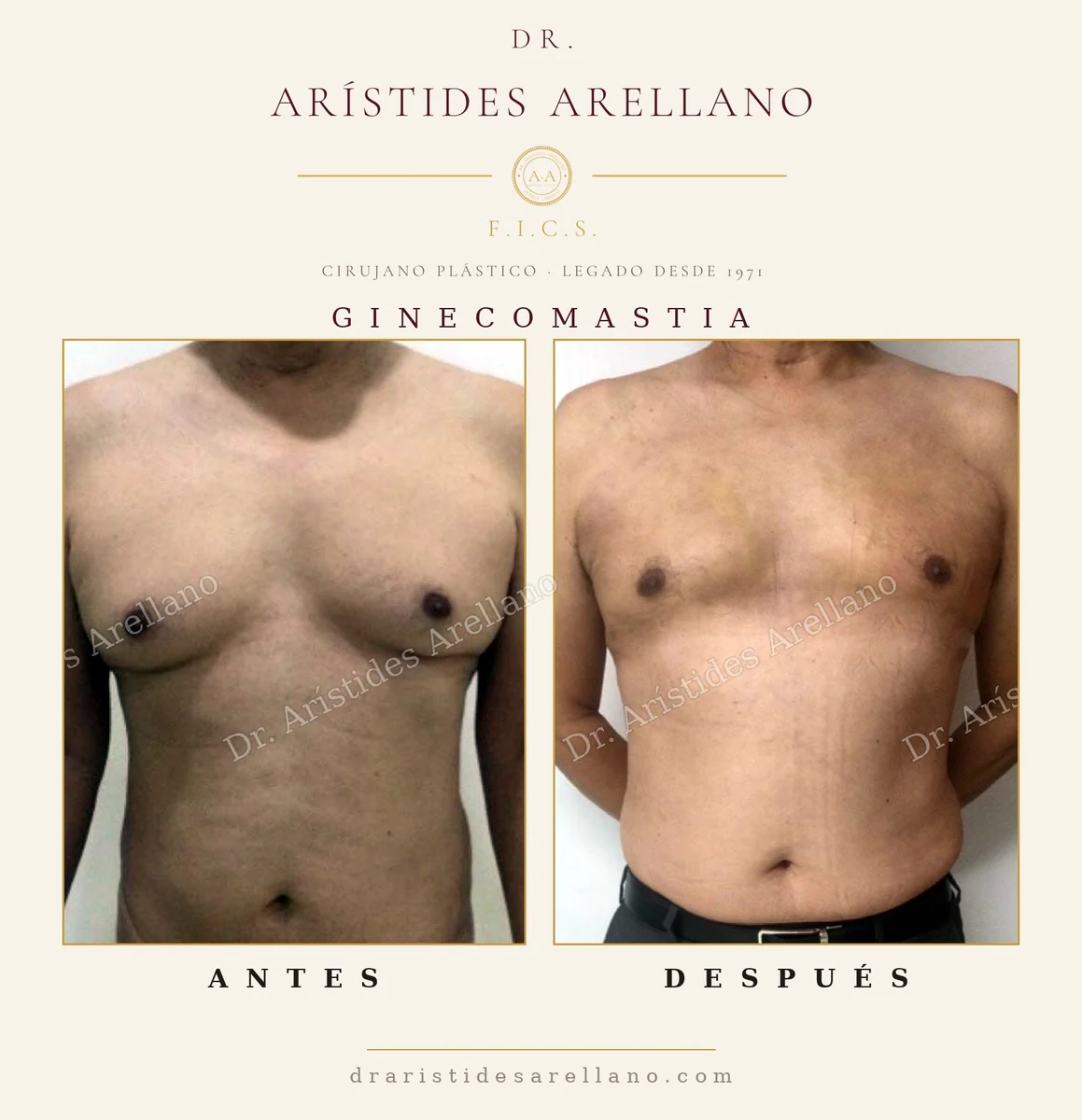
Real case of gynecomastia surgery in Puebla, frontal view. Head-on you judge two things the profile cannot show: symmetry between the two sides, and areola position, which on a male chest sits higher and smaller than on a female one. When the enlargement is marked, excess skin also matters and may need adjustment. All surgery carries risks and requires a prior medical assessment; results may vary from person to person.
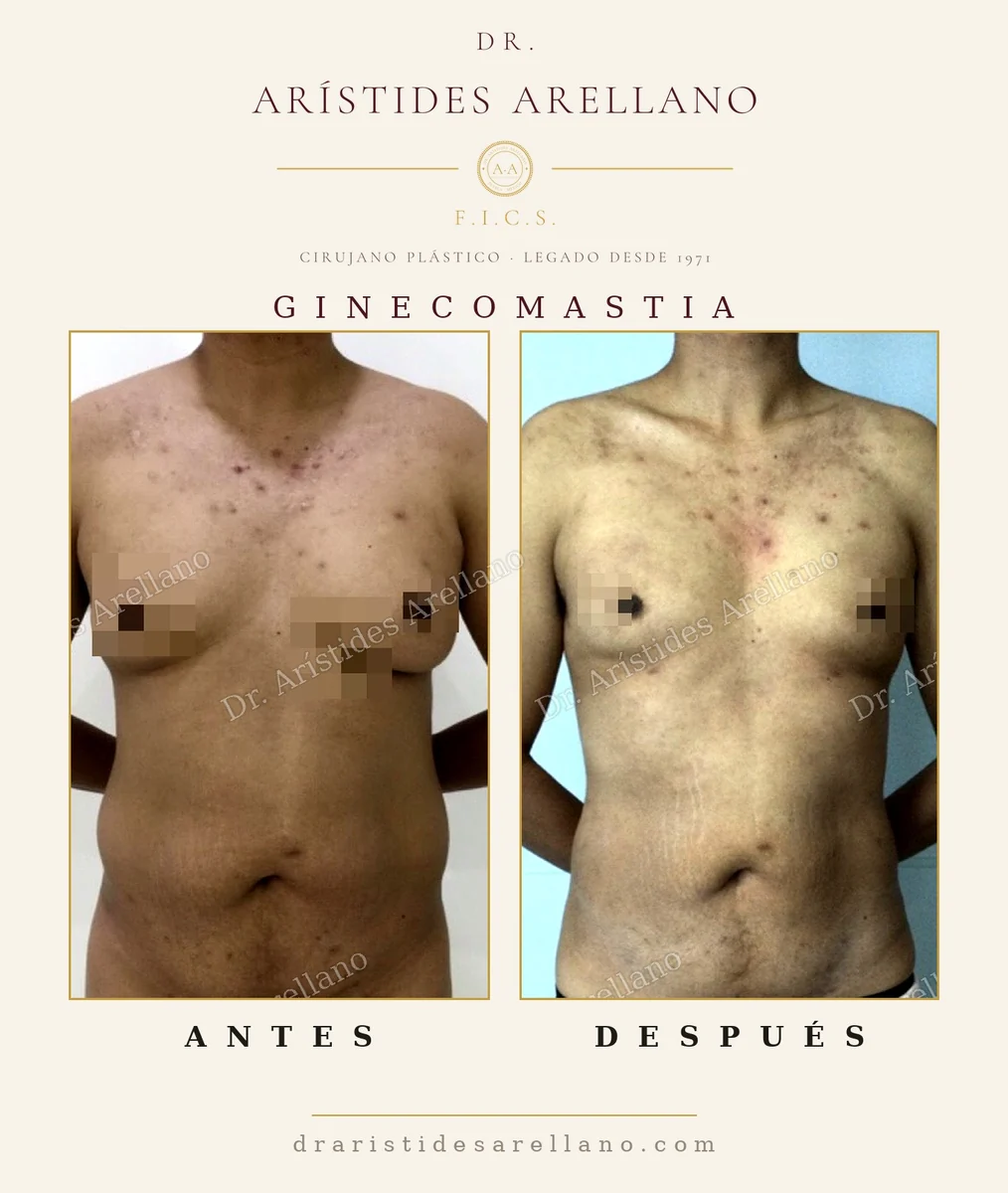
How much does gynecomastia surgery cost? Here it starts at approximately MX$45,000, all-inclusive: theatre, pre-operative labs and recovery. The price is not set by chest size but by what the chest is made of — if it is only fat, liposuction is enough; if there is true glandular tissue it must be excised through an incision, and that is additional operating time. The definitive cost of each case is set at the private assessment consultation. All surgery carries risks and requires a prior medical assessment; results vary from person to person.
Photographs of real patients, published with their written informed consent. Results may vary from person to person; these images are not a promise of outcome.
Every case is different. Discuss yours in a personal consultation.
Book a consultation on WhatsAppEvery figure published on this site is approximate and is not a quote. Any procedure or treatment first requires a private assessment consultation with Dr. Arístides Arellano —$800 MXN, charged separately— and it is at that consultation that the definitive cost of your case is determined.
Educational content; it does not replace a medical consultation. Results may vary from person to person.