
What is a keloid scar?
When skin repairs itself it produces collagen to close the wound. Normally that process switches off on its own. In some people it does not: the body keeps laying down collagen beyond the original injury, and the scar grows, rises, hardens and turns red or purplish. That is a keloid scar.
Its defining feature is that it invades the surrounding healthy skin: it extends past the edge of the wound that caused it. It usually itches, burns or hurts to the touch, and it does not fade on its own. It can appear months after the injury and keep growing for years.
It is more common in brown and dark skin, in younger people, and in high-tension areas: the chest (sternum), shoulders and upper back, the earlobe (piercings) and the jaw angle. There is a clear family predisposition: if your parents or siblings form keloids, you are more likely to form them too.
Keloid or hypertrophic: they are not the same
This distinction is not a technicality: it completely changes treatment and prognosis, and it is the first thing established at the consultation.
- Hypertrophic scar: raised and red, but it stays within the border of the original wound. It does not invade healthy skin. It tends to improve over 12–24 months and responds well to treatment. It rarely recurs.
- Keloid scar: it crosses the border of the wound and grows over healthy skin. It does not improve on its own. It frequently recurs if excised without adjuvant therapy. It demands a strategy, not just a cut.
- Atrophic scar: sunken, depressed (typical of acne or chickenpox). It is the opposite problem: tissue is missing, not excessive. Treated with laser, subcision or fat grafting.
- Contracture scar: tight, limiting movement (typical of burns). This is a reconstructive indication: released with plasties, grafts or flaps.
Technique and equipment: why surgery alone is not enough
The commonest mistake —and the reason many patients arrive with a keloid larger than the original— is to excise the keloid and close, and nothing else. Cutting out a keloid means creating a fresh wound in skin that has already proven it heals badly. If that response is not modified, the keloid returns, and often returns worse.
Keloid treatment is therefore combined: surgery, when indicated, always travels with therapy that controls collagen formation over the following months. The plan is built around size, location, how long it has been evolving and each patient’s history.
- Intralesional corticosteroid injection (triamcinolone): flattens and softens the scar and relieves itching and pain. Given in sessions weeks apart. It is the backbone of medical treatment and, very often, the mandatory companion to surgery.
- Surgical scar revision: the keloid tissue is excised and closed with minimal-tension technique —redistributing forces with plasties (Z-plasty, W-plasty) when scar orientation demands it— so the new wound heals under favourable conditions.
- Intralesional excision: in bulky keloids the core is removed leaving a rim of the keloid itself as the bed, rather than cutting into healthy skin, so the lesion’s territory is not enlarged.
- Laser (fractional CO₂ and ResurFX): remodels texture, improves colour and softens the mature scar. Very useful in hypertrophic and acne scars; in keloids it is part of the combined plan, never the sole treatment.
- Pressure therapy and silicone sheeting: sustained pressure and occlusion over months. Unglamorous and highly effective; on the earlobe the postoperative pressure earring is decisive.
- Cryotherapy: useful in small keloids, alone or combined with injection.
- Adjuvant radiotherapy: reserved for stubborn keloids at high risk of recurrence; indicated and coordinated with radiation oncology when the case justifies it.
How is surgical scar revision performed?
Most scar revisions are performed under local anaesthesia as day surgery: you come in and go home the same day. Only extensive, contracted scars, or those needing grafts or flaps, are scheduled in theatre under sedation or general anaesthesia.
The scar tissue is excised and the closure redesigned so the new scar is oriented along the skin’s natural tension lines with the least possible pull on the edges. When the scar crosses those lines or crosses a crease, a plasty (Z-plasty, W-plasty) is used to break the straight line, spread the tension and make the scar far less visible.
Closure is layered, with fine suture, and the edges are approximated without tension: tension is the chief enemy of a fine scar. From there begins what actually decides the result —the postoperative protocol: scheduled injections, silicone, pressure, strict sun protection and months of follow-up. A scar is not judged at two weeks; it is judged at one year.
See the full guide: Post-surgical recovery and care.
Who is a good candidate?
People with a keloid or hypertrophic scar that grows, itches, hurts, gets infected, limits movement or affects daily life; and people with older scars —from surgery, acne, accidents, burns, C-section or piercings— who want them improved. Also anyone facing surgery who has a keloid history: in that case the preventive plan is designed before the operation, not after.
With clear expectations: a scar is not erased, it is improved. The realistic goal is a flatter, paler, more flexible, symptom-free and far less visible scar. Anyone promising to erase it is not telling the truth. All surgery carries risk and requires a prior medical assessment. Results may vary according to each patient, their anatomy and their individual healing process.
Reconstructive surgery: the plastic surgeon’s own ground
The scar is the central object of study of plastic and reconstructive surgery: the entire specialty is built around how skin closes. Managing keloids, burn sequelae, contracted scars and defect reconstruction with grafts and flaps is this specialty’s own ground, not an add-on to it.
Dr. Arístides Arellano is a plastic surgeon holding a specialty licence: he practises under a Mexican medical licence (D.G.P. 1125959) and a specialty licence in Plastic & Reconstructive Surgery (0002008), both issued by the Directorate General of Professions (DGP), which reissued his certificate of professional standing in 2025. His career began before Mexico’s present-day specialty-board system existed: he belongs to the founding generation of plastic surgery in Puebla, the second generation of a surgical tradition started in 1971 by Dr. Francisco Arellano Ocampo. Trust is verified, not promised: both licences are public and anyone can look them up in the DGP’s National Registry of Professionals.
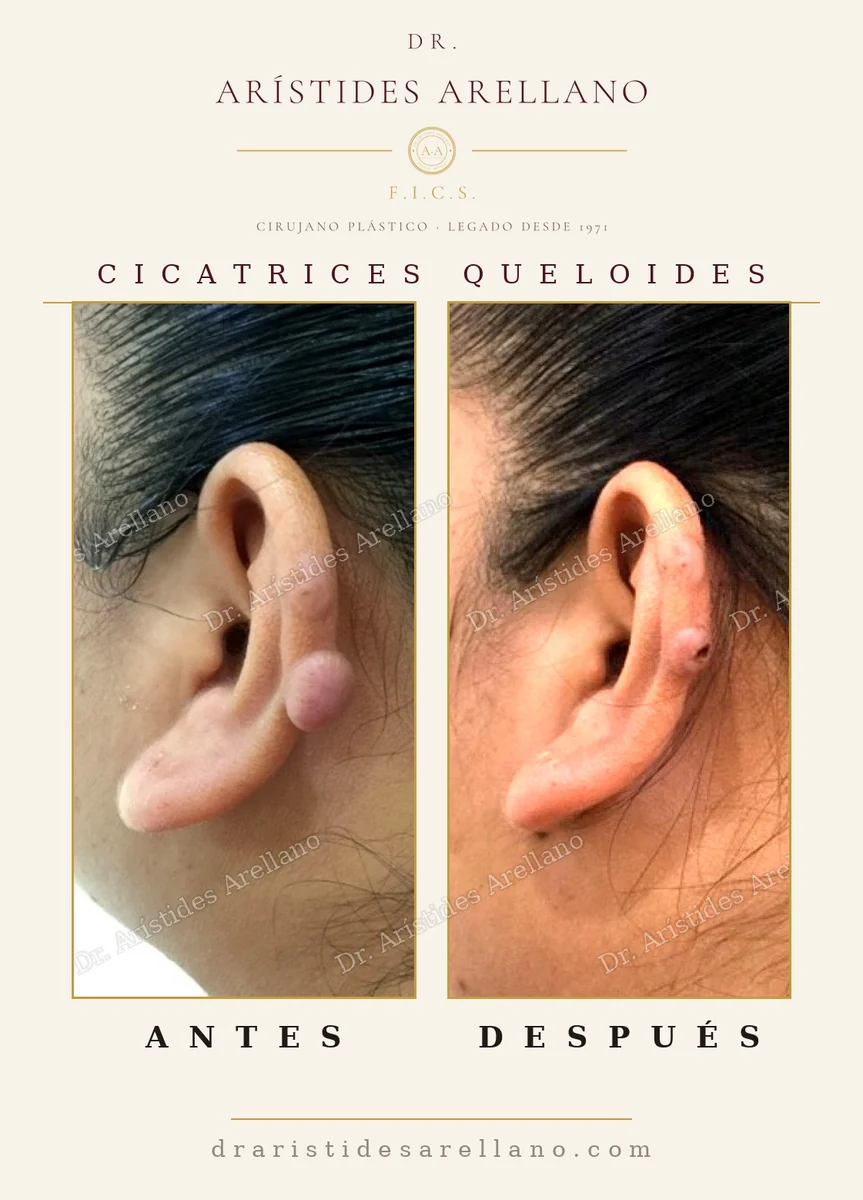
Before and after
The cases below are real patients of Dr. Arístides Arellano, published with their written informed consent. Out of respect for each person’s privacy, only expressly authorised cases are published; at your in-person consultation Dr. Arístides can show you further cases with a starting point similar to yours. Results may vary from patient to patient.
Approximate price in Puebla
Laser scar treatment (ResurFX) costs approximately $8,000 MXN. Approximate price — the definitive cost is set at your private consultation with Dr. Arístides Arellano.
The cost of surgical revision and of intralesional injections depends on the size and location of the scar and on how many sessions the combined plan requires; it is defined at the consultation, where a clear written quote is provided.
CO₂ laser on scars: two different jobs (and what it does not cure)
On a scar, the CO₂ laser can do two things worth not confusing. As a surgical scalpel (focused beam) it cuts and excises — a keloid, for example — cauterising as it cuts. As a fractional laser it does not cut: it improves the texture, thickness, redness and flexibility of hypertrophic, atrophic or surgical scars by stimulating collagen remodelling.
Now the truth many adverts leave out: with a keloid, no method — laser included — removes it forever. A keloid tends to recur, and excision alone has a high recurrence rate. That is why serious treatment is multimodal: the scar is reduced or flattened and paired with adjuvant measures (corticosteroid injection, pressure therapy, silicone and, in selected cases, other therapies), with follow-up. Promising a definitive cure would be a lie; improving the scar in a sustained way, with a plan, is realistic.
The two roles of the CO₂ laser in a keloid
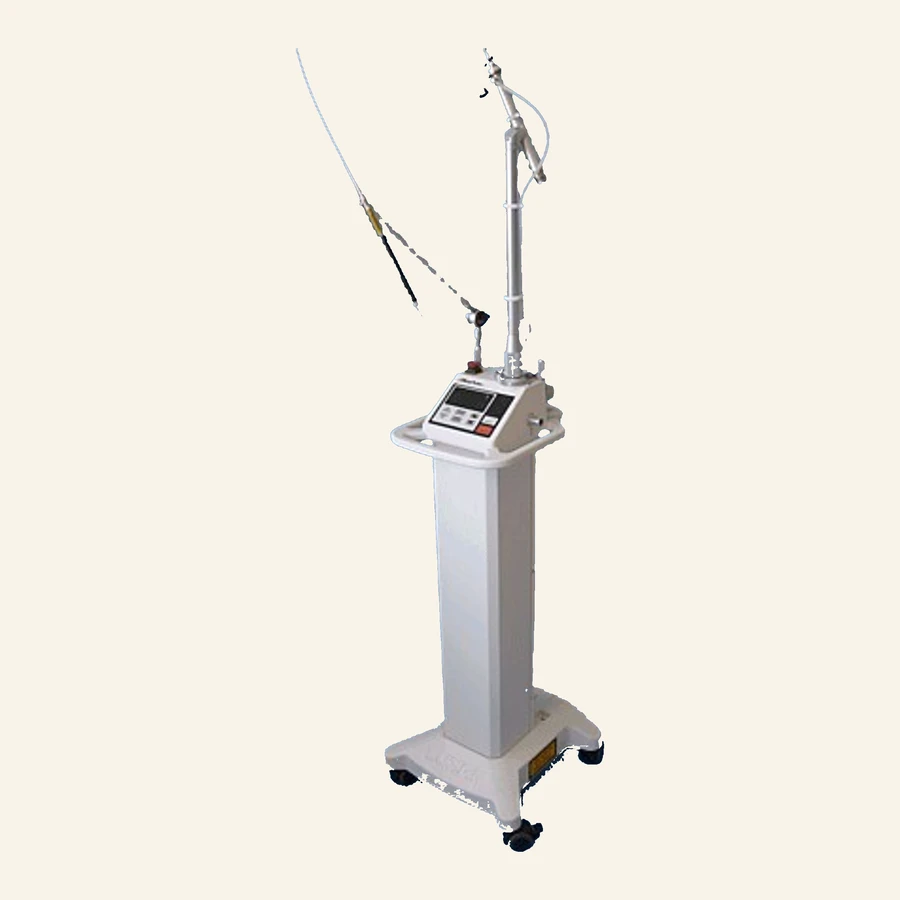
The CO₂ laser has two distinct functions in scars, and confusing them creates false expectations. As a scalpel (NovaPulse) it cuts and excises the keloid with less bleeding. As a fractional device (AcuPulse) it resurfaces and improves the texture and colour of a scar that has already matured.
CO₂ emits at 10,600 nm, a wavelength that tissue water absorbs almost completely. It therefore cuts in a very thin layer and seals the finest vessels as it goes: it incises and coagulates in the same pass.
Honesty matters here more than on any other page: keloids tend to recur. Excising one without complementary treatment — injections, pressure therapy, silicone, radiotherapy depending on the case — is the fastest route to it coming back, sometimes larger. No laser definitively cures a keloid, and anyone promising that is not being straight with you. Dr. Arístides Arellano, plastic surgeon in Puebla, frames the treatment as a plan with follow-up, not a single session.
Dr. Arístides Arellano’s track record in scars
The pathological scar is not merely something he treats: it is a subject he publishes on and is invited to speak about at international congresses. He is a plastic surgeon holding a specialty licence (cédula de especialidad) issued by the DGP, and these are the documents:
- E-poster: hypertrophic scars — 40th RADLA Brazil — Reunión Anual de Dermatólogos Latinoamericanos · Curitiba, 27–30 de mayo de 2023
- Certificate of Appreciation — international speaker (SCARS 2023) — SCARS Meeting · Berlín, 2023 SCARS Meeting, Berlin 2023 — the international congress devoted exclusively to scarring.
- Fellow — International Society for Dermatologic Surgery — Nueva York · abril de 1991
- Speaker: acne-scar correction with the Derma K laser — XXXVII Congreso Nacional CIC · Ixtapan de la Sal, 6 de septiembre de 2002
Trust is verified, not promised. All 210 scanned documents —degree, licences, diplomas, publications and certificates, from 1977 to 2025— are open in Dr. Arístides Arellano’s credential archive, alongside an explanation of the difference between a specialty licence and a board certification.
Recovery · step by step
- Days 1–3Wound care and mild discomfort. Dressing or silicone sheet as indicated; normal life resumes almost immediately for small scars.
- Days 7–14Sutures removed depending on the area. The protocol begins: silicone, pressure and strict sun protection.
- Weeks 3–12Scheduled injections if the plan includes them. The new scar turns pink and somewhat firm: this is normal, it is the maturation phase.
- Months 3–6The scar begins to flatten and lighten. Laser sessions for texture and colour are assessed.
- Months 6–18Final maturation. This is when the real result is judged, not before. Follow-up continues to catch any recurrence early.
Frequently asked questions
Can a keloid scar be removed for good?
A scar is not erased: it is improved. The realistic goal is a flatter, paler, more flexible scar with no itching or pain. Keloids also tend to recur, which is why treatment is never surgical alone: surgery is combined with injections, silicone, pressure and months of follow-up. Results may vary from patient to patient.
What is the difference between a keloid and a hypertrophic scar?
A hypertrophic scar is raised and red but stays within the border of the original wound and usually improves over time. A keloid crosses that border and invades surrounding healthy skin, does not improve on its own and tends to recur. Telling them apart is the first thing done at the consultation because it completely changes treatment.
Why did my keloid come back after surgery?
Because excising a keloid means creating a fresh wound in skin that has already proven it heals badly. If surgery is not paired with therapy that controls collagen formation —corticosteroid injection, silicone, pressure and, in selected cases, adjuvant radiotherapy— the keloid can return, sometimes larger. That is why treatment must be combined.
How is an earlobe keloid from a piercing removed?
Earlobe keloids are among the most common and the most responsive. They are usually excised under local anaesthesia in the office and paired with injection and, above all, a pressure earring or device worn for several months. That sustained pressure is decisive in preventing recurrence.
Does the cortisone injection hurt?
It is a brief discomfort, like a pressurised sting, because keloid tissue is dense. Local anaesthetic or prior cooling can make it more tolerable. Within a few days the scar’s itching and pain usually subside.
What can be done about acne scars?
Acne scars are usually atrophic —sunken— the opposite problem to a keloid: tissue is missing. They are treated with laser (fractional CO₂ or ResurFX), subcision and, when the depression is marked, fat grafting. Several sessions are generally needed and the result is improvement, not erasure.
How long does it take to see the result?
A scar is judged between 6 and 18 months, not at two weeks. Early on the new scar looks pink and firm: that is the normal maturation phase. Improvement in colour and relief is progressive and depends on adherence to the postoperative protocol.
How much does keloid scar treatment cost in Puebla?
Laser scar treatment (ResurFX) costs approximately $8,000 MXN. The cost of surgical revision and intralesional injections depends on size, location and the number of sessions; it is defined at the consultation, where a clear quote is provided. Approximate price, confirmed at your consultation.
How is a keloid scar flattened?
Flattening a keloid is almost never a single treatment but a combined plan: corticosteroid injections to reduce volume, pressure therapy or silicone sheets and gel, and — depending on the case — excision (which can be done with the CO₂ laser) or fractional resurfacing for texture. Because keloids tend to recur, follow-up is part of the treatment. The exact plan is defined at the consultation according to size, area and skin type.
Does the CO₂ laser erase scars completely?
No. The CO₂ laser improves scars — texture, relief, colour — but erasing completely is not a realistic result with any method. In hypertrophic and acne scars, fractional CO₂ often achieves noticeable improvement over several sessions; in keloids it is used within a combined treatment. Results depend on the scar type and skin phototype, and may vary.
Does the CO₂ laser remove a keloid for good?
No. It can excise it or improve its texture, but a keloid has a biological tendency to recur. That is why surgery or laser is combined with complementary treatment and follow-up; any promise of a definitive cure in a single session is false.
The equipment used
Before and after
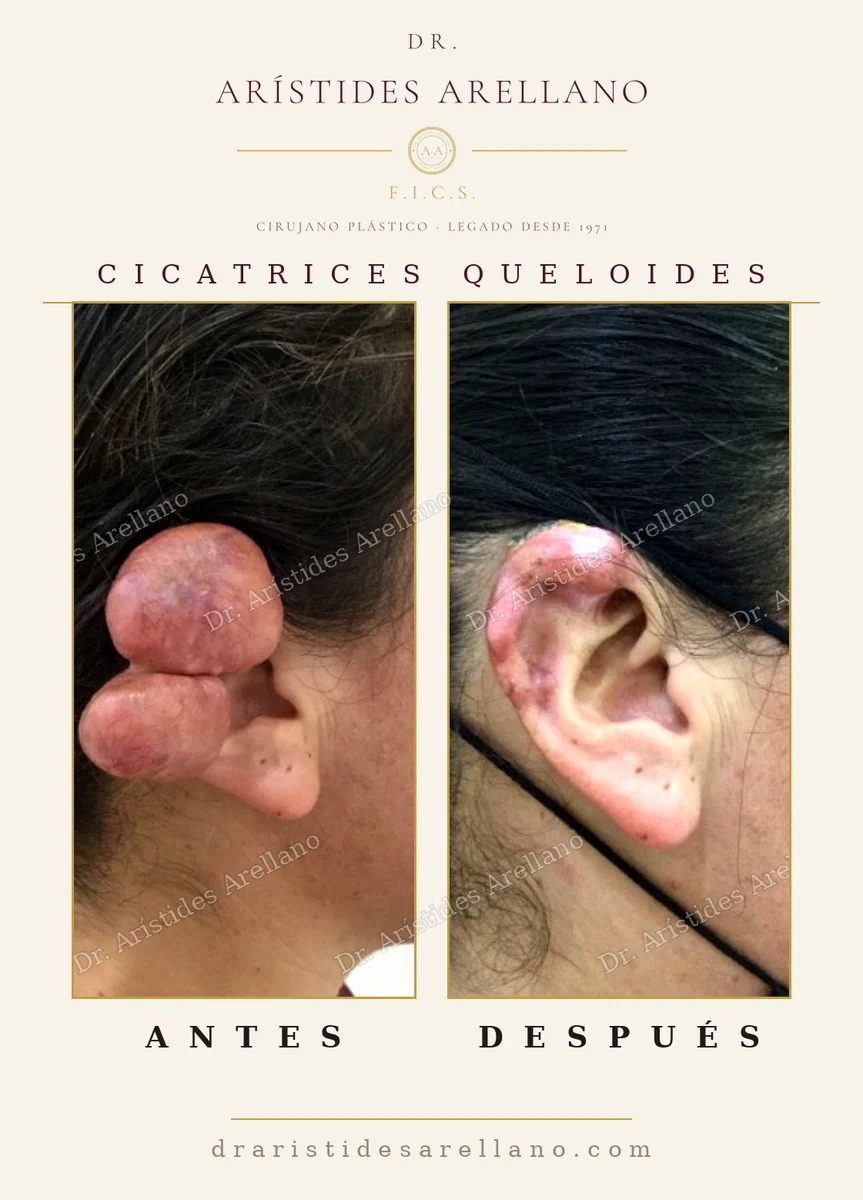
How is a keloid removed? Cutting it out is not enough on its own: excision alone sees the keloid return in more than half of cases, sometimes larger. Treatment that works combines removal with something that restrains the scar afterwards — corticosteroid injections, sustained pressure, silicone sheets. Anyone offering only to cut is not offering the full treatment. All surgery carries risks and requires a prior medical assessment; results vary from person to person.
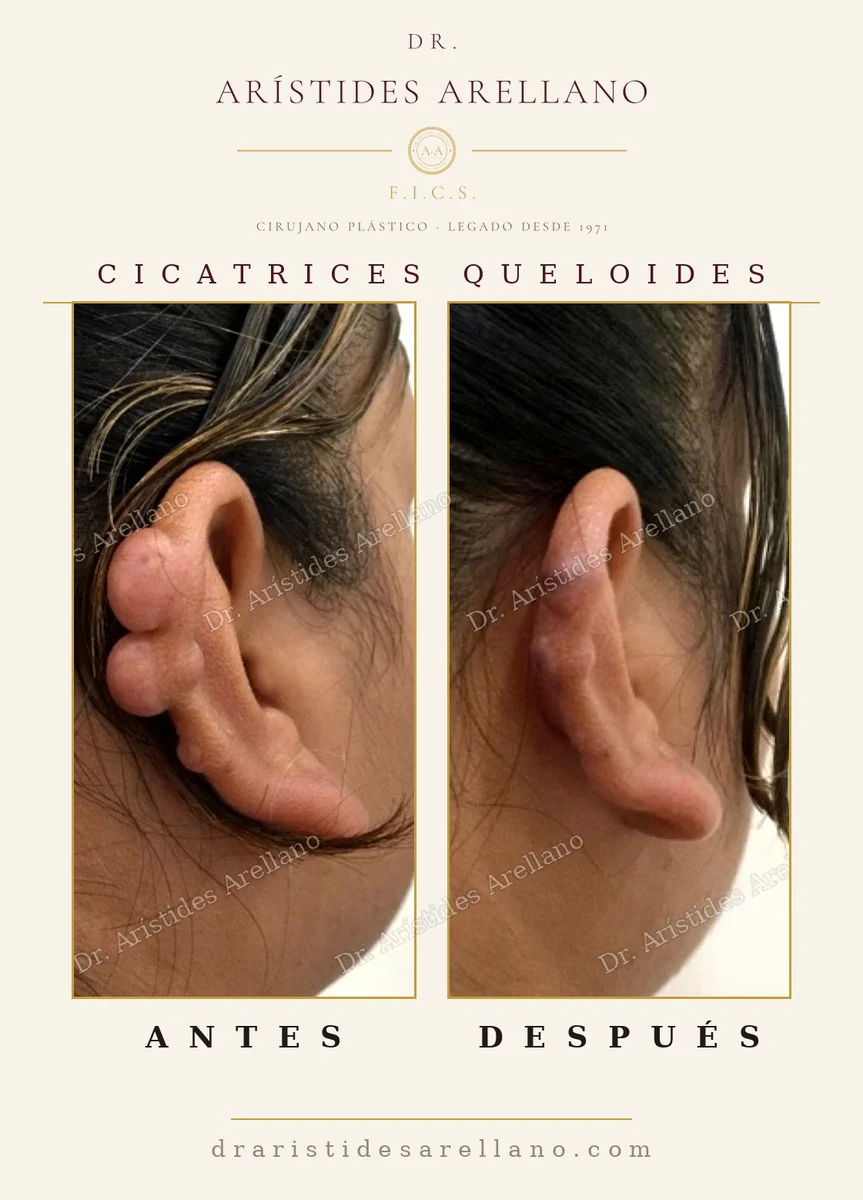
Can it come back? Yes, which is why follow-up is part of the treatment and not an extra. The first year is the risky one: if a lump appears it is injected early and controlled; left to grow, it starts over. Anyone who has formed one keloid tends to form another, so a new piercing deserves a second thought. All surgery carries risks and requires a prior medical assessment; results vary from person to person.
Photographs of real patients, published with their written informed consent. Results may vary from person to person; these images are not a promise of outcome.
Every case is different. Discuss yours in a personal consultation.
Book a consultation on WhatsAppEvery figure published on this site is approximate and is not a quote. Any procedure or treatment first requires a private assessment consultation with Dr. Arístides Arellano —$800 MXN, charged separately— and it is at that consultation that the definitive cost of your case is determined.
Educational content; it does not replace a medical consultation. Results may vary from person to person.