
Why several sessions are necessary
Every hair on your body is, at any given moment, in one of three phases: anagen (active growth), catagen (transition) or telogen (rest). The laser can only destroy the follicle in anagen, because that is the only phase in which the hair is firmly attached to the structure that must be damaged.
In any given area, only 20% to 30% of follicles are in anagen at once. Do the arithmetic: one session, however perfect, cannot treat more than that fraction. Hence the usual 6 to 8 sessions, spaced according to the area (closer together on the face, wider apart on legs and back).
And hence the honesty of the term: after the full plan most patients are left with a very substantial, lasting reduction — but hairs can reappear, finer, lighter and slower, and a maintenance session every year or two is often needed. That is not a failure of the treatment: it is how it works.
Darker skin: this is where the device genuinely matters
Hair-removal lasers work because the pigment in the hair absorbs the energy. The problem is obvious: darker skin also has pigment, and it competes for that energy. A device or settings designed for pale skin can burn the skin of a phototype IV, V or VI, or leave a mark.
This is the conversation almost no clinic in this city puts in writing, and it is the one that matters most in Mexico, where the majority of the population sits in exactly those phototypes.
The technical answer is a dual system. The LightSheer (805 nm diode, Lumenis, Israel), with its vacuum and cooling system, covers most cases. And for the darkest phototypes — where the diode runs out of safety margin — the Nd:YAG is used, whose longer wavelength is far less absorbed by the skin’s melanin and passes through pigmented epidermis without heating it.
That is what “every phototype” actually means, and it is not brochure copy: it is the difference between being able to safely treat most of the Mexican population or not. A clinic with only a diode has to choose between dropping the energy until it does nothing, or raising it until it burns.
What must not be done: treating tanned skin. If you have come from the beach or the pool, it is postponed. That is not a scheduling whim; it is the difference between a treatment and a burn.
Blonde, white and red hair: the limitation nobody advertises
If the laser needs pigment in the hair to work, then hair without pigment does not respond. White, grey, very light blonde and red hair responds poorly or not at all, no matter how much power is used.
This is a physical limitation, not a matter of device or technique. Anyone selling you a laser hair-removal package for white hair is selling you sessions that will not work. Saying so at the consultation costs a sale; not saying so costs the patient’s trust.
When hair is a symptom, not a cosmetic problem
There is an important clinical difference between having hair and having hirsutism: coarse, dark hair in a male pattern — chin, sideburns, neck, chest, lower abdomen — in a woman. When it appears newly, quickly, or alongside acne, menstrual changes or hair loss, it can be the outward sign of a hormonal problem, with polycystic ovary syndrome at the top of the list.
In that case the laser treats the consequence, not the cause — and treating only the consequence is an expensive way of solving nothing. The right route here is the clinic’s dermatology consultation and, where appropriate, an endocrine assessment, before or alongside the laser.
Laser is also first-line for ingrown hairs and recurrent folliculitis — the shave, ingrow, inflame, shave-again cycle — especially on the neck, beard and groin. In those cases hair removal is not cosmetic: it is the solution to a recurring medical problem.
How to prepare, and what to expect
Preparation is simple and decides the result: shave the area 24 hours beforehand (the laser needs the follicle, not the hair on the surface), no waxing, plucking or threading for 4 weeks before — those pull out the root, which is precisely what the laser must find — and no sun or tanning before or during the plan.
The session feels like hot rubber bands snapping against the skin, with the cooling tip buffering it. Afterwards there is redness and a small raised bump around each follicle for a few hours. Over the next 7 to 14 days you will see treated hairs “emerge”: they are not growing, they are being expelled.
What does it cost?
Pricing is per area and every figure is a 6-session package: from $3,000 MXN for the small areas up to full body. The per-area table is on the price list. Approximate price — the definitive cost is set at your private consultation with Dr. Arístides Arellano.
Track record and credentials
Laser hair removal is performed at the Clínica Dermatológica y Cirugía Estética de Puebla, in operation since 1971. The advantage of doing it in a medical setting rather than a beauty centre is concrete: here, if your hair is a hormonal symptom, someone will notice.
Dr. Arístides Arellano is a plastic surgeon holding a specialty licence: he practises under a Mexican medical licence (D.G.P. 1125959) and a specialty licence in Plastic & Reconstructive Surgery (0002008), both issued by the Directorate General of Professions (DGP), which reissued his certificate of professional standing in 2025. His career began before Mexico’s present-day specialty-board system existed: he belongs to the founding generation of plastic surgery in Puebla, the second generation of a surgical tradition started in 1971 by Dr. Francisco Arellano Ocampo. Trust is verified, not promised: both licences are public and anyone can look them up in the DGP’s National Registry of Professionals.
Before-and-after photographs
Most patients want to see before-and-after photographs before deciding. Out of respect for each person’s privacy, Dr. Arístides Arellano shows real cases —always with documented consent— during your in-person consultation, where you can review results from patients with a starting point similar to yours. Results may vary from patient to patient.
Risks and expectations
Every medical treatment —topicals, peels and energy-based devices included— carries risk and requires a prior assessment. In darker skin (Fitzpatrick IV–VI, the most common phototypes in Mexico) a poorly indicated procedure can darken the patch instead of lightening it. Results may vary according to each patient, their phototype and their individual triggers.
Trust is verified, not promised. All 210 scanned documents —degree, licences, diplomas, publications and certificates, from 1977 to 2025— are open in Dr. Arístides Arellano’s credential archive, alongside an explanation of the difference between a specialty licence and a board certification.
Session plan and aftercare
- 4 weeks beforeNo waxing, plucking or threading. The laser needs the root intact.
- 24 hours beforeShave the area. No sun, no tanning.
- Day 0Redness and small bumps around each follicle for a few hours.
- Days 7–14Treated hairs are expelled. They are not growing: they are coming out.
- Every 4–8 weeksNext session, depending on the area.
- After 6–8 sessionsSubstantial, lasting reduction. Annual or biennial maintenance as needed.
Frequently asked questions
Is laser hair removal really permanent?
No, and the correct term is permanent hair reduction. The laser destroys follicles that are in the growth phase during the session, which are only 20 to 30% of the total at any moment. After 6 to 8 sessions the reduction is substantial and lasts years, but finer, lighter hairs can reappear and an annual or biennial maintenance session is usually needed. Anyone promising permanent removal is selling you a word, not a result.
How many sessions do I need?
Usually 6 to 8, spaced 4 to 8 weeks apart depending on the area. The face needs shorter intervals; legs and back, longer ones. The number depends on your phototype, the thickness and colour of the hair, and the area treated, and it is adjusted as you go.
Does it work on darker skin?
Yes, with a dual system: the LightSheer diode for most cases, and Nd:YAG for the darkest phototypes, because its longer wavelength is far less absorbed by the skin’s melanin. What cannot be done is treating tanned skin: if you have been in the sun, the session is postponed, because that is exactly the difference between treating and burning.
Does it work on white or very blonde hair?
No. The laser needs pigment in the hair to work, and white, grey, very light blonde or red hair does not have enough of it. It responds poorly or not at all, regardless of the power of the device. This is a physical limitation, and anyone selling a laser package for white hair is selling sessions that will not work.
Does it help ingrown hairs and folliculitis?
Yes, and it is one of its best indications. The shave, ingrow, inflame, shave-again cycle is broken by eliminating the follicle. On the neck, beard and groin it is usually the most effective solution for recurrent folliculitis. In those cases the laser is not cosmetic: it resolves a recurring medical problem.
Do I have to shave before the session?
Yes, 24 hours before. The laser works on the follicle beneath the skin, not the hair on the surface; long hair only absorbs energy in the air and raises the risk of a burn. What you must not do is wax, pluck or thread in the 4 weeks beforehand, because that pulls out the root, which is precisely what the laser needs to find.
The equipment used
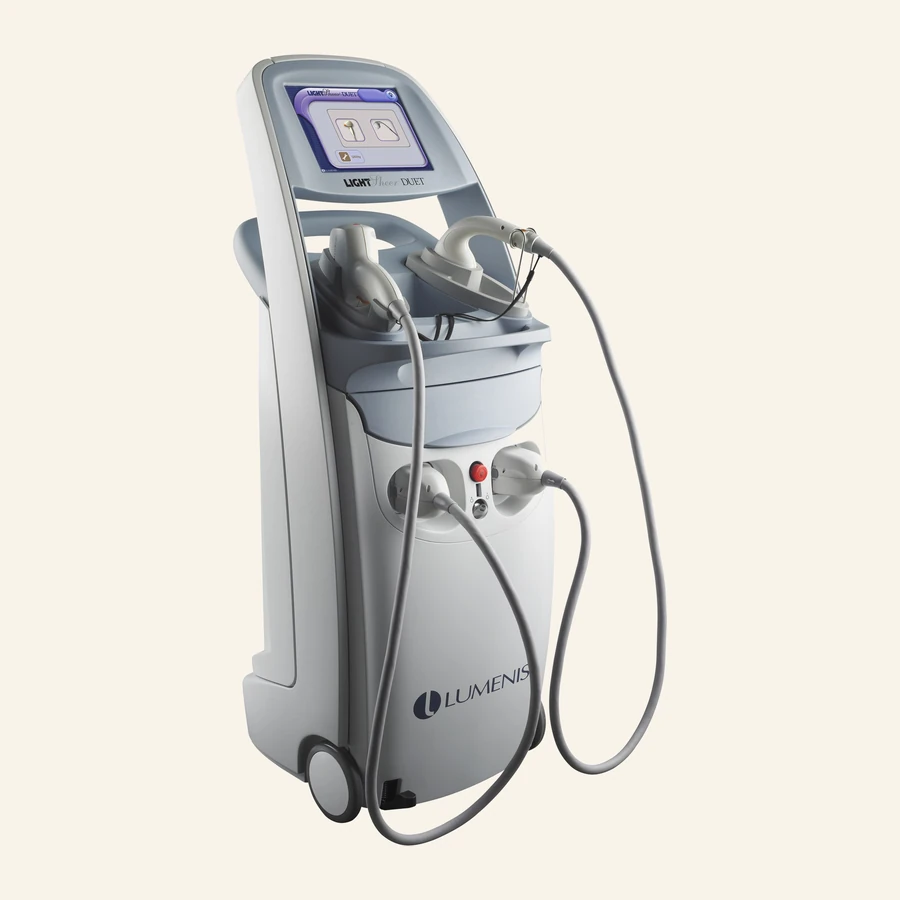
Every case is different. Discuss yours in a personal consultation.
Book a consultation on WhatsAppEvery figure published on this site is approximate and is not a quote. Any procedure or treatment first requires a private assessment consultation with Dr. Arístides Arellano —$800 MXN, charged separately— and it is at that consultation that the definitive cost of your case is determined.
Educational content; it does not replace a medical consultation. Results may vary from person to person.